Category: Perfomance Categories

  • MIPS Promoting Interoperability | Measures, CEHRT, and SRA

    MIPS Promoting Interoperability | Measures, CEHRT, and SRA

    MIPS Promoting Interoperability (PI) is the EHR-driven information-exchange category within the Merit-Based Incentive Payment System (MIPS). It is worth 25 percent of the 2026 MIPS final score. Clinicians report PI data across a minimum 180-day continuous period using the 2015 Edition Cures Update CEHRT. The category score builds from a mandatory base score, scored performance objectives, and optional bonus measures. Each clinician must also pass a Security Risk Analysis (SRA) attestation as a HIPAA Security Rule compliance check.

    Simplify MIPS Reporting and Maximize Reimbursement Outcomes.
    Get Started →
    Macralytics MIPS

    What is MIPS Promoting Interoperability?

    MIPS Promoting Interoperability (PI) is the EHR-driven information-exchange performance category CMS uses to measure clinician use of certified EHR technology. It operates under the Merit-Based Incentive Payment System. PI is one of four MIPS performance categories, alongside Quality, Cost, and Improvement Activities.

    PI accounts for 25 percent of the 2026 MIPS final score. The category replaced the Medicare EHR Incentive Program (Meaningful Use) in 2017, when the MACRA Quality Payment Program took effect.

    Key point: PI keeps the same 25 percent weight in 2026 that it carried in prior performance years.
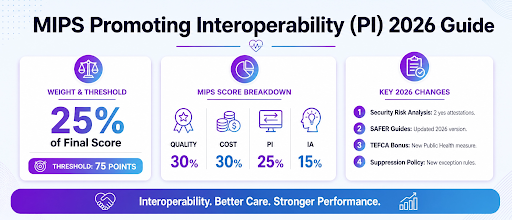
    PI keeps the same 25 percent weight in 2026

    How does PI contribute to the MIPS final score?

    The PI category contributes up to 25 points to the MIPS final score. CMS calculates this by multiplying the clinician PI category percent score by the 25 percent weight. The four MIPS categories combine into a single score from 0 to 100.

    Category Weight Max Points
    Quality 30% 30
    Cost 30% 30
    Promoting Interoperability 25% 25
    Improvement Activities 15% 15
    MIPS Final Score 100% 100

    A clinician must clear the 75-point performance threshold to avoid the -9 percent Medicare Part B penalty. The threshold remains at 75 points through the 2028 performance year.

    Did the MIPS Promoting Interoperability Change for 2026?

    Yes. CMS finalized four PI changes for the 2026 performance year:

    • The Security Risk Analysis now requires two yes attestations, covering the SRA itself and risk-management activities.
    • Clinicians must use the updated SAFER Guides for the High Priority Practices measure self-assessment.
    • A new TEFCA bonus measure was added under the Public Health and Clinical Data Exchange objective.
    • CMS finalized a measure suppression policy for circumstances that prevent reporting specific PI measures.

    What are MIPS PI measures and objectives?

    MIPS Promoting Interoperability uses a three-tier measure structure built around a single gate. A base score gates the entire category before any points count. Performance score points follow, tied to specific measure objectives. Bonus measures add optional points on top of base and performance.

    The base score covers four required objectives that every reporting clinician must satisfy:

    • e-Prescribing, which tracks the electronic transmission of prescriptions.
    • Health Information Exchange (HIE), which covers sending and receiving patient records.
    • Provider to Patient Exchange, which gives patients electronic access to their data.
    • Public Health and Clinical Data Exchange, which reports data to public-health agencies.

    Performance scoring is the second tier, where clinicians earn points based on actual measure rates. Bonus measures form the third tier and add up to 5 points across four available pathways.

    The sections below cover the base score gate, the performance-score objectives, bonus measures, the TEFCA bonus measure for 2026, and whether points are possible without the base score. For the complete inventory, see the full 2026 MIPS PI measures and objectives list.

    What is the PI Base Score Requirement?

    The PI base score is the mandatory minimum performance requirement across four required objectives. A clinician must meet it to earn any PI points at all. The four base-score objectives are:

    • e-Prescribing for electronic prescription transmission.
    • Health Information Exchange (HIE) for record exchange between providers.
    • Provider to Patient Exchange for patient electronic access.
    • Public Health and Clinical Data Exchange for reporting to public-health systems.

    Failure to meet any required measure produces a PI category score of zero for the entire performance period. The zero applies regardless of strong performance or bonus results. The base score functions as a pass-or-fail gate, not a partial-credit tier.

    What are the PI Performance-score Objectives?

    After meeting the base score, clinicians earn performance-score points based on the rates they achieve. Each measure carries a denominator and a numerator. Higher numerator-to-denominator ratios earn more points, up to each measure’s maximum. Clinicians select among three HIE objective options for 2026:

    • Send/Receive & Reconcile measures, the traditional exchange pathway.
    • HIE Bi-Directional Exchange is a single consolidated exchange measure.
    • Enabling Exchange under TEFCA, a network-based exchange pathway.

    The HIE objective lets clinicians match their EHR exchange capabilities to the most achievable option. Practices with limited connectivity often choose the bidirectional or TEFCA route. The choice does not affect the base-score requirement, which remains mandatory.

    Reduce Reporting Burden. Improve MIPS Performance
    Start Today →
    Macralytics MIPS

    What Bonus Measures Exist in PI?

    Bonus measures are optional pathways under the Public Health and Clinical Data Exchange objective. They add up to 5 points on top of a clinician’s base and performance score. A clinician earns a maximum of 5 bonus points across all four available bonus measures. Reporting more than one bonus measure does not raise the total beyond the cap.

    The four bonus measures are the original three Public Health and Clinical Data Exchange measures, plus the new 2026 TEFCA bonus measure. Bonus measures are voluntary, and skipping them does not affect base or performance scoring. They function purely as additive points within the fixed cap.

    How Does the TEFCA Bonus Measure Work?

    The Public Health Reporting Using TEFCA bonus measure is new for the 2026 performance year. It joins three pre-existing bonus measures under the Public Health and Clinical Data Exchange objective. TEFCA (the Trusted Exchange Framework and Common Agreement) is a national framework ONC published to standardize health information exchange across networks.

    A clinician earns the bonus by reporting public-health data through a Qualified Health Information Network (QHIN) that participates in TEFCA. This can replace or supplement reporting through traditional public-health registries. The TEFCA bonus shares the same 5-point cap that applies to all four bonus measures. Reporting via TEFCA does not stack points beyond that cap.

    TEFCA reporting is voluntary. Clinicians not yet connected to a QHIN can still earn full PI points through the original three bonus measures.

    Can a Clinician Earn PI Points Without Completing the Base Score?

    No. The PI base score is a gate, not a contributor. Failure to meet any required base-score measure produces a PI category score of zero for the entire performance period. This holds regardless of performance-score results or the number of bonus measures completed.

    What CEHRT requirement applies to MIPS PI?

    MIPS Promoting Interoperability requires Certified Electronic Health Record Technology (CEHRT) for reporting. Specifically, clinicians must use the 2015 Edition Cures Update CEHRT for a minimum of 180 continuous days during 2026. CEHRT is EHR software certified by the Office of the National Coordinator (ONC) to meet defined functional and interoperability standards.

    The 2026 requirement is the Cures Update edition, not earlier 2015 Edition variants. Clinicians choose any 180 consecutive days that end on or before December 31. The last possible 180-day start date is July 5 for a full-year submission. CEHRT is also the submission mechanism, so clinicians report MIPS PI via your CEHRT-equipped EHR.

    What is the 2015 Edition Cures Update CEHRT?

    2015 Edition Cures Update CEHRT is the current Office of the National Coordinator (ONC) certified EHR standard required for MIPS PI in 2026. It builds on the original 2015 Edition by adding requirements from the 21st Century Cures Act. The Cures Update introduces three additional capability areas:

    • Information-blocking compliance under the Cures Act rule.
    • API-based data access for patients.
    • Updated USCDI (United States Core Data for Interoperability) data classes.

    EHR vendors publish ONC certification identifiers, such as the CMS EHR Certification ID. Clinicians use that identifier to attest to CEHRT use in PI submissions. The next section covers how long a clinician must run CEHRT during the year.

    How Long is the PI Performance Period?

    The PI performance period is a minimum of 180 continuous days within the 2026 calendar year. Clinicians choose any 180-day window that ends on or before December 31. The last possible 180-day start date is July 5, 2026. Any later start means the window cannot be completed by December 31, and PI reporting is forfeited.

    Clinicians who installed CEHRT mid-year can still report PI if their window completes by year-end. The PI window differs from other categories. Quality measures use the full calendar year, while Improvement Activities require only 90 continuous days.

    Do I need a 2015 Edition Cures Update CEHRT for PI?

    Yes. MIPS PI for 2026 requires 2015 Edition Cures Update CEHRT, not the earlier 2015 Edition base variant. Clinicians using non-Cures-Update CEHRT cannot meet the base-score requirement and will score zero on PI. Most major EHR vendors completed the Cures Update transition during 2023 and 2024.

    What is the MIPS PI Security Risk Analysis requirement?
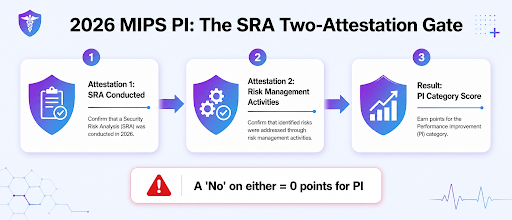
    The MIPS PI: SRA two attestation gate for PI

    The MIPS PI Security Risk Analysis (SRA) is an annual review of the practice’s security risk management posture. It is required under the HIPAA Security Rule and gated for PI by attestation. The SRA is a documented evaluation of risks to electronic protected health information (ePHI). It covers administrative, physical, and technical safeguards across the practice.

    Beginning in 2026, clinicians must attest yes to two separate questions. The first confirms that the SRA was conducted or reviewed during the performance period. The second confirms that security risk management activities were performed during that same period. A no on either attestation yields a PI score of zero, so the SRA acts as a hard gate.

    The H3 sections below cover the two-attestation rule, the SAFER Guide attestation, common audit findings, and the zero-out effect. For documentation guidance, see how to document the MIPS Security Risk Analysis.

    What Does the 2026 Two-attestation SRA Require?

    For the 2026 performance year, CMS requires clinicians to answer yes to two separate Security Risk Analysis attestations. Neither triggers a zero PI score. The two attestation questions are stated explicitly below:

    • Attestation 1: Was a Security Risk Analysis conducted or reviewed during the 2026 performance period?
    • Attestation 2: Were security risk management activities performed during the 2026 performance period under the HIPAA Security Rule?

    A no on either attestation yields a PI category score of zero for the entire period. Prior years required only the first attestation. The second attestation is new for 2026 and reflects an emphasis on risk-management actions, not just the analysis document.

    In practice, clinicians should retain documentation of both items. That includes the SRA report and evidence of risk-management activities, such as mitigation plans, policy updates, and training records.

    How Does the SAFER Guide Attestation Work?

    The SAFER Guide attestationis a separate yes or no requirement under the PI High Priority Practices measure. It asks clinicians to confirm an annual self-assessment using the updated ONC-published SAFER Guides. ONC publishes nine SAFER Guides covering EHR safety domains. Examples include system configuration, contingency planning, and patient identification.

    Clinicians must use the updated SAFER Guides published by ONC for 2026. The previous-year version is not accepted. A no on the SAFER Guide attestation produces zero points on the High Priority Practices measure. This effect is separate from the SRA attestation but carries the same binary consequence.

    What are Common MIPS PI Security Risk Analysis Audit Findings?

    CMS audit findings for MIPS PI Security Risk Analysis typically fall into four categories:

    1. Missing risk-management activities documentation, where the SRA exists but shows no evidence of follow-through, such as mitigation plans or staff training.
    2. Outdated SRA, completed more than 12 months before the start of the performance period.
    3. An incomplete asset inventory, where the SRA scope omitted systems handling ePHI, such as the patient portal or mobile device access.
    4. SAFER Guide attestation submitted without underlying self-assessment documentation.

    Practices should retain SRA documentation for at least 6 years per HIPAA retention requirements. They should also keep all evidence of risk-management activities completed during the performance year.

    Does a Missed SRA Attestation Zero Out PI?

    Yes. A no on either of the two SRA attestations yields a PI category score of zero for the entire 2026 performance period. This applies to the SRA-conducted attestation and the risk-management-activities attestation alike. The zero holds even when the clinician completed all base-score measures and earned high performance and bonus scores.

    How is the MIPS PI Score Calculated?
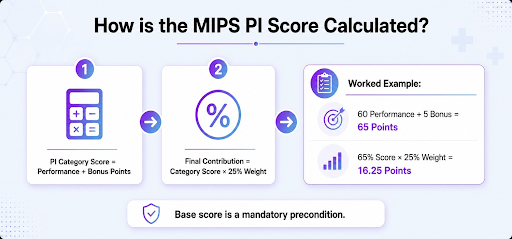
    The PI Category Percent Score sums performance-score points and bonus-measure points

    The PI Category Percent Score sums performance-score points and bonus-measure points. CMS divides that sum by 100 maximum possible points, then multiplies by 100. This calculation applies only after the base score is met.

    PI Category Percent Score = ((Performance Score Points + Bonus Points) / 100) × 100

    PI Contribution to MIPS Final Score = PI Category Percent Score × 25 percent weight

    A worked example shows the math in practice. Suppose a clinician completes all base-score measures, earns 60 of 70 performance-score points, and earns 5 bonus points.

    1. Sum the points: 60 + 5 = 65 points.
    2. PI category percent score: 65 / 100 × 100 = 65 percent.
    3. Weighted contribution: 65 percent × 25 percent = 16.25 of 25 possible MIPS Final Score points.

    The base score remains the precondition. Without it, none of these calculations apply, and the PI score is zero.

    Which Special Statuses Trigger Automatic PI Reweighting?

    CMS automatically reweights PI to 0 percent for clinicians in four special-status categories. These clinicians do not need to submit PI data. The 25 percent PI weight then redistributes to other performance categories.

    Special Status Qualifying Threshold
    ASC-based clinician 75 percent or more of services billed under the Place of Service code 24
    Hospital-based clinician 75 percent or more of services billed under inpatient, ED, or observation codes
    Non-patient-facing clinician 100 or fewer patient-facing encounters per year
    Small practice 15 or fewer eligible clinicians under one TIN

    A clinician with auto-reweighted PI can still voluntarily submit PI data. Voluntary submission overrides the automatic reweighting, and the clinician is scored on the submitted data.

    Other clinicians can apply for a Hardship Exception or an Extreme and Uncontrollable Circumstances (EUC) exception. If approved, either exception also reweights PI to 0 percent.

    What changed for MIPS PI in 2026?

    CMS finalized four MIPS PI changes for the 2026 performance year in the November 5, 2025, Physician Fee Schedule Final Rule. The four changes are listed below:

    1. The Security Risk Analysis now requires two yes attestations, one for the SRA conducted or reviewed and one for risk-management activities performed. Neither yields a zero PI score.
    2. Clinicians must use the updated SAFER Guides for the High Priority Practices measure self-assessment.
    3. The new TEFCA bonus measure was added under the Public Health and Clinical Data Exchange objective, joining three existing bonus measures within the 5-point cap.
    4. CMS finalized a measure suppression policy that allows full credit when defined circumstances prevent reporting specific PI measures, such as paused electronic case reporting registries.

    Standard PI weighting remains 25 percent of the MIPS Final Score. The four changes affect requirements within PI but not its weight contribution.

    How Does Macralytics Support MIPS PI Submission?

    Macralytics supports MIPS PI submission through a four-step EHR consulting service workflow:

    1. CEHRT verification. Confirm that the practice EHR holds the 2015 Edition Cures Update certification and can generate PI measure data.
    2. SRA documentation review. Validate that the Security Risk Analysis is current, complete, and supports both required 2026 attestations.
    3. PI submission via Macralytics Qualified Registry. Extract measure data from CEHRT and submit during the CMS window, January 2 to March 31 of the following year.
    4. Audit-prep retention. Retain the SRA, SAFER Guide self-assessments, and submission records for the 6-year HIPAA retention period.

    This workflow keeps documentation aligned with the 2026 attestation rules. See how we set up your EHR for MIPS PI.
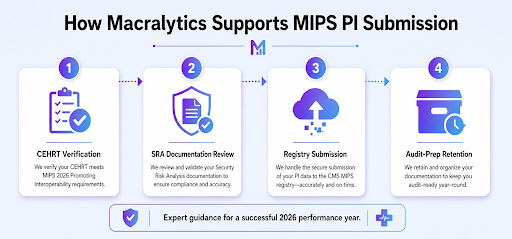
    This workflow keeps documentation aligned with the 2026 attestation rules

    Do MIPS Value Pathway (MVP) Requirements Include PI measures?

    Yes. PI is the foundation layer of every MIPS Value Pathway (MVP). Each MVP includes the entire PI measure set as a mandatory foundation. It sits alongside MVP-specific Quality measures, Improvement Activities, and Cost measures.

    MVP clinicians follow the same PI base score, performance score, bonus measures, CEHRT, and SRA two-attestation rules as Traditional MIPS clinicians. A clinician with auto-reweighted PI keeps that reweighting under MVP reporting. This applies to ASC-based, hospital-based, non-patient-facing, and small-practice statuses.

    MIPS Promoting Interoperability is the EHR-driven information-exchange component of the MIPS final score. It is 25 percent in2026, scored over a 180-day continuous performance period usingthe 2015 Edition Cures Update CEHRT, and gated by the Security Risk Analysis two-attestation requirement. Clinicians in ASC-based, hospital-based, non-patient-facing, or small-practice statuses see PI auto-reweighted to 0 percent. Everyone else must clear the base score before earning any PI points. For the full framework, see our overview of the four MIPS performance categories.

  • MIPS Quality Measures: Selection, Scoring, and Bonuses

    MIPS Quality Measures: Selection, Scoring, and Bonuses

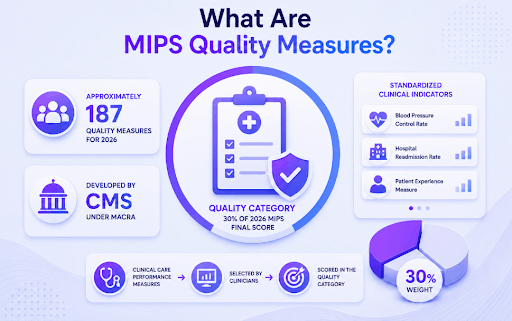
    MIPS Quality measures are the clinical-care performance measures CMS uses to score the Quality category, the largest component of the MIPS final score at 30 percent in 2026. Under the Merit-Based Incentive Payment System (MIPS), clinicians select six measures(including at least one outcome or high-priority measure) from approximately 187finalized for the 2026 performance year. 

    Each measure requires data on 75 percent of eligible encounters, submitted through a Registry, QCDR, eCQM, or Medicare Part B claims. Each measure earns 1 to 10 points on decile benchmarks.

    What Are MIPS Quality Measures?

    MIPS Quality measures are the clinical-care performance measures the Centers for Medicare and Medicaid Services (CMS) uses to score the Quality category of MIPS, one of four MIPS performance categories under the Quality Payment Program (QPP). The Quality category is weighted at 30 percent ofthe 2026 MIPS final score. CMS finalized approximately 187 quality measures forthe 2026 performance year under the Medicare Access and CHIP Reauthorization Act of 2015 (MACRA). 

    Each quality measure is a standardized clinical indicator, such as blood-pressure control rate or hospital readmission rate, assigned a measure ID by CMS. Clinicians select measures from the full inventory based on specialty, patient population, and reporting mechanism. The Quality category percent score feeds up to 30 points into the 100-point MIPS Final Score.

    Quality Measures Contribute to the MIPS Final Score

    How Do Quality Measures Contribute to the MIPS Final Score?

    The Quality category contributes up to 30 points to the 100-point MIPS Final Score. CMS calculates a Quality category percent score using earned achievement points across all submitted measures. That percent score is multiplied by the 30% weight to produce the Quality category’s contribution to the MIPS Final Score. The four-category weight distribution for 2026 is: Quality 30%, Cost 30%, Promoting Interoperability 25%, and Improvement Activities 15%.

    The MIPS performance threshold for 2026 is 75 points. Clinicians scoring at or above 75 points earn a positive Medicare Part B payment adjustment. Clinicians below that threshold face a negative adjustment of up to 9 percent. The three Quality bonus paths (small-practice, complex-patient, and improvement scoring) all help clinicians clear or exceed the 75-point threshold.

    How Many Quality Measures Does CMS Publish for 2026?

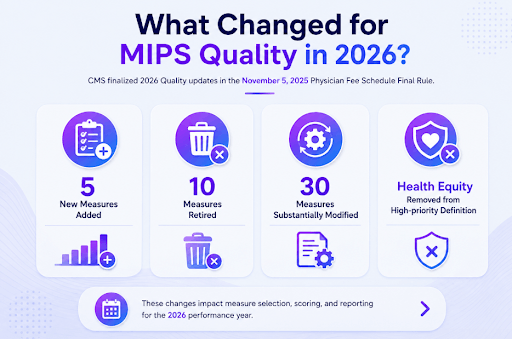
    CMS finalized approximately 187 quality measures for the 2026 performance year per the November 5, 2025, Physician Fee Schedule Final Rule. The 2026 inventory reflects 5 newly added measures, 10 measures retired from 2025, and 30 measures that received substantive modifications. Additional measures approved outside rulemaking by Qualified Clinical Data Registry (QCDR) vendors supplement the 187-measure base inventory.

    The 187-measure count represents the pool from which clinicians select their 6 reporting measures. Not every measure applies to every specialty or care setting. Specialty measure sets group pre-selected measures relevant to a given specialty, narrowing the selection decision for clinicians whose patient mix matches an available set.

    Did MIPS Quality Measures Change for 2026?

    Yes, CMS finalized 5 new measures, retired 10, substantively modified 30, and removed “health equity” from the high-priority measure definition for the 2026 performance year. The total inventory remained near 187 after accounting for additions and retirements. The full breakdown of 2026 Quality changes, including which measures were retired and which were modified, is detailed in the H2.6 section below.

    How Do Clinicians Select MIPS Quality Measures?

    Clinicians select MIPS Quality measures through two paths: individual measure selection (choosing 6 from the full ~187 inventory, including at least 1 outcome or high-priority measure) or submission of a complete specialty measure set in lieu of individual selection. The Eligible Measure Applicability (EMA) process applies when a clinician’s specialty or case mix does not support 6 applicable measures.

    Measure selection determines the scoring ceiling for the Quality category. Choosing measures where the clinician’s performance rates exceed national benchmarks produces more achievement points per measure. Topped-out measures cap at 7 points regardless of performance rate, so measure selection directly affects the maximum attainable Quality category percent score.

    What Is the 6-Measure Selection Rule?

    Clinicians reporting under traditional MIPS select 6 measures from the full Quality measure inventory for the 2026 performance year. At least 1 of the 6 measures must be an outcome measure. If no applicable outcome measure exists for the clinician’s case mix, at least 1 measure must be a high-priority measure instead. All 6 selected measures are reported across the full calendar-year performance period (January 1 through December 31, 2026).

    Selecting 6 measures that the clinician can consistently exceed on decile benchmarks produces the highest Quality category percent score. Measures with flat benchmarks (topped-out measures) cap at 7 points and reduce the maximum possible achievement. Measure selection is the single highest-impact decision point in MIPS Quality preparation.

    What Counts as an Outcome or High-Priority Measure?

    Outcome measures track the direct clinical results of patient care, such as HbA1c control rate (Measure #1), blood-pressure control in patients with hypertension (Measure #236), or 30-day hospital readmission rate. High-priority measures cover patient experience, appropriate use, patient safety, resource use, and care coordination. For the 2026 performance year, CMS removed “health equity” from the high-priority measure definition per the November 5, 2025, Physician Fee Schedule Final Rule.

    The distinction matters for selection compliance. Submitting 6 measures without at least 1 outcome (or 1 high-priority if no outcome applies) results in a selection penalty under CMS scoring rules. CMS publishes a measure-type flag in the QPP Quality measure specifications to identify which measures qualify as outcome or high-priority.

    How Does a Specialty Measure Set Differ from Individual Measure Selection?

    A specialty measure set is a pre-built list of Quality measures that CMS or a QCDR vendor assembles for a defined specialty, such as Cardiology, Orthopedic Surgery, or Internal Medicine. Clinicians who submit the complete specialty measure set report every measure in that set rather than choosing 6 individually. Specialty sets reduce the effort of selection by removing the need to evaluate 187 measures.

    The table below compares the two selection paths across key dimensions:

    Dimension Individual Selection Specialty Measure Set
    Measure count 6 measures chosen from ~187 inventory All measures in the pre-built specialty set
    Outcome requirement At least 1 outcome or high-priority measure Set satisfies outcome requirement if built to spec
    Flexibility High — clinician selects measures targeting higher decile performance Low — measure list is fixed by the set
    Best fit Clinicians with varied case mix or multiple specialties Clinicians whose patient mix maps cleanly to one specialty

    If a specialty measure set contains fewer than 6 measures, the clinician submits all measures in the set. CMS scores the clinician on the full set without penalizing the smaller measure count.

    What Is the 75% Data Completeness Requirement?

    Each selected MIPS Quality measure requires performance or exception data on at least 75 percent of denominator-eligible encounters across the 2026 performance year. A measure that falls below 75% data completeness scores zero points, regardless of the clinician’s actual performance rate on the encounters that were reported. The 75% data completeness threshold is unchanged from 2025 per the November 5, 2025 Final Rule. 

    Data completeness affects every reporting mechanism. Registry and QCDR vendors track completeness in real time during the performance year, allowing clinicians to identify measures at risk before the submission window opens. Claims-based reporters must rely on practice billing data to estimate completeness before the final submission deadline.

    Can a Clinician Report Fewer Than Six MIPS Quality Measures?

    Yes, in limited cases. The Eligible Measure Applicability (EMA) process allows CMS to score a clinician fairly when fewer than 6 applicable measures exist for the clinician’s specialty or case mix. EMA applies automatically when the QPP system identifies that a clinician’s patient population does not support 6 eligible measures. Outside EMA-qualifying situations, reporting 6 measures (including at least 1 outcome or high-priority measure) is the standard rule for traditional MIPS reporting.

    How Are MIPS Quality Measures Scored?

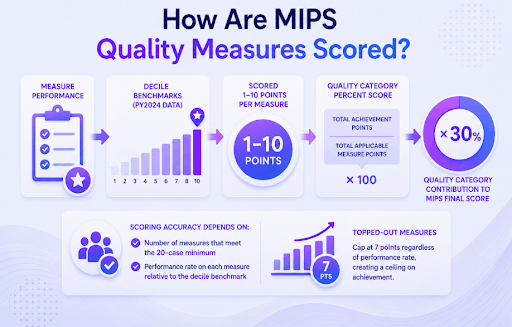
    MIPS Quality measures are scored 1 to 10 points per measure on decile benchmarks derived from PY2024 actual performance data. The Quality category percent score equals total achievement points divided by total applicable measure points, multiplied by 100. That percent score is then multiplied by the 30% weightto produce the Quality category’s contribution to the MIPS Final Score. 

    Scoring accuracy depends on two variables: the number of measures that meet the 20-case minimum, and the performance rate on each measure relative to the decile benchmark. Topped-out measures cap at 7 points regardless of performance rate, creating a ceiling on achievement from those measures.

    MIPS Quality measures are scored 1 to 10 points per measure on decile benchmarks derived from PY2024 actual performance data

    What Is a Decile Benchmark?

    A decile benchmark divides the national performance distribution for a given Quality measure into 10 equal buckets using actual submitted data from the PY2024 performance year. A clinician’s performance rate on the measure is compared to those 10 deciles to assign a point score from 1 (lowest decile) to 10 (highest decile). Performing at the top decile on a measure earns the maximum 10 points for that measure.

    Decile benchmarks are calculated separately for each measure and for each reporting mechanism (Registry, QCDR, eCQM, claims). A clinician switching from claims-based to Registry reporting may land in a different decile for the same performance rate because the benchmark populations differ by mechanism. The 2026 benchmarks use PY2024 submitted data, published annually by CMS through the QPP resource library.

    How Is the Quality Category Percent Score Calculated?

    The Quality category percent score is calculated using this formula: Quality % Score = (Total Achievement Points / Total Applicable Measure Points) x 100. That result is then multiplied by the 30% weight to produce the category’s contribution to the MIPS Final Score. Quality Improvement Scoring, if applicable, adds up to 10 percentage points to the Quality % Score before the weight multiplication.

    Worked example: A clinician submits 6 measures, all meeting the 20-case minimum. Decile scores earned per measure: 8, 7, 6, 9, 5, 8. Total achievement points = 43. Total applicable measure points = 60 (6 measures x 10 points each). Quality % Score = 43 / 60 x 100 = 71.7%. Weighted Quality contribution = 71.7% x 30% = 21.5 of 30 available Quality points toward the MIPS Final Score.

    What Is the 20 Denominator-Eligible Case Minimum?

    A MIPS Quality measure requires at least 20 denominator-eligible cases before CMS scores the measure against the national benchmark. A denominator-eligible case is a patient encounter that qualifies under the measure’s denominator criteria. If the attributed case count falls below 20 for a given measure, CMS excludes the measure from the Quality category score entirely without applying a scoring penalty for the exclusion.

    Low-volume specialties or practices in smaller markets commonly fall below the 20-case threshold on some selected measures. In that situation, only the measures with 20 or more eligible cases contribute to the Quality % Score. Selecting measures with sufficient patient volume in the practice’s case mix reduces the risk of exclusion.

    What Happens When a MIPS Quality Measure Becomes Topped-Out?

    A topped-out measure is one where the national performance distribution shows that most clinicians already perform at or near the top of the benchmark range. CMS applies a 7-point cap to topped-out measures: regardless of performance rate, no clinician earns more than 7 points on a topped-out measure in 2026. 

    Certain topped-out measures use a flat-benchmarking methodology, which replaces the decile structure with a fixed performance-rate-to-points table. Clinicians holding topped-out measures in their 6-measure selection face a lower maximum Quality % Score than clinicians holding non-topped-out measures. Reviewing the topped-out designation annually, which CMS updates with each Final Rule, is part of effective measure selection strategy.

    Are All MIPS Quality Measures Weighted Equally?

    Yes. Within the Quality category, each selected measure earns up to 10 points on its decile benchmark regardless of measure ID, specialty category, or clinical complexity. A measure’s contribution to the Quality category percent score equals its earned points divided by the total applicable measure points across all submitted measures. The single exception applies to topped-out measures, which cap at 7 points instead of 10.

    What MIPS Quality Bonuses Can Clinicians Earn?

    Three bonus paths exist under MIPS Quality for the 2026 performance year. The small-practice bonus adds +6 points directly to the MIPS Final Score. The complex-patient bonus adds up to +10 points to the MIPS Final Score. The Quality Improvement Scoring bonus adds up to +10 percentage points to the Quality category percent score before the 30% weight is applied. All three bonuses are stacked in the table below.

    Bonus Maximum Value Applied To Eligibility Gate
    Small-practice bonus +6 points MIPS Final Score TIN with 15 or fewer clinicians; at least 1 Quality measure submitted
    Complex-patient bonus Up to +10 points MIPS Final Score HCC risk score and dual-eligible ratio at or above the median threshold
    Quality Improvement Scoring Up to +10 percentage points Quality category percent score Year-over-year improvement in Quality achievement from prior performance year

    All three bonuses are calculated automatically by CMS from submitted data. No separate bonus application is required. Stacking all three is possible when a small practice serving a complex patient population also shows year-over-year Quality improvement.

    What Is the Small-Practice Bonus?

    The small-practice bonus adds +6 points directly to the MIPS Final Score for practices with a Tax Identification Number (TIN) covering 15 or fewer eligible clinicians. The bonus is triggered automatically when the small practice submits at least one Quality measure for the performance year. No separate application, attestation, or threshold of Quality performance is required to receive the small-practice bonus.

    The small-practice bonus applies at the TIN level. A solo clinician billing under a TIN alone qualifies. A group practice with 16 or more clinicians billing under the same TIN does not qualify. The +6 points are added to the MIPS Final Score after all four category scores are combined and weighted.

    How Does the Complex-Patient Bonus Work?

    The complex-patient bonus adds up to +10 points to the MIPS Final Score based on the complexity of the clinician’s attributed patient population. CMS calculates the bonus using two inputs: the average Hierarchical Condition Category (HCC) risk score across attributed patients, and the proportion of dual-eligible beneficiaries (patients enrolled in both Medicare and Medicaid) in the attributed population. Clinicians at or above the national median on both inputs receive the full bonus.

    The complex-patient bonus addresses the structural disadvantage that clinicians serving high-acuity or socially vulnerable populations face in cost and quality performance scoring. The bonus applies at the TIN-NPI level. It does not require any action from the clinician and is calculated automatically from Medicare claims and enrollment data after the performance year ends.

    What Is the Quality Improvement Scoring Bonus?

    Quality Improvement Scoring adds up to +10 percentage points to the Quality category percent score when the clinician’s year-over-year Quality achievement improves. The improvement bonus formula is: Improvement Points = 10 x (Current Year Achievement Points – Prior Year Achievement Points) / Prior Year Achievement Points. The result is capped at 10 percentage points and added to the Quality % Score before the 30% weight is applied.

    Unlike the small-practice and complex-patient bonuses, the Quality Improvement Scoring bonus is added to the Quality category percent score, not to the MIPS Final Score directly. The impact on the MIPS Final Score equals the improvement percentage points multiplied by the 30% weight. A clinician earning the full 10-percentage-point improvement bonus gains an additional 3 points on the MIPS Final Score.

    Is the Small-Practice Bonus Applied to MIPS Quality Alone?

    No, the +6 small-practice bonus is added to the MIPS Final Score, not to the Quality category percent score. The bonus applies to the total MIPS Final Score regardless of individual category performance, as long as the small practice submits at least one Quality measure. The bonus applies regardless of the practice’s Cost, Promoting Interoperability, or Improvement Activities scores.

    How Do Clinicians Report MIPS Quality Data?

    Clinicians report MIPS Quality data through five CMS-approved mechanisms for the 2026 performance year. The selected reporting mechanism determines the available measure inventory, the benchmark population used for scoring, and the data completeness tracking method. 

    Reporting mechanism selection affects score outcomes independently of measure selection. The same measure may benchmark differently across mechanisms because CMS calculates separate decile benchmarks for each mechanism using that mechanism’s submitted data from PY2024.

    What Are the Five MIPS Quality Reporting Mechanisms?

    CMS approves five reporting mechanisms for MIPS Quality data submission in 2026. Each mechanism supports a different collection type and fits a different practice profile:

    Mechanism Collection Type Best Fit 2026 Status
    Qualified Registry MIPS CQM Groups of any size, widest measure access Active
    Qualified Clinical Data Registry (QCDR) MIPS CQM (specialty-aligned) Specialty practices with QCDR-specific measures Active
    EHR (eCQM) eCQM via CEHRT Practices with Certified Electronic Health Record Technology (CEHRT) Active
    Medicare Part B Claims Claims-based measure Small practices only (15 or fewer clinicians) Active (small practice only)
    CMS Web Interface Group-level web submission Large groups; limited measure set Deprecated for most; limited eligibility

    Qualified Registry reporting offers the broadest measure access across all practice sizes. Claims-based reporting is restricted to small practices (15 or fewer clinicians) and covers a limited subset of MIPS Quality measures available through the claims mechanism.

    How Does eCQM Differ from MIPS CQM?

    An electronic Clinical Quality Measure (eCQM) is collected directly from Certified Electronic Health Record Technology (CEHRT)-certified EHR data using standardized eCQM logic specifications published by CMS. A MIPS CQM (Clinical Quality Measure) is collected through a Qualified Registry or QCDR using measure-specific data submission that does not require CEHRT certification. 

    Both measure types can cover the same underlying clinical concept, but the collection mechanism, data source, and benchmark population differ. Clinicians using CEHRT-equipped EHR systems can choose eCQM reporting, which eliminates the need for a separate Registry vendor. Practices without CEHRT or with EHR systems that do not support eCQM export use MIPS CQM reporting through a Registry or QCDR. 

    Decile benchmarks for eCQMs and MIPS CQMs are calculated separately, so a clinician’s point score for the same clinical measure may differ across collection types.

    When Does Registry Reporting Outperform Claims-Based Reporting?

    Registry reporting produces higher Quality scores than claims-based reporting in four specific scenarios:

    • The practice has 16 or more clinicians, claims-based reporting is restricted to small practices only, so Registry is the only available mechanism for larger groups.
    • Higher-decile measures are accessible only via Registry, the claims measure inventory is a subset of the full Registry measure list.
    • The Registry vendor offers real-time benchmark gap reporting Registry vendors alert clinicians to low-performing measures during the year, allowing corrective action before submission.
    • The practice submits a hybrid eCQM/Registry report, some clinicians combine eCQM and Registry submissions across their 6 measures to access the broadest benchmark set.

    Claims-based reporting carries the advantage of zero Registry vendor cost and no additional data collection infrastructure. For practices that qualify and whose claims already reflect the required quality indicators, claims reporting is the lowest-overhead option.

    What Changed for MIPS Quality in 2026?

    CMS finalized 2026 Quality category updates in the November 5, 2025 Physician Fee Schedule Final Rule. Four changes affect measure selection, scoring, and reporting for the 2026 performance year:

    CMS finalized 2026 Quality category updates in the November 5, 2025 Physician Fee Schedule Final Rule

    • 5 New Measures Added: CMS added 5 measures to the 2026 Quality inventory. The full list appears in the Final Rule and the QPP Quality measure specifications published annually by CMS.
    • 10 Measures Retired: Ten measures were removed from the 2026 inventory. Clinicians who reported any of the 10 retired measures in 2025 must replace those measures with eligible 2026 alternatives.
    • 30 Measures Substantively Modified: CMS revised measure specifications, denominator definitions, or performance benchmarks for 30 existing measures. Practices that track measure performance internally must review updated 2026 specifications before the performance year begins.
    • Health Equity Removed from High-priority Definition: CMS removed “health equity” as a qualifying category for high-priority measure designation for 2026. Clinicians relying on a health equity measure to satisfy the 1 outcome/high-priority requirement must confirm the measure retains high-priority status or identify a replacement.

    Which MIPS Quality Measures Were Retired for 2026?

    Ten MIPS Quality measures were retired for the 2026 performance year per the November 5, 2025 Physician Fee Schedule Final Rule. Examples of retired measures include:

    • Measure #185 (Colonoscopy Interval for Patients with a History of Adenomatous Polyps)
    • Measure #264 (Sentinel Lymph Node Biopsy for Invasive Breast Cancer)
    • Measure #322 (Cardiac Stress Imaging Not Meeting Appropriate Use Criteria for Low-Risk Surgery)
    • Measure #443 (Non-Recommended Cervical Cancer Screening in Adolescent Females)
    • Measure #487 (Screening for Social Drivers of Health), and Measure #508 (Adult COVID-19 Vaccination Status).

    Clinicians who selected any retired measure in their 2025 set must rebuild their 6-measure selection for 2026. The full retired-measure list lives on the 2026 MIPS Quality measures page at /quality/measures/ and in the QPP Quality measure specifications document published by CMS after Final Rule release each year.

    Did MIPS Quality Data Completeness Change for 2026?

    No. CMS held the data completeness threshold at 75 percent of denominator-eligible encounters for the 2026 performance year, unchanged from 2025 per the November 5, 2025 Physician Fee Schedule Final Rule. Measures that fall below 75% data completeness score zero points regardless of the actual performance rate on reported encounters.

    How Does Macralytics Support MIPS Quality Measure Selection and Submission?

    Macralytics runs measure-selection audits by modeling each practice’s patient mix against the full 2026 Quality measure inventory. The audit identifies which measures the practice’s case data supports, projects the decile score range for each eligible measure using PY2024 benchmarks, and flags any topped-out measures that cap at 7 points. Macralytics then manages data-completeness monitoring through the performance year and submits final Quality data through the Macralytics Qualified Registry.

    The selection audit process identifies the 6-measure combination with the highest projected Quality category percent score before the performance year begins, not after submission closes. Practices that complete a measure-selection audit in Q4 of the prior year or Q1 of the performance year have the full year to collect qualifying encounters on the optimal measure set. 

    Do MIPS Quality Measures Apply to MIPS Value Pathway (MVP) Reporting?

    Yes. MIPS Value Pathways (MVPs) include Quality measures as a required component, but MVP reporting uses 4 Quality measures instead of the 6 required under traditional MIPS. The 4 MVP Quality measures are drawn from the MVP’s pre-defined specialty-aligned subset rather than the full ~187-measure inventory. 

    At least 1 of the 4 measures must be an outcome measure. The decile-benchmark scoring method (1 to 10 points per measure) applies unchanged across both traditional MIPS and MVP reporting. MVP-specific Quality measures share the same underlying clinical concepts as traditional MIPS measures but are pre-selected by CMS to match the clinical focus of each MVP. Clinicians who participate in an MVP cannot substitute measures from outside the MVP’s pre-defined subset. 

    The Quality category weight (30% of the MIPS Final Score) and the data completeness requirement (75% of eligible encounters) apply equally to MVP and traditional MIPS Quality reporting. MIPS Quality measures are the clinical-care performance measures CMS uses to score the Quality category, the 30%-weighted component of the MIPS Final Score for approximately 187 finalized measures in 2026.

  • MIPS Improvement Activities: Scoring, Attestation & Special-Status Rules

    MIPS Improvement Activities: Scoring, Attestation & Special-Status Rules

    MIPS Improvement Activities (IA) is the attestation-based practice-improvement performance category under the Merit-Based Incentive Payment System (MIPS), accounting for 15 percent of the 2026 MIPS final score. Clinicians attest to performing activities for a minimum of 90 continuous days

    Standard clinicians attest to 2 activities; small-practice, rural, non-patient-facing, and HPSA clinicians attest to 1 activity for full credit. Activities no longer carry high or medium weights.

    What are MIPS Improvement Activities?

    MIPS Improvement Activities (IA) are practice-improvement attestations clinicians complete to earn points toward the IA performance category of the Merit-Based Incentive Payment System (MIPS). IA is one of four MIPS performance categories, alongside Quality, Cost, and Promoting Interoperability. The IA category carries a 15 percentweight for the 2026 performance year.

    IA is the smallest weight component but the lowest-lift category to complete. Attestation alone earns credit, with no continuous measure-level data collection required. CMS finalized more than 100 activities for 2026 across seven active subcategories.

    How do Improvement Activities contribute to the MIPS final score?

    The IA category contributes up to 15 points to the MIPS final score, calculated by multiplying the clinician’s IA category percent score by the 15 percent category weight. The four MIPS categories combine as Quality 30 percent, Cost 30 percent, Promoting Interoperability 25 percent, and IA 15 percent, totaling a final score of 0 to 100.

    A clinician must clear the 75-point performance threshold in 2026 to avoid the -9 percent Medicare Part B penalty. IA is often the easiest category to maximize, which makes it a strategic anchor for clinicians starting below the threshold. CMS maintains the 75-point threshold through the 2028 performance year.

    How many Improvement Activities does CMS publish for 2026?

    CMS finalized more than 100 Improvement Activities for the 2026 performance year. The year-over-year change includes 3 new activities, 7 modified activities, and 8 removed activities, plus 4 additional activities previously finalized for removal effective 2026.

    CMS finalized the 2026 inventory in the Physician Fee Schedule Final Rule published November 5, 2025. The full activity list with subcategories appears on the 2026 MIPS Improvement Activities list page. 

    Did MIPS Improvement Activities change for 2026?

    Yes. CMS finalized 3 new Improvement Activities, removed 8, substantively modified 7, and replaced the Achieving Health Equity (AHE) subcategory with a new Advancing Health and Wellness (AHW) subcategory for the 2026 performance year. The total inventory remains above 100 activities. 

    How are MIPS Improvement Activities scored in 2026?

    MIPS Improvement Activities use a flat-point scoring model in 2026, with each activity worth 20 points and a maximum IA category score of 40 points. Beginning in the 2025 performance year, CMS removed the high-weighted and medium-weighted designations. All activities now carry equal point value.

    A standard MIPS clinician reaches the 40-point maximum by attesting to 2 activities. Small-practice and other special-status clinicians reach the maximum by attesting to 1 activity. The IA category percent score then feeds the 15 percent category weight.

    How many activities earn full Improvement Activities credit?

    Standard MIPS clinicians earn full IA credit by attesting to 2 activities performed for at least 90 continuous days. Special-status clinicians earn full credit with 1 activity. The special statuses are small practice, rural, non-patient-facing, and Health Professional Shortage Area (HPSA).

    Partial attestation earns partial credit. A standard clinician who attests to 1 of the 2 required activities earns 50 percent of the IA category score, which equals 7.5 of the 15 possible final-score points. Attesting to more than the required number of activities does not increase the category score.

    What is each Improvement Activity worth in 2026?

    Each MIPS Improvement Activity is worth 20 points in 2026, regardless of subcategory or scope. The IA category caps at 40 points, which equals a 100 percent category score. CMS sets these values in the annual Physician Fee Schedule Final Rule.

    A standard clinician needs 2 activities at 20 points each to reach the 40-point cap. The flat-point model replaced the prior system, where activities earned either 20 points (high) or 10 points (medium). The change reduced selection complexity for clinicians choosing activities.

    Are Improvement Activities still high-weighted or medium-weighted?

    No. CMS removed the high-weighted and medium-weighted designations starting with the 2025 performance year. All Improvement Activities now carry the same point value, and no activity ranks above another for scoring purposes. Clinicians select activities by relevance to their workflow, not by weight tier. Many third-party pages still reference the retired high-and-medium model, which no longer applies in 2026.

    How do clinicians attest to MIPS Improvement Activities?

    MIPS Improvement Activities are attestation-based: clinicians declare that they performed selected activities for at least 90 continuous days during the 2026 performance year. No measure-level data submission is required. Standard clinicians attest to 2 activities; special-status clinicians attest to 1.

    Each activity must run for a minimum of 90 continuous days within the calendar year. The last possible 90-day start date is October 3, 2026. Group reporting carries an added rule: at least 50 percent of clinicians in the group must perform the same activity during the same window.

    How many activities must a clinician attest?

    Standard MIPS clinicians must attest to 2 Improvement Activities to earn the full 40-point IA category score. Special-status clinicians attest to 1 activity of any type for full credit. The special statuses are small practice, rural, non-patient-facing, and HPSA.

    Clinicians can attest to additional activities, but the IA category caps at 40 points. Extra activities earn no additional category-level credit. Most practices select 2 activities that align with existing workflows to limit added administrative cost.

    What is the 90-day continuous attestation period?

    Each MIPS Improvement Activity must be performed for a minimum of 90 continuous days within the 2026 calendar year. Clinicians choose any 90-day window that ends by December 31, 2026. The 90-day window is the minimum; clinicians can perform an activity longer.

    The last possible 90-day start date is October 3, 2026. Starting later means the window cannot be completed by year-end, and the clinician forfeits IA credit for that activity. For group reporting, all attesting clinicians perform the activity during the same 90-day window. 

    What is the 50% group-attestation rule?

    For group reporting at the TIN level, MIPS Improvement Activities require at least 50 percent of the MIPS-eligible clinicians in the group to perform the same activity during the same continuous 90-day period. In a group of 20 eligible clinicians, at least 10 must perform the attested activity.

    Groups retain documentation showing which clinicians participated and during which window. Clinician rosters with start and end dates per activity satisfy this requirement. Virtual groups apply the same 50 percent rule across the virtual group’s combined clinician roster.

    Can a single clinician’s attestation cover the whole group?

    No. Under group reporting, at least 50 percent of MIPS-eligible clinicians in the group must perform the same activity during the same 90-day window. A single clinician’s attestation does not satisfy the group requirement, even when the rest of the group holds special status. The group either meets the 50 percent threshold or earns zero credit for that activity.

    What special-status rules reduce the Improvement Activities requirement?

    MIPS Improvement Activities apply a reduced-requirement rule for special-status clinicians: these clinicians attest to 1 activity instead of 2 to earn the full 40-point IA category score. The rule lets eligible clinicians reach the maximum with half the standard activity count.

    The reduced requirement applies to clinicians designated small practice (15 or fewer eligible clinicians), rural, non-patient-facing, or HPSA. The rule is specific to the IA category and does not change Quality, Cost, or Promoting Interoperability scoring.

    Which special statuses qualify for the reduced Improvement Activities requirement?

    Four MIPS special statuses reduce the Improvement Activities requirement from 2 activities to 1:

    1. Small practice – a TIN with 15 or fewer eligible clinicians.
    2. Rural – a practice delivering the majority of services in a ZIP code designated rural under CMS’s rural definition.
    3. Non-patient-facing – a clinician billing 100 or fewer patient-facing encounters per year, or a group where 75 percent of clinicians meet that threshold.
    4. Health Professional Shortage Area (HPSA) – a practice located in a federally designated HPSA per the Health Resources and Services Administration (HRSA).

    CMS applies the reduced requirement automatically based on TIN-level status determination. No separate application is required.

    How does the reduced-requirement rule work?

    The reduced-requirement rule lets special-status clinicians earn the full 40-point IA category score by attesting to a single activity. A standard clinician needs 2 activities at 20 points each. A special-status clinician’s single activity earns full category credit.

    The practical effect is a 50 percent reduction in attestation burden. A small-practice clinician selects 1 activity that fits an existing workflow, performs it for 90 continuous days, and reaches a 100 percent IA category score. The category percent score still caps at 100 percent regardless of how many activities the clinician completes.

    Does the reduced IA requirement stack with the small-practice MIPS bonus?

    Yes. The IA reduced-requirement rule and the separate small-practice MIPS bonus apply independently. The IA rule lets a small practice reach the full IA category score with 1 activity. The small-practice bonus then adds points to the Quality performance category score, separate from any IA-category math. The two mechanisms operate at different scoring layers and do not cancel each other.

    How is the MIPS Improvement Activities score calculated?

    The IA category percent score equals total IA points earned divided by the 40-point maximum, multiplied by 100. That percentage is then multiplied by the 15 percent category weight to determine the IA contribution to the MIPS final score.

    IA Category Percent Score = (Total IA Points / 40) × 100, capped at 100%

    IA Contribution to MIPS Final Score = IA Category Percent Score × 15% weight

    Example 1, standard clinician (2 activities): completes 2 activities at 20 points each = 40 IA points. IA category percent score: 40 / 40 × 100 = 100 percent. Contribution to MIPS final score: 100% × 15% = 15 of 15 possible points.

    Example 2, special-status clinician (1 activity): completes 1 activity, which earns full category credit = 40 IA points. IA category percent score: 100 percent. Contribution to MIPS final score: 100% × 15% = 15 of 15 possible points from a single activity.

    A standard clinician who attests to only 1 of the 2 required activities earns 20 of 40 points, a 50 percent category score, and 7.5 of 15 final-score points.

    Patient-Centered Medical Home (PCMH) recognition earns the maximum IA category score automatically, without per-activity attestation. A practice holding PCMH recognition completes IA scoring by default for the entire category. For deeper scenarios, see our worked MIPS IA scoring examples for small practices and groups.

    How are MIPS Improvement Activities organized by subcategory?

    CMS organizes the 2026 MIPS Improvement Activities into eight subcategories that group activities by improvement focus. The 2026 inventory replaced one subcategory and retained the rest.

    1. Advancing Health and Wellness (AHW) – NEW for 2026, replaces the previous Achieving Health Equity (AHE) subcategory. Focuses on chronic and preventive care management for empaneled patients.
    2. Care Coordination (CC) – care transitions, referral loops, and post-discharge follow-up.
    3. Population Management (PM) – outcomes tracking across a defined population, including registries and panel management.
    4. Patient Safety and Practice Assessment (PSPA) – harm reduction, medication safety, infection control, and practice self-assessment.
    5. Beneficiary Engagement (BE) – patient involvement in care decisions and self-management.
    6. Expanded Practice Access (EPA) – telehealth access, language access, and after-hours availability.
    7. Behavioral and Mental Health (BMH) – behavioral health integration, depression management, and substance-use intervention.
    8. Emergency Response and Preparedness (ERP) – public-health emergency response and practice continuity.

    The 2026 inventory carries the highest activity counts in Population Management and Care Coordination. The AHW subcategory launched with a single activity, IA_AHW_1 (Chronic Care and Preventative Care Management for Empaneled Patients), and will expand in future rules. The full subcategory breakdown lives on the 2026 MIPS Improvement Activities list page.

    What changed for MIPS Improvement Activities in 2026?

    CMS finalized four MIPS Improvement Activities changes for the 2026 performance year in the Physician Fee Schedule Final Rule published November 5, 2025.

    1. Three new IAs added for 2026:
    • IA_PM_27 – Improving Detection of Cognitive Impairment in Primary Care.
    • IA_PM_28 – Integrating Oral Health Care in Primary Care.
    • Patient Safety in Use of Artificial Intelligence (AI) – a new Patient Safety and Practice Assessment activity.
    • Eight IAs removed, plus 4 previously finalized for removal effective 2026. The removed activities include several former Achieving Health Equity activities (such as IA_AHE_8, Create and Implement an Anti-Racism Plan) and outdated Care Coordination measures (IA_CC_1 and IA_CC_2).
    • Seven existing IAs substantively modified, with updated activity descriptions, performance-period clarifications, or documentation requirements.
    • The Achieving Health Equity (AHE) subcategory was removed and replaced with the new Advancing Health and Wellness (AHW) subcategory.

    The IA category weight remains 15 percent of the MIPS final score for 2026. The changes affect the activity inventory and subcategory taxonomy, not the category’s contribution to scoring. Many competitor pages still cite pre-2026 activity counts or the retired AHE subcategory.

    How does Macralytics support MIPS Improvement Activities selection and attestation?

    Macralytics supports MIPS Improvement Activities selection and attestation through a four-step service workflow.

    1. Activity audit – review the clinician’s practice workflows to identify the 1 or 2 activities most likely already in place, applying any special-status reduced requirement.
    2. 90-day attestation plan – set the start date, documentation cadence, and group roster to meet the 90-day continuous-period and 50 percent group rules.
    3. Attestation documentation – assemble workflow logs, training rosters, and meeting minutes that support the attestation in an audit.
    4. Submission via Macralytics Qualified Registry – submit IA attestations alongside Quality and Promoting Interoperability data during the CMS submission window.

    For the activity-selection method in detail, see how we pick MIPS Improvement Activities.

    Do MIPS Value Pathway (MVP) requirements include Improvement Activities?

    Yes, with a simplified requirement compared with Traditional MIPS. Each MIPS Value Pathway (MVP) requires the clinician to attest to 1 Improvement Activity from the MVP-specific inventory, regardless of special status. The 90-day continuous-period and 50 percent group-attestation rules apply to MVP IA reporting identically to Traditional MIPS. Practices considering MVP reporting find the single-activity IA requirement attractive given the reduced administrative burden.

  • MIPS Cost Category: Measures, Attribution, and Risk

    MIPS Cost Category: Measures, Attribution, and Risk

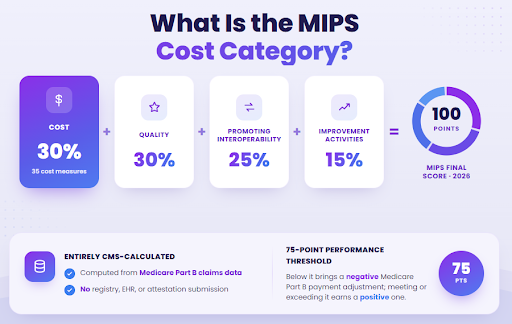
    The MIPS Cost category is the CMS-calculated, claims-based performance category that measures resource use under the Merit-Based Incentive Payment System (MIPS). The Cost category accounts for 30 percent of the 2026 MIPS final score across 35 measures: the Total Per Capita Cost (TPCC), the Medicare Spending Per Beneficiary (MSPB) Clinician measure, and 32 episode-based measures. Clinicians submit no Cost data; CMS calculates each score directly from Medicare Part B claims using attribution rules and risk adjustment.

    What Is the MIPS Cost Category?

    The MIPS Cost category is one of four MIPS performance categories under the Quality Payment Program (QPP), alongside Quality, Promoting Interoperability, and Improvement Activities. The Cost category is weighted at 30 percentof the 2026 MIPS final score and covers 35 cost measures in total. Unlike the other three categories, the Cost category is entirely CMS-calculated from Medicare Part B claims data. Clinicians do not submit Cost data through a registry, EHR, or attestation portal.

    The MIPS Cost Category 15% to 100%

    The four MIPS performance categories together form a 100-point MIPS Final Score. The 2026 weight distribution is: Cost at 30%, Quality at 30%, Promoting Interoperability at 25%, and Improvement Activities at 15%. The MIPS performance threshold for 2026 is 75 points. Clinicians scoring below the threshold face a negative payment adjustment; those above earn a positive adjustment to their Medicare Part B payments.

    How Does Cost Contribute to the MIPS Final Score?

    The Cost category contributes up to 30 points to the 100-point MIPS Final Score. CMS calculates a Cost category percent score by averaging the measure-level scores for each cost measure attributed to the clinician. That percent score is then multiplied by the 30% weight to produce the category’s point contribution to the MIPS Final Score. A clinician who scores 90% on Cost contributes 27 of the 30 available Cost points.

    The remaining 70 points come from Quality (30%), Promoting Interoperability (25%), and Improvement Activities (15%). Each category is scored separately, and the four category scores are combined to produce the MIPS Final Score. Clinicians use their annual MIPS feedback report to review Cost performance before the applicable payment adjustment year.

    Do Clinicians Submit MIPS Cost Data?

    No, CMS calculates Cost performance directly from Medicare Part B claims. Clinicians do not submit any Cost data through a registry, EHR vendor, or the QPP portal. The no-submission rule applies only to Cost; the other three MIPS categories (Quality, Promoting Interoperability, and Improvement Activities) require active data submission by the clinician or the reporting group.

    What MIPS Cost Measures Does CMS Use?

    The 2026 MIPS Cost measure inventory contains 35 measures across three classes: 1 Total Per Capita Cost (TPCC) measure, 1 Medicare Spending Per Beneficiary (MSPB) Clinician measure, and 32 episode-based cost measures. CMS attributes each measure to a clinician based on the type of care delivered and the applicable attribution rules. 

    Clinicians may be attributed one, several, or all three measure classes depending on practice type and patient population. The three measure classes differ by trigger type, patient population, and attribution window:

    Measure Class Count (2026) Attribution Trigger Care Focus
    Total Per Capita Cost (TPCC) 1 Primary-care E/M visits (plurality) Primary care, annual
    Medicare Spending Per Beneficiary (MSPB) Clinician 1 Inpatient admission (admitting clinician) Inpatient, episode window
    Episode-based cost measures 32 Procedure or condition trigger code Condition/procedure-specific
    Total 35    

    Each measure class uses a distinct attribution mechanism, and a single patient can generate attribution across multiple measure classes and TIN-NPIs in the same performance year.

    What Is the Total Per Capita Cost (TPCC) Measure?

    The Total Per Capita Cost (TPCC) measure is the primary-care-attributed cost measure that calculates the average annual Medicare Parts A and B costs across all patients attributed to a clinician through primary-care visits. TPCC attribution is based on the plurality of primary-care evaluation and management (E/M) visits. The clinician who bills the highest share of a patient’s primary-care E/M visits over the performance year receives TPCC attribution for that patient.

    TPCC measures the total cost of care across all services, not only services that the attributed clinician delivers personally. That design reflects TPCC’s role as a resource-use measure: the attributed primary-care clinician is accountable for the full cost associated with coordinating care for attributed patients.

    How Did TPCC Change for 2026?

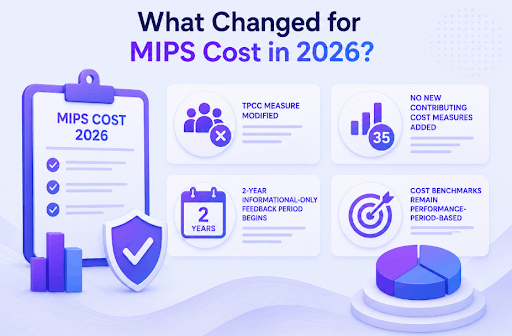
    CMS modified the TPCC measure for 2026 in the November 5, 2025, Physician Fee Schedule Final Rule. Candidate events initiated by Advanced Care Practitioner (ACP) TIN-NPIs are excluded when all non-ACP TIN-NPIs in the group are specialty-excluded. In practice, mixed physician-ACP groups where the physicians fall outside primary-care specialties are less likely to accumulate TPCC attribution under the 2026 rule. 

    Groups with mixed physician-ACP staffing should audit their TIN-NPI composition to determine whether the 2026 TPCC modification changes their attribution exposure before the performance year closes.

    What Is the Medicare Spending Per Beneficiary (MSPB) Clinician Measure?

    The Medicare Spending Per Beneficiary (MSPB) Clinician measure attributes inpatient-care spending to the clinician who serves as the admitting physician for a Medicare hospitalization. The MSPB Clinician episode window spans 3 days before the inpatient admission through 30 days after discharge. All Medicare Parts A and B claims within that window are included in the episode cost calculation.

    MSPB Clinician is distinct from TPCC in both trigger and scope. TPCC is a longitudinal measure across a full performance year of primary-care visits. MSPB Clinician is an episode measure triggered by a single inpatient admission. A hospitalist or attending physician who regularly admits Medicare patients is likely to accumulate MSPB Clinician attribution; a primary-care-only outpatient practice typically does not.

    What Are Episode-Based Cost Measures?

    Episode-based cost measures attribute the total cost of a defined clinical episode to the clinician who billed the trigger code that initiated the episode. The 32 episode-based cost measures active for 2026 include Hip Replacement, Acute Myocardial Infarction (AMI), COPD Exacerbation, Knee Replacement, and Revascularization, among others. Each measure has a specific trigger code, an attribution rule, and a defined episode cost window.

    Episode-based measures fall into two types:

    • Procedure-triggered episodes: The trigger is a specific procedure code, such as a total hip arthroplasty CPT code for the Hip Replacement measure.
    • Condition-triggered episodes: The trigger is a condition-related claim code, such as a COPD-related hospitalization code for the COPD Exacerbation measure.

    The episode cost window includes all Medicare Parts A and B spending from the trigger date through the end of the defined episode period, regardless of which clinician delivered those services.

    How Many MIPS Cost Measures Exist for 2026?

    The 2026 MIPS Cost measure inventory contains 35 total measures: 1 TPCC measure, 1 MSPB Clinician measure, and 32 episode-based measures. CMS finalized one additional claims-based measure for 2026, but that measure carries informational-only status and does not contribute to the Cost category score. 

    The count of scoring-eligible measures is 35, unchanged from 2025 per the November 5, 2025, Physician Fee Schedule Final Rule.

    Can a New MIPS Cost Measure Lower a Clinician’s 2026 Final Score?

    No. Beginning with performance year 2026, any new cost measure CMS finalizes enters a 2-year informational-only feedback period before contributing to the Cost category score or MIPS Final Score. Clinicians receive performance feedback on a new measure during the two informational years, but the measure carries zero scoring weight during that period. Standard scoring for a new measure begins in year 3 of the measure’s existence under MIPS.

    How Does CMS Attribute a MIPS Cost Measure to a Clinician?

    Attribution is the process CMS uses to assign a patient (for TPCC) or a clinical episode (for episode-based measures) to a specific clinician at the TIN-NPI level. CMS assigns attribution based on candidate-event rules that differ across the three measure classes. The unit of attribution is always the TIN-NPI combination: the clinician’s individual National Provider Identifier (NPI) paired with the Tax Identification Number (TIN) of the practice under which the service was billed.

    The attribution process runs automatically from Medicare Part B claims data after the performance year ends. Clinicians do not submit attribution requests. Attribution results are published in the annual MIPS Cost feedback report from CMS and are available through the QPP portal.

    Attribution is the process CMS uses to assign a patient

    What Is a Candidate Event in MIPS Cost Attribution?

    A candidate event is a billed service that triggers the attribution logic for a given MIPS Cost measure. For TPCC, the candidate event is a primary-care evaluation and management (E/M) visit billed by the clinician during the performance year. For episode-based measures, the candidate event is the procedure or condition trigger code that initiates the episode cost window.

    Specialty exclusion rules apply to candidate events. If a clinician’s specialty code appears on CMS’s specialty-exclusion list for a given measure, candidate events billed by that clinician do not trigger attribution for that measure. The 2026 TPCC modification adds a specific exclusion: ACP TIN-NPI candidate events are excluded when all non-ACP TIN-NPIs in the group are specialty-excluded from TPCC.

    How Does TPCC Attribution Differ from Episode-Based Attribution?

    TPCC attribution and episode-based attribution use different triggers, time windows, and attribution logic. The table below compares the two approaches across key attribution dimensions.

    Dimension TPCC Attribution Episode-Based Attribution
    Attribution trigger Plurality of primary-care E/M visits across the performance year A single procedure or condition trigger code
    Time window Full performance year (12 months) Condition- or procedure-specific episode window
    Attribution unit TIN-NPI with the most primary-care E/M visits for the patient TIN-NPI that billed the trigger code
    Typical clinician attributed Primary care physician or ACP with the highest E/M visit share Surgeon, hospitalist, or specialist who performed the trigger procedure

    Worked attribution example: A Medicare patient undergoes total hip replacement surgery. The surgeon’s TIN-NPI billed the hip arthroplasty CPT code, so the surgeon is attributed the Hip Replacement episode-based measure cost for that patient. The same patient sees a primary-care physician for annual management throughout the year. 

    The primary-care physician’s TIN-NPI holds the plurality of primary-care E/M visits, so the primary-care physician is attributed TPCC cost for that same patient. One patient generates two separate cost attributions to two different TIN-NPIs.

    What Is the TIN-NPI Level in MIPS Cost Attribution?

    The TIN-NPI is the attribution unit CMS uses for MIPS Cost. A TIN-NPI is the pairing of a clinician’s individual National Provider Identifier (NPI) with the Tax Identification Number (TIN) of the practice or group through which the clinician billed Medicare. Cost attribution sits at the TIN-NPI level: if the same NPI bills under two different TINs during the performance year, each TIN-NPI pair accumulates attribution and scoring separately.

    TIN-NPI-level attribution matters most for clinicians who practice at multiple locations or switch groups mid-year. Each TIN-NPI combination produces a separate Cost performance result. Group-level reporting combines the TIN-NPI results of all clinicians billing under the group TIN into a single group-level Cost score.

    Can Clinicians Dispute MIPS Cost Attribution?

    Yes. Clinicians can dispute MIPS Cost attribution through the CMS Targeted Review process after the MIPS Final Score is released. Common grounds for a Targeted Review request include incorrect TIN-NPI attribution (for example, claims billed under the wrong TIN), specialty exclusion rules misapplied to the clinician, and candidate events miscoded in the underlying Medicare claims data. Targeted Review requests are submitted through the QPP Help Desk after final scores are published each year.

    How Is Risk Adjustment Applied to MIPS Cost?

    Risk adjustment normalizes raw cost figures for patient mix so that clinicians treating sicker or more complex patients are not penalized for the higher costs associated with that population. CMS applies risk adjustment to MIPS Cost scores using Hierarchical Condition Category (HCC) scores, demographic factors, and dual-eligibility status. 

    Risk adjustment operates at the measure level: each attributed patient’s expected cost is adjusted before comparing actual cost to the performance-period benchmark.

    Without risk adjustment, a primary-care practice serving a high-acuity geriatric population would consistently show higher raw costs than a practice serving healthier Medicare patients, even with identical care quality. Risk adjustment corrects for that population-mix difference before scoring.

    What Is a Hierarchical Condition Category (HCC) Score?

    A Hierarchical Condition Category (HCC) score is a CMS-administered risk model that converts a patient’s ICD-10 diagnosis codes into a numeric risk score. Higher HCC scores indicate greater patient complexity and higher expected Medicare costs. CMS uses HCC scores as the primary input for MIPS Cost risk adjustment: each attributed patient’s HCC score raises or lowers the expected cost against which the clinician’s actual cost is measured.

    HCC scores are built from diagnosis codes submitted on Medicare claims during the measurement period. Incomplete ICD-10 documentation leads to lower HCC scores and underestimated expected costs. 

    What Demographic Factors Affect MIPS Cost Risk Adjustment?

    Four demographic factors apply to MIPS Cost risk adjustment alongside HCC scores. Each factor adjusts the expected cost for a given patient up or down before comparison to the benchmark:

    • Age: Older Medicare beneficiaries carry higher expected costs, and risk adjustment incorporates age-related cost increases across the attributed patient population.
    • Sex: Sex-specific cost differences are incorporated into the CMS risk adjustment model and applied at the individual patient level.
    • Dual-eligibility (Medicare + Medicaid): Beneficiaries enrolled in both Medicare and Medicaid (dual-eligible beneficiaries) carry higher expected costs due to greater social and clinical complexity.
    • Medicaid-status interactions with HCC: Dual-eligibility status interacts with HCC scores to produce a combined adjustment that reflects the compounding effect of clinical and social complexity on expected cost.

    Dual-eligible beneficiaries add the most meaningful adjustment complexity and are the most significant demographic factor for practices serving low-income or underserved populations.

    Does Risk Adjustment Guarantee a Fair MIPS Cost Score?

    No, risk adjustment normalizes Cost scores for HCC-coded complexity, age, sex, and dual eligibility, but risk adjustment does not capture every clinical or social risk factor that drives Medicare cost. Social determinants of health, undocumented chronic conditions, and geographic care-access differences are not fully reflected in HCC-based models. 

    Practices serving complex populations should validate HCC coding completeness annually to confirm that risk adjustment operates on an accurate diagnosis record.

    How Is the MIPS Cost Category Score Calculated?

    The Cost category percent score is the average of all measure-level scores attributed to the clinician, expressed as a percentage. Each measure-level score runs on a scale of 1 to 10, reflecting how the clinician’s actual cost compares to the performance-period benchmark for that measure. 

    The Cost category percent score is then multiplied by the 30% weight to produce the Cost category’s point contribution to the MIPS Final Score. Cost benchmarks use performance-period data, not historical data. The table below shows a simplified three-measure scoring example. 

    Measure Attributed Cases Measure Score (1-10) Weighted Contribution
    TPCC 45 patients 7.2 Part of the average cost percent score
    Hip Replacement (episode-based) 28 episodes 8.1 Part of the average cost percent score
    MSPB Clinician 6 episodes 4.5 Part of the average cost percent score
    Cost Category Percent Score   (7.2 + 8.1 + 4.5) / 3 = 6.6 / 10 x 100 = 66% 66% x 30% = 19.8 MIPS points

    CMS publishes Cost performance feedback through the QPP portal after the performance year closes. Clinicians can review measure-level scores, attributed case counts, and benchmark comparisons in the annual Cost feedback report.

    What Is the 20-Case Minimum for MIPS Cost Scoring?

    A cost measure requires at least 20 attributed cases before CMS scores the measure against the benchmark. For TPCC, a case is an attributed patient. For episode-based measures, a case is an attributed episode. If the attributed count falls below 20 for a given measure, CMS excludes that measure from the Cost category score calculation entirely.

    Low-volume specialties or practices in smaller markets may fall below the 20-case minimum on certain episode-based measures. In that situation, the measure is dropped from the clinician’s Cost category score without penalty. Only measures with 20 or more attributed cases enter the average that produces the Cost category percent score.

    Did the MIPS Cost Category Weight Change for 2026?

    No, CMS held the Cost category weight at 30 percent of the MIPS Final Score, unchanged from 2025, per the November 5, 2025, Physician Fee Schedule Final Rule. The four-category weight distribution for 2026 is: Cost 30%, Quality 30%, Promoting Interoperability 25%, and Improvement Activities 15%. The Cost weight has remained at 30% since the category reached full weighting under MACRA.

    What Changed for MIPS Cost in 2026?

    CMS finalized four Cost-category updates for 2026 in the November 5, 2025, Physician Fee Schedule Final Rule. The updates cover the TPCC measure design, the scoring-eligible measure count, the treatment of newly-finalized measures, and benchmark methodology:

    CMS finalized four Cost-category updates for 2026

    • TPCC measure modified: Candidate events initiated by ACP TIN-NPIs are excluded when all non-ACP TIN-NPIs in the group are specialty-excluded from TPCC.
    • No new contributing cost measures added: The 35 scoring-eligible measures are unchanged from 2025. One new claims-based measure was finalized but carries informational-only status.
    • 2-year informational-only feedback period begins: Any new cost measure finalized beginning with PY 2026 enters a 2-year informational period before scoring.
    • Cost benchmarks remain performance-period-based: CMS did not shift Cost benchmarks to a historical-data basis for 2026.

    Which 2026 Cost Change Matters Most for Clinicians?

    The TPCC modification matters most for groups with mixed physician-ACP staffing. If a group practice includes physicians who are specialty-excluded alongside ACPs who previously triggered TPCC attribution, the 2026 rule change may reduce or eliminate TPCC attribution for that group. Groups in this situation should audit their TIN-NPI composition and run an attribution review before the performance year ends to understand the practical exposure.

    The 2-year informational-only feedback period carries zero immediate scoring impact because the only new measure finalized for 2026 already enters informational-only status automatically. The remaining two changes (no new contributing measures; benchmark methodology unchanged) are procedural confirmations with minimal operational effect on 2026 Cost scores.

    How Does the 2-Year Informational-Only Feedback Period Work?

    Beginning with performance year 2026, any new cost measure CMS finalizes enters a 2-year informational-only feedback period before contributing to the Cost category score. The three-stage timeline for a new measure runs as follows:

    Year Status Score Impact
    Year of finalization (PY 2026 or later) Informational-only No contribution to Cost score or MIPS Final Score
    Year 2 Informational-only No contribution to Cost score or MIPS Final Score
    Year 3 onward Standard scoring Contributes to the Cost category percent score

    Clinicians receive performance feedback on new-measure results during the two informational years. That feedback allows practices to understand cost position and adjust care coordination patterns before the measure carries scoring weight. The 2-year buffer applies only to measures newly finalized after 2026; existing measures (TPCC, MSPB Clinician, and the 32 episode-based measures) continue under standard scoring in 2026.

    How Can a Practice Influence MIPS Cost Performance?

    Even though CMS calculates MIPS Cost, clinicians influence performance through five indirect levers. Each lever targets a specific cost mechanism within the attribution model:

    • Complete HCC Coding: Accurate ICD-10 documentation confirms that HCC scores reflect true patient complexity. Incomplete HCC coding produces lower risk adjustment and makes actual costs appear higher relative to expected costs, lowering the Cost measure score.
    • Coordinate Post-acute Placement: Placement decisions after hospitalization (skilled nursing facility, home health, or self-managed recovery) directly affect episode costs for episode-based measures and MSPB Clinician, because post-discharge claims fall inside the episode window.
    • Manage Referral Patterns: Referrals to in-network or value-based specialists reduce fragmentation costs that fall inside the attribution windows of TPCC and episode-based measures.
    • Follow Up After Hospital Discharge: Timely post-discharge primary-care visits reduce readmission risk and the associated claims that accumulate inside MSPB Clinician and episode-based episode windows.
    • Document Primary-care Visits Fully: Complete primary-care visit documentation supports both HCC accuracy and TPCC attribution. Underdocumented visits may not qualify as primary-care E/M visits, reducing the visit count that determines TPCC attribution.

    How Does Macralytics Monitor MIPS Cost Attribution and Risk?

    Macralytics reviews MIPS Cost attribution accuracy using QPP feedback reports, validates HCC coding completeness against the attributed patient population, and identifies episode-based measure exposures before the performance year closes. The review process checks TIN-NPI-level attribution results, flags candidate events that may be subject to specialty exclusion, and confirms that risk adjustment inputs align with the practice’s actual patient complexity.

    Practices that complete an attribution review before year-end have time to correct documentation gaps and request a Targeted Review if attribution errors are identified after final-score release. For details on how we monitor MIPS Cost performance, visit the Macralytics QPP services page.

    Do MIPS Value Pathway (MVP) Cost Measures Match Traditional MIPS Cost Measures?

    Partial. MIPS Value Pathways (MVPs) draw from the same 35-measure inventory used in traditional MIPS, but MVP participants receive a specialty-aligned subset of those measures rather than the full set. The attribution rules for MVP Cost differ from traditional MIPS Cost attribution because MVPs apply MVP-specific candidate-event logic aligned to each pathway’s specialty focus. 

    The underlying measure logic for TPCC, MSPB Clinician, and the 32 episode-based measures is unchanged across both pathways. The subset of measures scored and the attribution path that leads to each score differ between traditional MIPS and MVP reporting.

    The MIPS Cost category is the CMS-calculated, claims-based 30%-weighted component of the MIPS Final Score that measures resource use across 35 measures for the 2026 performance year. Clinicians submit no Cost data; attribution and scoring run automatically from Medicare Part B claims.

  • MIPS Performance Categories: Quality, Cost, PI, IA

    MIPS Performance Categories: Quality, Cost, PI, IA

    MIPS, the Merit-Based Incentive Payment System, scores Medicare Part B clinicians across four performance categories: Quality (30%), Cost (30%), Promoting Interoperability (25%), and Improvement Activities (15%) for the 2026 performance year. 

    CMS combines the four weighted scores into a MIPS final score on a 0 to 100 scale. The final score is compared to the 75-pointperformance threshold. This is done to set each clinician’s payment adjustment, up to plus or minus 9 percent of Medicare Part B allowed charges, applied two years later.

    Read the article below to understand all of the performance categories in detail. After going through this guide, you will have a firm grip on the weightage of each performance category, reweighting redistribution, and other related concepts. 

    What are MIPS Performance Categories?

    MIPS Performance Categories are the four scoring areas CMS uses to evaluate clinician performance under the Quality Payment Program. Each category is scored on an internal 100-point scale, weighted, and summed to produce the MIPS final score. MIPS scores clinicians across four performance categories, including Quality, Cost, Promoting Interoperability, and Improvement Activities.

    The 2026 standard weights are Quality 30 percent, Cost 30 percent, Promoting Interoperability 25 percent, and Improvement Activities 15 percent, per the November 5, 2025 Physician Fee Schedule Final Rule. The four category scores combine into a MIPS final score on a 0 to 100 point scale. 

    The following table shows the 2026 standard weights, what each category measures, and which party is responsible for submitting the data.

    Category 2026 Weight What It Measures Who Submits
    Quality 30% Clinical care delivery via 6 clinician-selected measures from a 187-measure inventory Clinician
    Cost 30% Resource use measured via Medicare Part B claims data CMS calculates, no clinician submission
    Promoting Interoperability (PI) 25% Electronic health information exchange using CEHRT Clinician
    Improvement Activities (IA) 15% Practice-improvement work across approximately 100 activities Clinician

    Quality and Cost each carry equal weight at 30 percent, making them the two largest scoring components. The following sections cover each MIPS Performance Category in the order CMS lists the categories in the title. 

    What is the MIPS Quality Category?

    The MIPS Quality category measures clinical care delivery and accounts for 30 percent of the 2026 MIPS final score. CMS finalized 187 MIPS Quality measures for the 2026 performance year, including 5 new measures, 10 retired measures, and 30 substantively modified measures.

    Clinicians select 6 measures from the 187-measure inventory, with at least 1 outcome or high-priority measure required. Quality measures require 75 percent data completeness for the 2026 performance year. CMS scores each submitted measure against a decile benchmark derived from prior-year national performance data.

    Key Quality category requirements for the 2026 performance year:

    • Measure Selection: 6 measures from 187 total, including at least 1 outcome or high-priority measure per CMS guidelines.
    • Data Completeness: 75 percent of submitted cases must meet the completeness criterion or the measure receives a score of zero.
    • Benchmarking: CMS scores each measure against a decile performance band using prior-year national performance data as the reference population.
    • Topped-out Measures: CMS caps the scoring contribution for measures where national performance consistently exceeds the top decile, limiting maximum point accrual.

    Weighted at 30 percent, the Quality category is one of the two highest-weighted MIPS Performance Categories alongside Cost. 

    What is the MIPS Cost Category?

    The MIPS Cost category measures resource use and accounts for 30 percent of the 2026 MIPS final score. The Cost category includes 35 measures for 2026: Total Per Capita Cost (TPCC), Medicare Spending Per Beneficiary (MSPB), and 32 episode-based cost measures.

    CMS calculates Cost performance directly from Medicare Part B claims. Clinicians do not submit Cost data. New cost measures enter a two-year informational-only feedback period before counting in the MIPS final score, allowing practices to review attribution data before the measure affects payment.

    Cost category key facts for 2026:

    • Total measures: 35 total, structured as TPCC, MSPB, and 32 episode-based cost measures.
    • Submission requirement: None. CMS calculates the Cost category entirely from Medicare Part B claims.
    • New-measure transition: A two-year informational-only feedback period applies to newly adopted cost measures.
    • Attribution review: Practices benefit from auditing their claims attribution to understand which Cost measures apply before payment calculations are finalized.

    What is the MIPS Promoting Interoperability (PI) Category?

    The MIPS Promoting Interoperability (PI) category measures electronic health information exchange and accounts for 25 percent of the 2026 MIPS final score. PI replaced the Medicare EHR Incentive Program (Meaningful Use) in 2017 under the Quality Payment Program framework.

    The PI category requires Certified Electronic Health Record Technology (CEHRT), specifically the 2015 Edition Cures Update, for the 2026 performance year. Clinicians must use CEHRT for a continuous 180-day minimum reporting period during the performance year.

    Key 2026 updates to the PI category include:

    • Security Risk Analysis (SRA): The SRA now requires two yes-attestations under the HIPAA Security Rule starting in PY 2026, replacing the prior single-attestation standard.
    • 2025 SAFER Guides: CMS adopted the 2025 SAFER Guides as the current self-assessment framework for PI reporting readiness.
    • TEFCA Bonus Measure: A new optional Public Health Reporting bonus measure under the Trusted Exchange Framework and Common Agreement (TEFCA) is available for clinicians participating in a national interoperability network.

    What is the MIPS Improvement Activities (IA) Category?

    The MIPS Improvement Activities (IA) category measures practice-improvement work and accounts for 15 percent of the 2026 MIPS final score. The IA inventory includes approximately 100 activities organized across CMS-defined subcategories.

    Clinicians attest to 2 activities (or 1 activity with a qualifying special status) for a minimum of 90 continuous days during the performance year. Each activity carries a defined weight toward the 40-point IA maximum score.

    IA activity weights and requirements for 2026:

    • High-weighted Activities: Each high-weighted IA is worth 20 points toward the 40-point maximum.
    • Medium-weighted Activities: Each medium-weighted IA is worth 10 points toward the 40-point maximum.
    • Minimum Duration: 90 continuous days of activity performance per attestation period.
    • 2026 Subcategory Change: The Advancing Health and Wellness (AHW) subcategory replaces the Achieving Health Equity (AHE) subcategory, per the November 5, 2025 Final Rule. Three new activities were added and 8 were removed.

    How does MIPS Reweighting Redistribute Category Weights?

    Reweighting is the process by which CMS redistributes the weight of a MIPS Performance Category reduced to 0 percent across the remaining three scored categories. Three conditions trigger reweighting: 

    • A qualifying special status
    • An approved hardship exception
    • An inability to score a category due to insufficient data.

    When Promoting Interoperability is reweighted to 0 percent, the redistribution path differs for large practices and small practices (15 eligible clinicians or fewer). For large practices, the 25 percent PI weight redistributes equally between Quality and Cost. For small practices, the PI weight flows to Quality and IA rather than to Cost.

    The following table shows the standard 2026 weights alongside four reweighting scenarios for large practices and small practices.

    Scenario Quality Cost PI IA
    Standard (all categories scored) 30% 30% 25% 15%
    PI = 0% (large practice) 42.5% 42.5% 0% 15%
    PI = 0% (small practice with ≤15 clinicians) 40% 30% 0% 30%
    Quality = 0% (approved exception) 0% 37.5% 37.5% 25%
    IA = 0% (approved exception) 34.3% 34.3% 31.4% 0%

    Small practices with no PI submission are auto-reweighted to Quality 40 percent and IA 30 percent under the traditional MIPS 2026 structure. 

    What is Automatic vs. Manual Reweighting?

    Automatic reweighting means CMS applies the category weight redistribution without any clinician action, triggered by a qualifying special status. Manual reweighting means a clinician submits an approved Hardship Exception or Extreme and Uncontrollable Circumstances (EUC) application to request redistribution.

    Clinicians who receive automatic reweighting for Promoting Interoperability can still override the automatic status by voluntarily submitting PI data during the performance year. Voluntary PI submission restores the standard 25 percent PI weight and removes the automatic reweighting from the final score calculation.

    Which Special Statuses Trigger Automatic Reweighting of PI?

    Four special statuses trigger automatic reweighting of Promoting Interoperability to 0 percent. CMS applies the redistribution without any clinician action when a qualifying status is confirmed for the performance year.

    Special Status Qualifying Threshold PI Redistribution (Large Practice) PI Redistribution (Small Practice with ≤15)
    ASC-based Clinician (POS code 24) ≥75% of Medicare services billed with POS 24 25% split: Quality +12.5%, Cost +12.5% 25% split: Quality +10%, IA +15%
    Hospital-based Clinician ≥75% of Medicare services in hospital settings (POS 21, 22, or 23) 25% split: Quality +12.5%, Cost +12.5% 25% split: Quality +10%, IA +15%
    Non-patient-facing Clinician ≤100 patient-facing encounters in the prior performance year 25% split: Quality +12.5%, Cost +12.5% 25% split: Quality +10%, IA +15%
    Small Practice ≤15 eligible clinicians in the group 25% split: Quality +12.5%, Cost +12.5% 25% split: Quality +10%, IA +15%

    Clinicians who qualify under any of the four automatic reweighting statuses may still submit Promoting Interoperability data voluntarily. Voluntary PI submission overrides automatic reweighting and restores the standard 25 percent PI weight in the MIPS final score calculation. 

    How Do the Four MIPS Category Scores Combine into the MIPS Final Score?

    The four MIPS Performance Category scores combine into the MIPS final score using the following formula: 

    (Quality Score × 0.30) + (Cost Score × 0.30) + (Pi Score × 0.25) + (Ia Score × 0.15) + Applicable Bonus Points. 

    The MIPS performance threshold is 75 points for performance year 2026, held through 2028.

    A worked example shows the calculation for a clinician scoring 80 percent on Quality, 70 percent on Cost, 88 percent on PI, and 100 percent on IA:

    • Quality: 80 × 0.30 = 24.0 points
    • Cost: 70 × 0.30 = 21.0 points
    • Promoting Interoperability: 88 × 0.25 = 22.0 points
    • Improvement Activities: 100 × 0.15 = 15.0 points
    • Base MIPS final score: 82.0 points

    A base score of 82.0 exceeds the 75-point threshold, placing the clinician above the performance threshold and qualifying for a positive payment adjustment. MIPS adjusts Medicare Part B payments by up to plus or minus 9 percent based on final score position relative to the threshold and the performance benchmark.

    A final score below 75 points triggers up to a negative 9 percent Medicare Part B adjustment. The complex-patient bonus and other applicable bonuses are added to the base calculation after the four weighted category scores are summed. PY 2026 performance results affect 2028 Medicare Part B payments.

    What Changed in the Four MIPS Performance Categories for 2026?

    CMS finalized four-category updates for 2026 in the November 5, 2025 Physician Fee Schedule Final Rule. Each MIPS Performance Category received distinct changes to its measure inventory, reporting rules, or subcategory structure.

    Category What Changed for 2026 What Did Not Change
    Quality 5 new measures added; 10 retired; 30 substantively modified — 187 total measures 6-measure selection rule; 75% data completeness requirement; decile benchmarking structure
    Cost No new measures added; 35 measures retained from 2025 TPCC, MSPB, and episode-based structure; no-submission rule; two-year informational-only period
    Promoting Interoperability (PI) SRA now requires two yes-attestations; 2025 SAFER Guides adopted; TEFCA bonus measure added 180-day continuous reporting period; 2015 Edition Cures Update CEHRT requirement
    Improvement Activities (IA) 3 new activities added; 8 activities removed; AHW subcategory replaces AHE subcategory 90-day continuous attestation period; high-weighted (20 pts) and medium-weighted (10 pts) structure

    The 2026 Final Rule also added 6 new specialty types to MIPS Value Pathways (MVPs), bringing the total MVP count to 27 active pathways for the performance year.

    Which of The Four MIPS Categories Changed Most for 2026?

    Promoting Interoperability changed most for 2026. The SRA two-attestation requirement is the largest single-rule shift across all four MIPS Performance Categories, as the change replaces a long-standing single-attestation standard with a dual-attestation requirement under the HIPAA Security Rule.

    Improvement Activities ranks second in change depth, with the Advancing Health and Wellness (AHW) subcategory replacing Achieving Health Equity (AHE) and 8 activities removed from the inventory. Quality and Cost received measure-inventory updates but no rule-level changes to selection methodology or submission requirements. Rule changes carry greater scoring impact than inventory updates alone.

    Which MIPS Performance Category Should a Practice Prioritize First?

    Category prioritization depends on four factors specific to each practice. The fastest path to the 75-point performance threshold varies based on special status, CEHRT readiness, existing Quality data maturity, and available time in the performance year.

    • Check special status first. ASC-based, hospital-based, non-patient-facing, and small practices receive automatic PI reweighting to 0 percent. Practices with PI auto-reweighted skip PI preparation entirely and reallocate that effort to Quality, Cost attribution, and IA.
    • Lock PI early if CEHRT is installed. PI accounts for 25 percent of the MIPS final score. A practice with a functioning 2015 Edition Cures Update CEHRT system that secures a strong PI score early builds a large portion of the threshold in one category.
    • Prioritize Quality when the measured inventory is mature. Six measures averaging the 7th or 8th decile yield 21 to 24 points of the 30-point Quality weight. Quality performance compounds across performance years as benchmark positions improve.
    • Use IA for the fastest single-quarter lift. One or two activity attestations covering 90 continuous days earns the full 15-point IA contribution. IA is the quickest incremental path to the threshold for practices starting below 75 points.

    Cost is CMS-calculated from Medicare Part B claims. The Cost category requires attribution review rather than direct submission, so practices focus on confirming which episode-based measures apply to their patient population. 

    MIPS Value Pathways offer specialty-specific measure bundles covering all four MIPS Performance Categories for practices in one of the 27 available MVPs. 

    How Does Quality Compare to IA for Fast Threshold Attainment?

    IA wins on speed: 1 to 2 attestations covering 90 continuous days earns the full 15-point IA contribution toward the performance threshold. Quality wins on ceiling: 6 measures averaging the 7th or 8th decile yield 21 to 24 points of the 30-point Quality weight over a full performance year.

    Category Lever Time to Full Points Maximum Contribution to Final Score
    Improvement Activities (IA) 90 continuous days 15 points
    Quality Full 12-month performance year 30 points

    For practices scoring below the 75-point threshold, an IA-first combined with Quality-second sequence is the fastest dual-lever path to threshold attainment. The two categories together contribute up to 45 points of the 75-point minimum target.

    How Does Macralytics Support Practices Across All Four MIPS Performance Categories?

    Macralytics conducts category-by-category audits for each of the four MIPS Performance Categories as part of the MIPS Reporting Services workflow. The Macralytics process covers Quality measure selection from the 187-measure inventory, PI attestation management for the two-attestation SRA requirement, Cost attribution review, and IA activity identification to reach the 75-point threshold.

    Practices that work with Macralytics receive a structured review of each MIPS Performance Category before the performance year begins. The review covers applicable special statuses, CEHRT readiness for PI, measure-selection logic for the Quality category, and eligible activities for IA. 

    What are the Most Common MIPS Performance Category Questions?

    Five questions surface consistently when clinicians review the four MIPS Performance Categories. Here we will answer them to clear doubts related to MIPS performance categories. 

    Are the four MIPS performance categories weighted equally?

    No, the four MIPS Performance Categories carry different weights for 2026: Quality at 30 percent, Cost at 30 percent, Promoting Interoperability at 25 percent, and Improvement Activities at 15 percent. Weights shift through reweighting when a category is reduced to 0 percent and the weight redistributes across the remaining three scored categories.

    Did MIPS performance category weights change for 2026?

    No, CMS held the standard weights unchanged from 2025: Quality 30 percent, Cost 30 percent, Promoting Interoperability 25 percent, and Improvement Activities 15 percent, per the November 5, 2025 Physician Fee Schedule Final Rule.

    Can a MIPS performance category be reweighted to zero percent?

    Yes, CMS automatically reweights Promoting Interoperability to 0 percent for ASC-based, hospital-based, non-patient-facing, and small-practice clinicians (15 eligible clinicians or fewer). Other MIPS Performance Categories can be reweighted to 0 percent through an approved Hardship Exception or when insufficient data prevents CMS from scoring the category.

    Is Cost the only MIPS category CMS calculates without clinician submission?

    Yes, CMS calculates Cost performance directly from Medicare Part B claims, as clinicians submit no Cost data. The other three MIPS Performance Categories (Quality, Promoting Interoperability, and Improvement Activities) require active clinician submission during the performance year.

    Do the four MIPS performance categories apply to MVP reporting?

    Yes, MIPS Value Pathways cover all four MIPS Performance Categories. Promoting Interoperability functions as a foundation layer across all 27 MVPs for 2026, and each MVP bundles specialty-specific Quality, IA, and Cost measures alongside the PI foundation layer.