Category: Reporting Methods

  • MIPS via EHR (CEHRT): Direct Submission Guide

    MIPS via EHR (CEHRT): Direct Submission Guide

    EHR-based MIPS reporting means submitting MIPS data directly from a Certified EHR (CEHRT) to the Centers for Medicare & Medicaid Services (CMS). Three performance categories move through the EHR: Quality, Promoting Interoperability, and Improvement Activities

    CMS calculates Cost from Medicare Part B claims instead. Submission happens in the QRDA III format, by file upload on qpp.cms.gov or through an API. The submitting EHR must be certified to the ONC health IT certification criteria at 45 CFR 170.315.

    What is EHR-based MIPS reporting?

    EHR-based MIPS reporting is the direct submission of MIPS data from a Certified EHR (CEHRT) to CMS. The practice keeps quality data inside one system, from point of capture through final submission. No third-party intermediary handles the file and reporting responsibility stays with the clinician and the certified EHR.

    EHR reporting is one of several reporting methods available for the 2026 performance year. The others are the Qualified Registry, a Qualified Clinical Data Registry (QCDR), and Medicare Part B claims measures. Medicare Part B claims measures are limited to small practices of 15 or fewer clinicians.

    EHR reporting fits practices that:

    • Run one certified EHR across the whole tax identification number (TIN)
    • Want direct control of the data submitted to CMS
    • Already capture eCQM, Promoting Interoperability and Improvement Activities data in structured fields
    • Prefer to avoid third-party intermediary fees and submission timelines

    The CMS Web Interface no longer appears in that list. CMS retired the CMS Web Interface as a quality collection type beginning with the 2025 performance year. Older MIPS guides that still name five reporting methods are out of date.

    What is Certified EHR Technology (CEHRT)?

    Certified EHR Technology (CEHRT) is electronic health record software certified under the ONC Health IT Certification Program. For the 2026 performance year, CEHRT functionality must meet the ONC health IT certification criteria at 45 CFR 170.315.

    CMS retired the yearly edition naming convention. The CY2024 Physician Fee Schedule final rule aligned the Base EHR definition with the ONC HTI-1 rule. The 2015 Edition Cures Update label gave way to a single, edition-less criteria set at 45 CFR 170.315.

    CEHRT does two jobs in MIPS:

    • Promoting Interoperability cannot be scored without CEHRT, whatever the submission path
    • Quality reporting through eCQMs requires the CMS EHR Certification ID from the Certified Health IT Product List (CHPL)

    Which MIPS categories can you report through an EHR?

    Three of the four MIPS performance categories move through the certified EHR. The fourth is calculated by CMS with no practice action.

    Performance Category Reportable Through the EHR? How the Data Moves 2026 Weight
    Quality Yes, as eCQMs QRDA III file generated by the CEHRT 30%
    Promoting Interoperability Yes, and CEHRT is required Measure numerators, denominators and attestations 25%
    Improvement Activities Yes, by attestation Yes or No attestation per activity 15%
    Cost No CMS calculates from Medicare Part B claims 30%

    One submission can carry all three reportable categories. Cost accounts for 30% of the final score without a single submitted record.

    Can you report the Cost category through your EHR?

    No. The Cost category is never submitted through an EHR, or through any other reporting method. CMS calculates Cost automatically from Medicare Part B claims already on file. Through the certified EHR, the practice submits Quality, Promoting Interoperability and Improvement Activities only.

    How does EHR reporting fit into the MIPS reporting methods?

    EHR reporting is one of several MIPS reporting methods, and the reporting-methods hub compares each one. The method chosen changes which measures are available and how each measure scores. The same clinical performance can score differently by collection type.

    Method choice is not all-or-nothing. A practice can combine collection types inside the Quality category, reporting some measures as eCQMs and others through a registry. CMS scores each submission received and keeps the highest result.

    What the method decides:

    • Which quality measures are available to report
    • Which benchmark each measure scores against
    • Who holds responsibility for validating the file before submission
    • Whether the practice pays a third-party intermediary fee

    Compare the full set of options on the MIPS reporting methods hub before locking a submission plan for 2026.

    How does EHR-based MIPS reporting work?

    EHR-based MIPS reporting runs on a four-step workflow inside the certified EHR. Configuration happens before the performance period. Capture runs across the performance period. Export and submission happen after the performance period closes.

    Each step depends on the one before it. An EHR that is not certified by the last day of the performance period cannot produce a scoreable file. Measures that were never mapped will not populate the export.

    2026 timeline anchors:

    • Quality performance period: January 1 to December 31, 2026
    • Last start date for a 180-day Promoting Interoperability period: July 5, 2026
    • Submission window: January 4 to March 31, 2027

    CEHRT Configuration and Measure Mapping

    Step 1 confirms the EHR meets the ONC health IT certification criteria at 45 CFR 170.315. The practice then maps each selected eCQM to the structured fields that feed it. Promoting Interoperability measures and Improvement Activities are configured in the same pass. Unmapped fields produce empty numerators at export.

    Data Capture During the Performance Year

    Step 2 runs the length of the performance period. The CEHRT captures eCQM data as clinicians document care in structured fields. Free-text documentation does not count toward an eCQM numerator. Monthly measure reports catch capture drift while the data set is still open.

    QRDA III File Generation

    Step 3 exports the aggregated results as a QRDA III file. QRDA III is the CMS Quality Reporting Document Architecture Category III standard for aggregate MIPS data. The file carries measure results at the TIN or TIN/NPI level, not patient-level detail. The 2026 CMS QRDA III Eligible Clinicians Implementation Guide governs the format.

    Direct Submission to CMS (File Upload or API)

    Step 4 delivers the file to CMS between January 4 and March 31, 2027. The practice signs in to qpp.cms.gov and uploads the QRDA III file. Direct API submission is a separate path, performed by an authorized third-party intermediary or health IT vendor. CMS scores every submission received and applies the highest score.

    What are the direct submission requirements?

    Direct submission carries requirements across four areas, and each one is checked before a score is issued. Three concern the technology and the file. One concerns the volume of data behind each quality measure.

    Requirement 2026 Standard Applies To
    EHR certification ONC health IT certification criteria, 45 CFR 170.315 Quality (eCQM), Promoting Interoperability
    Certification identifier CMS EHR Certification ID from the CHPL Quality (eCQM), Promoting Interoperability
    File format QRDA III, per the 2026 CMS QRDA III EC Implementation Guide Quality, Promoting Interoperability, Improvement Activities
    Quality performance period 12 months, January 1 to December 31, 2026 Quality
    Promoting Interoperability period Minimum 180 continuous days in 2026 Promoting Interoperability
    Improvement Activities period Minimum 90 continuous days in 2026 Improvement Activities
    Data completeness 75% of eligible encounters, all payers Quality
    Case minimum 20 eligible cases for benchmark scoring Quality

    A miss on certification or on the CMS EHR Certification ID zeroes the Promoting Interoperability category outright.

    CEHRT Certified to ONC Criteria (45 CFR 170.315)

    The EHR must have certified functionality in place on the first day of the performance period. Certification must be complete by the last day of that period. Submission also requires the CMS EHR Certification ID, generated on the Certified Health IT Product List (CHPL).

    QRDA III Format

    MIPS data leaves the EHR as a QRDA III extensible markup language (XML) file. The 2026 CMS QRDA III Eligible Clinicians Implementation Guide, version 1.1, sets the conformance rules. Files that fail the CMS Schematron validation are rejected before scoring.

    Performance Periods (Quality 12 Months / PI 180 Days / IA 90 Days)

    Each category carries a different minimum data window in 2026. Quality runs the full calendar year, January 1 to December 31, 2026. Promoting Interoperability requires a minimum of 180 continuous days, making July 5, 2026 the last possible start date. Improvement Activities require a minimum of 90 continuous days.

    Data Completeness (75% Threshold)

    Quality measures submitted as eCQMs must report on at least 75% of eligible encounters. The 75% threshold counts patients across all payers, not Medicare patients alone. CMS holds the threshold at 75% through the 2028 performance year. A measure below 75% scores minimal points.

    Does your EHR still need 2015 Edition Cures Update certification for 2026?

    Not under that name. CMS retired the edition naming convention starting with the 2024 performance year. The requirement for 2026 is CEHRT functionality meeting the ONC health IT certification criteria at 45 CFR 170.315. Products previously certified to the 2015 Edition Cures Update criteria were folded into that single criteria set. An EHR that never made the update cannot be scored for Promoting Interoperability.

    How do you meet Promoting Interoperability (PI) through your EHR?

    Promoting Interoperability is the MIPS category that requires a Certified EHR, so the EHR method is the natural fit. Promoting Interoperability carries 25% of the final score in 2026 for most participants.

    The category covers five objectives. Those objectives are Electronic Prescribing, Health Information Exchange, Provider to Patient Exchange, Public Health and Clinical Data Exchange, and Protect Patient Health Information. Six or seven measures are required, depending on the Health Information Exchange option selected.

    Four attestations gate the category in 2026:

    • Security Risk Analysis, now carrying a second attestation on security risk management
    • Annual self-assessment against the 2025 High Priority Practices SAFER Guide
    • Actions to Limit or Restrict Interoperability of CEHRT
    • ONC Direct Review

    A “No” response on any of these attestations scores the entire category at zero. Measure-level requirements and scoring sit on the Promoting Interoperability category page.

    When should you use Registry reporting instead of an EHR?

    A Qualified Registry is a done-for-you alternative when a third party should validate and submit the data. The registry collects MIPS CQM data from the practice, applies current CMS specifications, and submits on the practice’s behalf.

    Many registries pull directly from the EHR, which is where the confusion starts. A registry submission is not an EHR submission. The collection type changes from eCQM to MIPS CQM, and the benchmark changes with it.

    Choose a registry when:

    • The EHR is not certified, or certification lapses mid-year
    • Needed measures exist as MIPS CQMs but not as eCQMs
    • Clinicians span multiple EHRs under one TIN
    • Data validation should sit with a vendor rather than the practice

    Registry mechanics and vendor selection sit on the MIPS registry reporting page.

    When should you use a QCDR instead of an EHR?

    A Qualified Clinical Data Registry (QCDR) is the choice when specialty or non-MIPS measures are needed that an EHR cannot report. A QCDR develops and maintains its own measures, approved by CMS each year.

    That measures inventory is the difference. QCDR measures are built for specialty workflows where the standard MIPS measure sets scores poorly or does not apply. Surgical, interventional and behavioral health specialties use QCDRs most heavily.

    Choose a QCDR when:

    • Specialty measures outperform the general MIPS measure set
    • The EHR cannot produce the measures the specialty actually needs
    • Benchmarks on available eCQMs are topped out and score poorly

    Approval status and measure inventories sit on the QCDR MIPS reporting page.

    Which EHRs support direct MIPS submission?

    Most major certified EHRs support direct MIPS submission, including Epic, athenahealth, eClinicalWorks, Kareo/Tebra and Allscripts. Support means the EHR can generate a conformant QRDA III file for upload to qpp.cms.gov. Certification status is verifiable on the Certified Health IT Product List (CHPL).

    One distinction matters at submission time. Uploading a QRDA III file is something the practice does directly.

    An EHR vendor can only submit through the API on a practice’s behalf if that vendor is a CMS-approved third-party intermediary.

    Vendor-specific configuration steps sit on the MIPS reporting by EHR software pages.

    Is a Certified EHR required to report MIPS?

    Not for every category. MIPS data can reach CMS through a Qualified Registry, a QCDR, or Medicare Part B claims, with no direct EHR submission involved. The Promoting Interoperability category is the exception. Promoting Interoperability requires Certified EHR Technology (CEHRT) regardless of submission method, because the category measures use of a certified EHR.

    A practice without CEHRT can still report Quality and Improvement Activities. Promoting Interoperability then scores zero unless the practice qualifies for automatic reweighting or an approved hardship exception. Small practices, hospital-based clinicians, ASC-based clinicians and non-patient-facing clinicians receive automatic reweighting.

    How does Macralytics set up EHR-based MIPS reporting?

    Macralytics connects a certified EHR to CMS for direct MIPS submission. Work runs in four stages across the performance year.

    1. Confirm the EHR meets the ONC health IT certification criteria at 45 CFR 170.315 and pull the CMS EHR Certification ID from the CHPL.
    2. Map eCQM, Promoting Interoperability and Improvement Activities data to the structured fields that feed each measure.
    3. Generate the QRDA III file and validate it against the 2026 CMS Schematron before the submission window opens.
    4. Submit through qpp.cms.gov and confirm acceptance in the submission record.

    Scope and timelines for the setup and validation work sit on the EHR integration for MIPS page.

    Reporting MIPS through a Certified EHR (CEHRT) puts Quality, Promoting Interoperability and Improvement Activities into one workflow. That workflow ends with a QRDA III file submitted to CMS. Cost stays claims-calculated. The method suits practices running one certified EHR that want direct control of the file. A Qualified Registry or QCDR fits better where measure availability or validation capacity is the constraint. Compare each option on the MIPS reporting methods hub before the 2026 submission window opens.

  • MIPS Registry Reporting: Workflow, Benefits & Accuracy

    MIPS Registry Reporting: Workflow, Benefits & Accuracy

    MIPS Registry reporting submits performance data to the Centers for Medicare & Medicaid Services (CMS)through a Qualified Registry. It is a CMS-approved third-party vendor that collects, validates, and transmits MIPS data on behalf of clinicians and groups. Registry is the most commonly used Merit-Based Incentive Payment System (MIPS) reporting method because it supports all four MIPS performance categories and works across specialties.

    This guide covers the end-to-end Registry submission workflow, the group-reporting benefits that make Registries the default for TIN-level submission. It will also discuss five acceptance conditions that achieve 100 percent data acceptance for the 2026 performance year.

    What Is a Qualified Registry?

    A Qualified Registry is a third-party vendor approved annually by the Centers for Medicare & Medicaid Services (CMS)to collect, validate, and submit MIPS performance data on behalf of eligible clinicians. The Qualified Registry is one of the five MIPS reporting methods under the Quality Payment Program (QPP).

    Qualified Registries operate as a data submission channel between the practice’s EHR or measure-tracking system and the CMS Quality Payment Program (QPP) submission infrastructure. The Registry aggregates measure data, validates completeness against CMS thresholds, and transmits the final submission in the QRDA III XML file format.

    Most Qualified Registries provide additional value during the performance year. Common services include real-time benchmark gap reporting, measure-selection guidance, audit-prep documentation, and data-completeness audits.

    The current CMS designation is Qualified Registry. Older CMS documentation occasionally references the legacy term Data Submission Vendor (DSV). That term has been superseded and no longer applies.

    The three sections below cover the QCDR distinction, the annual approved list, and the approved vendor count.

    How Is a Qualified Registry Different From a QCDR?

    Qualified Registries and Qualified Clinical Data Registries (QCDRs) both submit MIPS data to CMS through the same Self-Nomination and annual approval process. QCDRs hold an additional authority that Registries lack: submitting non-MIPS specialty measures.

    Here is how the two differ:

    Qualified Registry:

    • Submits standard MIPS measures only.
    • Cross-specialty applicability — one Registry can serve cardiology, ophthalmology, primary care, and others.
    • Typically, a lower annual subscription cost.

    QCDR:

    • Submits standard MIPS measures plus non-MIPS specialty measures approved annually by CMS.
    • Narrower specialty focus.
    • Often higher subscription cost. Specialty-society membership may be required.

    Practices needing specialty-specific measures that the standard MIPS inventory does not cover should evaluate the QCDR specialty submission option alongside Registry.

    Does CMS Publish an Annual List of Approved Qualified Registries?

    Yes. CMS publishes the Registry Qualified Posting annually before each MIPS performance year, listing every Qualified Registry approved to submit data for that year. The list is published on the CMS Quality Payment Program (QPP) Resource Library. The list is updated only when an approved Registry has its certification revoked or amended mid-year. Vendors must reapply through CMS Self-Nomination each year to remain on the list. Approval does not roll over automatically.

    How Many Qualified Registries Does CMS Approve for 2026?

    CMS approves approximately 60 to 80 Qualified Registries each MIPS performance year. The exact number is published in the annual Registry Qualified Posting.

    The exact count varies year to year. Some vendors do not reapply. New entrants are approved. A small number of mid-year revocations occur. Recent years have seen approximately 70 approved Qualified Registries.

    A single Qualified Registry can serve clinicians across all specialties. The standard MIPS measure inventory covers cross-specialty Quality, Promoting Interoperability, and Improvement Activities categories.

    Practices typically evaluate Registry options by measure-set fit, integration with the practice’s EHR, real-time benchmark gap reporting quality, and subscription cost. Raw vendor count is not a useful selection filter.

    How Does Data Submission via Registry Work?

    Data submission via a Qualified Registry follows a three-step workflow. The three steps are Collection, Validation, and Transmission of the final QRDA III XML file to CMS during the official submission window. Practices also rely on EHR direct submission as an alternative workflow for certain collection scenarios.

    The three steps run sequentially but overlap in practice. Collection happens throughout the year. Validation happens continuously as data arrives. Transmission concentrates in January through March of the year following the performance period.

    The sections below develop each workflow step under its own heading. Additional sections cover whether Registry reporting works without an EHR integration, when the 2026 submission window opens and closes, and which MIPS performance categories the Registry submits.

    Collection

    Step 1 of the Registry workflow is collection. Collection moves MIPS measure data from the practice’s EHR or measure-tracking system into the Qualified Registry. This process runs continuously throughout the MIPS performance year.

    Qualified Registries accept measure data through three primary channels:

    • API-based EHR integration, the most common configuration for CEHRT-equipped practices.
    • Scheduled file exports, including daily, weekly, or monthly CSV or QRDA-formatted files from the EHR.
    • Manual portal entries are used by practices without integrated EHRs.

    API-based EHR integration is the most efficient configuration. The EHR exports measure data on a schedule using the Registry’s API or the FHIR-based bulk data export specification. The EHR pushes encounters, diagnoses, procedures, and quality-action documentation directly into the Registry without manual export.

    Continuous collection during the performance year is a key advantage. Collecting throughout the year gives the Registry time to flag data-completeness gaps, case-minimum shortfalls, and specification mismatches early. This is the foundation for the 100 percent data acceptance discipline covered in the Accuracy section below.

    Practices without integrated EHRs use Registry portal entry or CSV uploads. That path is covered in the no-EHR Boolean section below.

    Validation

    Step 2 of the Registry workflow is validation. The Qualified Registry runs every submitted record through a series of checks before the data is packaged into the QRDA III XML submission file.

    Continuous validation begins as soon as data arrives during Step 1 (collection). Validation continues until the submission file is sealed in Step 3 (transmission). Registries do not validate only at year-end. Registries flag issues continuously so practices can correct workflow gaps mid-year.

    Each measure record is validated against the five CMS acceptance conditions. Those are data completeness against the 75 percent rule, case minimums (20 cases per Quality measure), measure-specification version match, denominator and exclusion logic accuracy, and QRDA III encoding integrity. The Accuracy section below covers each condition as its own section.

    The corrective-feedback loop works as follows. Records flagged at validation are returned to the practice with a measure-level issue summary. The summary identifies missing denominator data, incomplete exclusion documentation, and measure-version mismatches. The practice corrects the records or updates EHR documentation. The data then re-enters validation.

    Registry validation is the validation safety net that claims-based reporting lacks. Claims-based submissions are evaluated directly by CMS without a pre-submission Registry layer to catch errors before transmission.

    Transmission

    Step 3of the Registry workflow is transmission. The Qualified Registry packages validate measure data into the QRDA III XML submission file and transmit the file to the CMS Quality Payment Program (QPP) submission API during the official submission window.

    CMS requires Registry submissions in the QRDA III XML format. QRDA III stands for Quality Reporting Document Architecture, Category III. This standard is published by HL7 and adopted by CMS for MIPS Quality, PI, and IA category data. The Registry compiles all validated records for the TIN or NPI into a single QRDA III file.

    Registries transmit the QRDA III file to the CMS QPP submission API. This is an authenticated machine-to-machine transmission channel that CMS uses for all third-party submission vendors. The transmission carries authentication credentials tied to the Registry’s annual CMS approval.

    Transmission concentrates in January through March of the year following the performance year. For PY2026, the window runs January 2 through March 31, 2027. Registries typically transmit in early January and resubmit corrected records throughout the window until the March 31 close at 8 p.m. Eastern Time.

    CMS returns a per-measure confirmation or measure-level rejection within hours of transmission. Confirmation completes the workflow. Rejections re-enter Step 2 validation for correction and resubmission.

    Can a Registry Submit MIPS Data Without an EHR Integration?

    Yes, Qualified Registries accept measure data through multiple channels beyond API-based EHR integration. Practices without integrated CEHRT EHRs can submit data via Registry portal manual entry, scheduled CSV uploads, or batch file imports formatted to the Registry’s specification. The trade-off is operational.

    Manual entry and file uploads add data-entry overhead during the performance year and increase the validation work the Registry performs before transmission. Most groups with an integrated CEHRT EHR prefer API integration. Small practices and specialty practices without modern EHRs commonly use portal entry.

    What Is the Submission Window for Registry Reporting in 2026?

    The MIPS submission window for the 2026 performance year (PY2026) opens January 2, 2027, and closes March 31, 2027. This is the same three-month window CMS has used since the program’s inception.

    Qualified Registries must transmit completed submissions to the CMS QPP submission API before 8 p.m. Eastern Time on March 31, 2027. Submissions accepted after that timestamp are not counted toward PY2026 scoring.

    Most Registries finalize data validation and clinician sign-off during November and December 2026. Registries then begin transmitting submissions in January 2027 to leave buffer time for partial-rejection resubmission before the March 31 deadline.

    CMS releases preliminary feedback in spring 2027 and the final PY2026 MIPS Final Score in summer 2027. Payment adjustments apply to 2028 Medicare Part B reimbursement.

    Which MIPS Categories Can Be Reported via Registry?

    A Qualified Registry can submit data for all four MIPS performance categories, which are Quality, Cost, Promoting Interoperability (PI), and Improvement Activities (IA) — though the mechanism differs by category.

    • Quality: Submitted directly through the Registry. Practices select from the standard MIPS Quality measure inventory or a specialty measure set. Many Registries offer real-time benchmark gap reporting to guide measure selection. For further details, see quality via registry.
    • Cost: CMS calculates Cost performance from Medicare Part B claims directly. The Registry does not submit Cost data. Registry feedback often includes Cost score projections sourced from historical Medicare claims.
    • Promoting Interoperability (PI): Submitted via the Registry by exporting CEHRT-generated PI measure data. PI submission requires 2015 Edition Cures Update CEHRT regardless of submission method.
    • Improvement Activities (IA): Attested through the Registry portal. The Registry transmits attestations to CMS during the submission window.

    Practices submitting an MIPS Value Pathway (MVP) still rely on one of the five reporting methods underneath. Qualified Registry is the most common pathway for MVP submission.

    What Are the Benefits of Registry Reporting for Groups?

    Qualified Registries offer four core benefits that make them the default MIPS reporting method for groups. TIN-level aggregation, broader measure availability than claims-based or direct EHR submission, real-time benchmark gap reporting during the performance year, and a validation safety net that catches data issues.

    Here is what each benefit means in practice:

    1. TIN-level Aggregation: A Registry aggregates all clinicians billing under one Tax Identification Number (TIN) into a single group submission. This simplifies coordination and standardizes measure selection across the practice.
    2. Broader Measure Choice: Registries can submit any standard MIPS Quality measure. This includes measures with low Medicare Part B claim volume that claims-based reporting cannot capture.
    3. Real-time Benchmark Gap Reporting: Most Qualified Registries display measure-level performance against current CMS decile benchmarks throughout the performance year. The practice can adjust workflows mid-year.
    4. Validation Safety Net: Registry validation catches data-completeness gaps, case-minimum shortfalls, and measure-specification mismatches before the CMS submission deadline.

    The three sections below cover the measure-set advantage, whether Registry suits solo clinicians, and how Registry reporting affects MIPS Final Score.

    What Measure-Set Advantages Do Registries Offer Over EHR Direct Submission?

    Qualified Registries can submit the full standard MIPS Quality measure inventory. This includes measures specified as the MIPS CQM (Clinical Quality Measure) collection type. EHR direct submission is limited to measures specified as eCQM (electronic Clinical Quality Measure) collection type.

    MIPS Quality measures have one or more approved collection types. Those types are MIPS CQM (Registry), eCQM (EHR), claims, and QCDR. Some measures exist as MIPS CQM only. Others exist as eCQM only. Some exist as both. Registry submission accesses the broader set.

    CMS publishes specialty-specific measure sets covering cardiology, gastroenterology, orthopedic surgery, and other specialties. Registries can submit these sets as a unit. They often match specialty workflows better than ad hoc measure selection.

    EHR direct submission remains the natural fit for the Promoting Interoperability category. It also suits practices with mature CEHRT integration where the eCQM measure set covers the practice’s reporting needs.

    Does Registry Reporting Suit Solo Clinicians?

    Yes, Qualified Registries support NPI-level (individual) reporting in addition to TIN-level (group) reporting. This makes them a workable option for solo clinicians. The trade-off for a solo clinician is cost. Registry subscriptions typically carry an annual fee per clinician or per group.

    Medicare Part B claims-based reporting is available to small practices (TIN with 15 or fewer eligible clinicians)at no per-year vendor cost. Solo clinicians weigh Registry’s broader measure access and real-time benchmark gap reporting against claims-based reporting’s zero subscription cost.

    How Does Registry Reporting Affect MIPS Final Score?

    Choosing Registry as the submission method does not change the maximum achievable MIPS Final Score on the 0-to-100 scale. However, the Registry affects three score-determining factors that influence the actual score outcome.

    1. Measure Availability: Registry can submit the full standard MIPS Quality inventory, plus specialty measure sets. This gives more selection optionality and access to higher-benchmarked measures.
    2. Data-Completeness Ceiling: Registries can validate 100 percent data completeness across the calendar year and resubmit on partial rejection. This often achieves fuller completeness than claims-based reporting can match.
    3. Benchmark Match: Each Quality measure has separate decile benchmarks for each collection type. Registry submissions are scored against the MIPS CQM benchmark. That benchmark sometimes scores differently from the eCQM benchmark for the same measure.

    For most groups, the practical effect is that Registry submission produces a higher Quality category score than claims-based. Registry is comparable to EHR direct submission when the measure inventory overlaps. Registry scores lower than QCDR submission only when specialty non-MIPS measures would have scored higher than the standard MIPS equivalents.

    How Do You Ensure 100% Data Acceptance?

    100 percent data acceptance means every submitted measure record is accepted by CMS without rejection. This depends on five conditions that a Qualified Registry validates before transmitting the QRDA III XML file to the CMS Quality Payment Program (QPP) submission API.

    The five acceptance conditions are Data Completeness (the 75 percent rule), Case Minimum (20 cases per quality measure), and Measure-Specification Version Match against the current CMS-published specifications. They also include Denominator and Exclusion Logic Accuracy according to each measure’s definition and QRDA III Encoding Integrity based on the CMS QRDA III Implementation Guide.

    All five conditions apply simultaneously. A submission meeting four conditions but missing the fifth will be rejected by CMS at the measure level. Registries validate continuously during the Validation step of the workflow to catch any condition failure before transmission.

    The sections below cover each of the five acceptance conditions in its own section — Data Completeness, Case Minimum, Measure-Specification Version Match, Denominator and Exclusion Logic Accuracy, and QRDA III Encoding Integrity — plus what happens if CMS still rejects part of a submission after all five conditions are met.

    Data Completeness (75% Rule)

    Condition 1is the 75 percent data-completeness rule. CMS requires Registry submissions to include measure data on at least 75 percent of the eligible patient encounters during the performance year for each Quality measure to qualify for full decile benchmark scoring.

    A measure submitted with data on 75 percent or more of eligible encounters scores against the current CMS decile benchmark for the measure. Submissions below 75 percent face reduced scoring. In some cases, the measure defaults to the minimum measure achievement score rather than the standard benchmark.

    Here is a worked example. A practice with 500 eligible encounters for a Quality measure must submit data on at least 375 encounters (500 multiplied by 0.75 equals 375) for the measure to score against the standard benchmark.

    For most Quality measures, the 75 percent rule applies to all-payer eligible encounters, not Medicare-only. This broadens the data submission requirement beyond Medicare Part B claims.

    Qualified Registries track measure-level data completeness during the performance year. The Registry alerts the practice when a measure approaches the 75 percent threshold. This gives time to capture missing documentation before year-end.

    Case Minimum (20 Cases per Quality Measure)

    Condition 2 is the 20-case minimum. Each MIPS Quality measure must include at least 20 eligible cases in the Registry submission for full decile benchmark scoring.

    A case is one eligible patient encounter that meets the measure’s denominator inclusion criteria during the performance year. Encounters excluded by the measure’s exception or exclusion logic are not counted toward the 20-case minimum.

    A measure submitted with 19 cases or fewer is still accepted by CMS. The submission is not rejected. However, the measure scores against an alternative low-volume benchmark rather than the standard decile benchmark. The alternative benchmark typically caps the measure’s achievable score lower than the standard benchmark allows.

    The 20-case minimum functions as a measure-selection filter. Practices choose six Quality measures (or a specialty measure set) for MIPS submission. Measures that the practice expects to perform fewer than 20 times in a year should be deprioritized even if they are clinically relevant.

    Qualified Registries display per-measure case counts during the performance year. Registries flag measures approaching the 20-case threshold so the practice can substitute a different measure if needed.

    Measure-Specification Version Match

    Condition 3 is a measure-specification version match. The data submitted for each Quality measure must conform to the current MIPS measure specification version published by CMS for the performance year being reported.

    CMS updates measure specifications annually. Revisions cover denominator inclusion criteria, exception logic, numerator definitions, code value sets, and reporting frequency. A practice using PY2025 specifications to submit PY2026 data will see measure-level rejection.

    CMS publishes the upcoming performance year’s measure specifications in late fall through the QPP Resource Library. The CY 2026 Final Rule was published on November 5, 2025. EHR vendors and Qualified Registries refresh their measure logic against the new specifications before the performance year begins.

    Qualified Registries align internal measure logic to the current performance-year specifications. The Registry validates that the submitted encounter data uses the correct denominator, exclusion, and numerator definitions for that year. Mid-year specification corrections from CMS are propagated to the Registry’s validation rules when issued.

    Practices submitting via Registry rarely need to track specification versions directly. The Registry abstracts the version match. Practices submitting via direct EHR must independently ensure the EHR’s measure logic matches the current performance-year specifications.

    Denominator and Exclusion Logic Accuracy

    Condition 4is the denominator inclusion criteria accuracy. Every encounter record submitted for a Quality measure must match the measure’s denominator inclusion criteria. Any approved exclusions or exceptions used to remove an encounter from the denominator must be documented per the measure specification.

    A Quality measure’s denominator defines the population of encounters the measure evaluates. Inclusion criteria cover patient age range, diagnosis codes, procedure codes, encounter setting, and other factors. An encounter included in the denominator that does not meet these criteria is a denominator-accuracy failure.

    Measure specifications allow encounters to be removed from the denominator through exclusions (for example, a patient in hospice) or exceptions (for example, a documented medical reason for not meeting the measure). Each exclusion or exception has a specific code or documentation requirement that the Registry validates.

    Qualified Registries cross-check submitted encounter data against the measure’s denominator inclusion criteria. The Registry validates diagnosis codes, procedure codes, encounter type, and patient demographics against the specification. The Registry also validates that any exclusions or exceptions have the supporting documentation code present in the encounter record.

    Denominator and exclusion errors are among the most common reasons for measure-level rejection. These errors are typically caused by EHR documentation gaps where the clinical action was performed but not coded with the specification-required code value.

    QRDA III Encoding Integrity

    Condition 5is QRDA III encoding integrity. The Qualified Registry compiles validated measure data into a single QRDA III XML file and validates the file against the CMS QRDA III Implementation Guide schema for the performance year before transmitting to CMS.

    QRDA III stands for Quality Reporting Document Architecture, Category III. This standard is published by HL7 and adopted by CMS for MIPS Quality, PI, and IA category data. The Category III standard packages aggregate performance measures, including the numerator, denominator, exclusions, and exceptions, into a single XML document for transmission.

    CMS publishes an annual QRDA III Implementation guide that defines the XML schema, required and optional elements, value-set bindings, and validation rules for the performance year. Registries must align their QRDA III output to the current Implementation Guide.

    Before transmission, the Qualified Registry runs the compiled QRDA III file through schema validation. The Registry checks element structure, required attributes, code-value-set conformance, and cross-element consistency. Files with encoding errors are corrected before transmission to the CMS QPP submission API.

    A QRDA III file that fails schema validation at CMS is rejected at the file level, not the measure level. The entire submission may fail rather than just individual measures. Encoding integrity is the gate condition before measure-level scoring even begins.

    What Happens if CMS Rejects Part of a Registry Submission?

    Even with all five acceptance conditions validated before transmission, CMS can still flag measure-level issues at submission. Rejections are returned at the measure level with specific error codes. This allows the Qualified Registry to resubmit the affected measures before the submission window closes.

    Each measure record submitted through the QRDA III XML file is validated independently by the CMS QPP submission API. Records that fail validation are returned with measure-level error codes such as missing denominator, invalid exclusion code, and measure-version mismatch.

    The Registry corrects rejected records, resubmits the affected measures, and may iterate multiple times until the submission window closes on March 31. This is why Registries advise practices to transmit in early January rather than late March.

    Records still rejected after the submission window closes are excluded from MIPS Final Score calculation. Practices who believe their final score does not reflect their actual performance can file a Targeted Review with CMS within 60 days of feedback release.

    What Does It Cost to Use a Qualified Registry?

    Most Qualified Registries charge an annual subscription fee, billed per clinician (NPI) or per group (TIN), covering the data-collection portal, validation processing, real-time benchmark gap reporting, and CMS submission.

    Annual Registry subscription pricing typically ranges from approximately 250 to 600 USD per clinician for standard MIPS submission. Volume discounts apply for larger groups. Setup fees of 500 to 2,500 USD may apply in the first year. Pricing varies based on EHR integration scope, real-time analytics features, and audit-support inclusion.

    Smaller groups under 10 clinicians typically see per-clinician billing. Larger groups of 15 or more clinicians often negotiate flat group-level pricing.

    The two sections below cover pricing by practice size and whether free Registry options exist for small practices.

    What Does Typical Qualified Registry Pricing Look Like by Practice Size?

    Qualified Registry pricing scales with practice size and EHR-integration complexity.

    Practice Size Typical Pricing Model Approximate Annual Cost
    Solo or Small (1 to 5 clinicians) Per-clinician 250 to 500 USD per clinician
    Medium (6 to 25 clinicians) Per-clinician with volume discount 200 to 400 USD per clinician (often 30 to 40 percent below solo pricing)
    Large (26 or more clinicians) Group-level flat fee plus setup 5,000 to 25,000 USD annual (variable by integration scope)

    Practices should request itemized pricing covering subscription, setup, EHR integration, real-time analytics, and audit-support modules. Some Registries quote a single bundled price while others itemize.

    Are There Free Qualified Registry Options for Small Practices?

    Yes, a small number of Qualified Registries operate at no cost to clinicians, typically as a member benefit from a specialty-society membership or as a CMS-funded option for specific clinician populations. Free Registry availability is narrow. Free options usually require specialty society membership or eligibility for a specific CMS-supported initiative.

    The free tier may exclude certain value-added features like real-time benchmark gap reporting. Practices considering a free Registry should confirm the Registry remains CMS-approved each year through the annual Registry Qualified Posting.

    How Is a Qualified Registry Approved by CMS?

    A vendor becomes a CMS-approved Qualified Registry by completing the annual Registry Self-Nomination process. This is a formal CMS evaluation that assesses data-collection capability, measures validation rigor, security posture, and operational readiness.

    CMS opens the Registry Self-Nomination window in late spring each year, typically May or June, for the following performance year. Vendors complete the Self-Nomination Form, document data-collection methods and supported MIPS measures, demonstrate validation processes, and undergo a security and operational-readiness review.

    CMS reviews each application against published Qualified Registry criteria. The criteria cover measure coverage, data validation processes, HIPAA-aligned security controls, technical capability to transmit QRDA III XML to the CMS QPP submission API, and the ability to support clinicians from data collection through CMS submission.

    Approved Registries are listed on the annual Registry Qualified Posting, published on the QPP Resource Library before the next performance year begins. Approval does not carry over. Vendors must reapply each year.

    CMS retains the authority to revoke approval mid-year if a Registry fails to meet ongoing operational or compliance requirements. Revocations are documented on the Qualified Posting.

    How Does Registry Reporting Compare to EHR and QCDR?

    Qualified Registry is one of three closely related MIPS reporting methods, alongside EHR direct submission and QCDR specialty submission. The three differ in submission unit, measure scope, typical cost, and best-fit practice profile.

    Method Measure Scope Typical Cost Best-Fit Practice Profile
    Qualified Registry Standard MIPS measures (full inventory) 250 to 600 USD per clinician annually Multi-specialty groups, mid to large practices, and practices new to MIPS
    EHR direct submission (CEHRT) eCQM subset of MIPS Quality plus PI and IA Bundled in EHR vendor cost (no separate Registry fee) CEHRT-mature practices with in-house IT and stable workflows
    QCDR specialty submission Standard MIPS plus non-MIPS specialty measures 400 to 1,200 USD per clinician annual; specialty-society membership may be required Single-specialty groups whose specialty has an active QCDR (cardiology, ophthalmology, GI, ortho, anesthesia)

    Practices choosing a method weigh measure-set fit against cost and operational complexity. See EHR direct submission and QCDR specialty submission for detailed coverage of the two sibling methods.

    How Does Macralytics Handle MIPS Registry Submission?

    Macralytics submits MIPS data through a CMS-approved Qualified Registry on behalf of partner practices. The team applies a four-step workflow that maps to the collection, validation, and transmission steps described above.

    1. Measure planning: The Macralytics team reviews the practice’s specialty, patient mix, and historical MIPS data. The team identifies the highest-scoring measure mix from the standard MIPS Quality inventory and specialty measure sets.
    2. Data extraction and validation: Data is exported from the practice’s EHR via API where available, or entered through the Macralytics submission portal. The team validates data completeness against the 75 percent rule, case minimums, and measure-specification accuracy throughout the performance year.
    3. CMS submission: The final QRDA III XML file is transmitted to the CMS QPP submission API in January 2027 for PY2026. This leaves buffer time for partial-rejection resubmission before the March 31 deadline.
    4. Feedback review and Targeted Review filing: After CMS releases the annual MIPS feedback report, the team reviews attribution accuracy. The team files Targeted Reviews on the practice’s behalf within the 60-day window if discrepancies appear.

    To learn more about how Macralytics manages the end-to-end process, visit our registry submission.

    Can a Practice Switch Qualified Registries Mid-Year?

    Yes, a practice can switch from one Qualified Registry to another within a MIPS performance year. The condition is that the final submission must contain complete data covering the full reporting period for every submitted measure.

    CMS does not constrain mid-year Registry changes directly. The constraint is operational. Data submitted to CMS for a Quality measure must cover the full performance year without gaps. Practices switching Registries must transfer or rebuild the year-to-date measure data in the receiving Registry before the submission window closes.

    Practical switching costs are not trivial. EHR reintegration, measure mapping, data re-validation, and a fresh familiarity curve with the receiving Registry’s portal all add up. Most practices that switch do so between performance years rather than mid-year.

    If CMS revokes a Qualified Registry’s approval mid-year, CMS publishes guidance to affected practices on transitioning to a different approved Registry to complete submission for that performance year. Mid-year revocations are rare but documented.


  • MIPS Reporting Methods: Registry, EHR, QCDR, Claims

    MIPS Reporting Methods: Registry, EHR, QCDR, Claims

    MIPS reporting methods are the five CMS-approved paths for submitting performance data under the Merit-Based Incentive Payment System (MIPS). The four mainstream methods are Qualified Registry, CEHRT-equipped EHR, Qualified Clinical Data Registry (QCDR), and Medicare Part B claims.

    The fifth is the sunsetting CMS Web Interface. MIPS Value Pathways (MVPs) run alongside as an alternative framework that bundles measures by specialty. CMS publishes 27 MVPs for the 2026 performance year, including 6 new specialty pathways.

    What are MIPS reporting methods?

    MIPS reporting methods are the five CMS-approved channels clinicians and groups use to submit performance data to CMS. The submissions feed the Merit-Based Incentive Payment System (MIPS), the program run by the Centers for Medicare and Medicaid Services (CMS). MIPS is one of two tracks under the Quality Payment Program (QPP), created by MACRA in 2015.

    The choice of method depends on practice size, specialty, and technology maturity. Each method can submit a different mix of MIPS categories, and the four mainstream methods remain broadly available for 2026.

    The table below compares the five methods across submission unit, best fit, supported categories, and 2026 status.

    Method Submission unit Best fit MIPS categories supported 2026 status
    Qualified Registry TIN or NPI Most groups All four (Quality, Cost, PI, IA) Active
    EHR (CEHRT) TIN or NPI CEHRT-mature practices Quality, PI, IA Active
    QCDR TIN or NPI Specialty practices Quality (specialty plus non-MIPS), PI, IA Active
    Medicare Part B Claims NPI only Small practices (TIN 15 or fewer) Quality (claims-based subset) Active (limited)
    CMS Web Interface Group Legacy ACOs Quality, PI (historical) Sunsetting

    The sections below explain how reporting methods feed the MIPS final score, how many methods CMS approves for 2026, and whether clinicians can mix methods in one performance year.

    How Do MIPS Reporting Methods Feed the MIPS Final Score?

    MIPS reporting method feeds the four MIPS performance categories(Quality, Cost, Promoting Interoperability, and Improvement Activities)

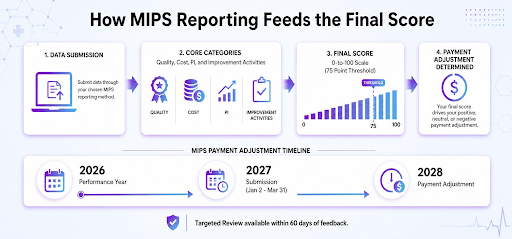
    Data submitted through any MIPS reporting method feeds the four MIPS performance categories (Quality, Cost, Promoting Interoperability, and Improvement Activities). These categories combine into a single MIPS Final Score on a 0-to-100 scale. A performance threshold of 75 points separates positive from negative payment adjustments for the 2026 performance year.

    Clinicians submit performance-year data through their chosen method during the CMS submission window, January 2 through March 31 of the following year. CMS then calculates the MIPS Final Score and releases the annual MIPS feedback report.

    CMS applies the payment adjustment two years after the performance year. Performance year 2026 affects 2028 Medicare Part B payments. Clinicians who disagree with the final score can request a Targeted Review within 60 days of feedback release.

    Pick the right method, protect your 2028 payment adjustment
    See how Macralytics helps →
    Macralytics MIPS

    How Many MIPS Reporting Methods Does CMS Approve For 2026?

    CMS approves five standard MIPS reporting methods for the 2026 performance year: Qualified Registry, EHR via CEHRT, Qualified Clinical Data Registry (QCDR), Medicare Part B claims, and the CMS Web Interface (sunsetting). Four methods remain active and broadly available. The CMS Web Interface is sunsetting and available only to legacy users.

    MIPS Value Pathways (MVPs) are not a sixth reporting method. MVPs are a parallel framework for organizing measures by specialty. Clinicians reporting an MVP still submit through one of the five reporting methods.

    For 2026, CMS finalized 27 MVPs, including 6 new specialty pathways:

    • Diagnostic Radiology
    • Interventional Radiology
    • Neuropsychology
    • Pathology
    • Podiatry
    • Vascular Surgery

    Can Clinicians Mix MIPS Reporting Methods in One Performance Year?

    Yes, across MIPS performance categories, but not within a single measure. A clinician can submit Quality measures via a Qualified Registry and PI measures via direct EHR submission. IA attestations can flow through the Registry at the same time. A single measure, for example, Quality measure #001, must be submitted entirely through one method. CMS does not aggregate partial submissions for the same measure from different reporting channels.

    What is the MIPS Registry Reporting?

    A Qualified Registry is a CMS-approved third-party vendor that collects measure data, validates it, and transmits

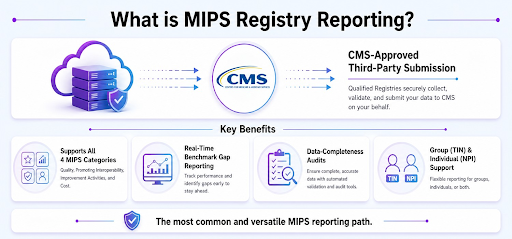
    MIPS registry reporting submits performance data to CMS through a Qualified Registry. A Qualified Registry is a CMS-approved third-party vendor that collects measure data, validates it, and transmits the final submission during the submission window.

    Registry is the most common MIPS reporting path because it supports all four performance categories. It accommodates both TIN-level (group) and NPI-level (individual) submissions, and it works across specialties.

    Beyond data transmission, a qualified registry typically provides:

    • Measure selection guidance based on the practice specialty
    • Real-time benchmark gap reporting during the performance year
    • Data-completeness audits before submission
    • Audit-prep documentation for CMS validation

    The subsections below cover what a qualified registry is, how data submission works, which MIPS categories it supports, and whether Registry reporting suits small practices. For workflow specifics, see the MIPS Registry reporting workflow details.

    What is a CMS-approved Qualified Registry?

    A Qualified Registry is a third-party vendor approved by CMS each performance year. The vendor collects, validates, and submits MIPS data on behalf of eligible clinicians and groups.

    CMS publishes an updated list of approved Qualified Registries before each performance year. Vendors must reapply annually to maintain certification, so the approved list changes year to year.

    Qualified Registries and Qualified Clinical Data Registries (QCDRs) overlap in submission capability but differ in measure scope. The QCDR section below covers the distinction.

    How Does Data Submission via Registry Work?

    Data submission via a qualified registry follows a three-step workflow: collection, validation, and transmission.

    1. Collection: Clinicians or the practice export measure data from the EHR, or enter it via a Registry portal during the performance year. Many Registries support API-based EHR integration.
    2. Validation: The Registry checks data completeness (75 percent for Quality) and measure-specific case minimums (a 20-case minimum for Quality scoring). The Registry flags missing or incomplete records before submission.
    3. Transmission: The Registry transmits the final submission to CMS during the official submission window, January 2 through March 31 of the year following the performance period.

    Groups submit at the TIN (Tax Identification Number) level. All clinicians billing under one TIN are aggregated into a single submission. Individuals submit at the NPI (National Provider Identifier) level.

    Which MIPS Categories can be Reported via Registry?

    Qualified Registries support submission for all four MIPS performance categories, though the mechanism differs by category.

    • Quality: Submitted directly through the Registry. Clinicians choose individual measures or a complete specialty measure set.
    • Cost: CMS calculates the cost from Medicare Part B claims. No Registry submission is required, though Registry feedback often includes Cost score projections.
    • Promoting Interoperability (PI): Submitted via Registry-integrated EHR data export, which requires 2015 Edition Cures Update CEHRT.
    • Improvement Activities (IA): Attested through the Registry portal. The Registry passes attestations to CMS.

    Many Registries also offer real-time benchmark gap reporting for Quality measures during the performance year, which lets practices adjust mid-year.

    Does Registry Reporting Suit Small Practices?

    Yes, Qualified Registries serve small practices well, though small practices have an additional Medicare Part B claims-based option not available to larger groups. Registries offer broader measure availability, real-time benchmark gap reporting, and centralized submission across all four MIPS categories. The trade-off is the Registry subscription cost, which claims-based reporting avoids.

    What is MIPS EHR (CEHRT) reporting?

    MIPS EHR reporting submits performance data directly from a Certified Electronic Health Record Technology (CEHRT) system to CMS. Direct submission bypasses third-party Registries when the EHR has the certification and API integration to do so.

    EHR direct submission requires the 2015 Edition Cures Update CEHRT, certified by the Office of the National Coordinator for Health Information Technology (ONC).

    The three subsections below cover:

    • The CEHRT requirement that applies to EHR reporting
    • Which MIPS categories fit the EHR submission best
    • Whether a practice can submit without leaving the EHR

    EHR direct submission suits practices with mature CEHRT integration, in-house IT capability, and predictable workflows. Practices without these often submit through a Registry that imports EHR data instead. For the requirement details, see the MIPS EHR direct submission requirements.

    What CEHRT Requirement Applies to EHR Reporting?

    EHR-based MIPS reporting in 2026 requires 2015 Edition Cures Update CEHRT, the current standard published by the Office of the National Coordinator (ONC).

    The Cures Update extends the original 2015 Edition with three additions:

    • Information-blocking compliance
    • API-based patient data access
    • Updated USCDI (United States Core Data for Interoperability) data classes

    EHR vendors publish ONC certification IDs, such as the CMS EHR Certification ID, that clinicians use to attest to CEHRT use in MIPS submissions.

    Which MIPS Categories Work Best via EHR Direct Submission?

    EHR direct submission best supports Quality, Promoting Interoperability (PI), and Improvement Activities (IA), the three categories that involve clinician-submitted data.

    • Promoting Interoperability (PI): The natural fit. PI already requires the 2015 Edition Cures Update CEHRT, regardless of submission method, so submitting PI directly from CEHRT keeps one workflow.
    • Quality (eCQM): Electronic Clinical Quality Measures (eCQMs) are extracted directly from CEHRT data using ONC-published eCQM specifications.
    • Improvement Activities (IA): Attested through the CEHRT vendor MIPS portal, where available, otherwise via a Registry.

    Cost is calculated by CMS from Medicare Part B claims. No EHR submission is required for the Cost category.

    Can a Practice Submit MIPS Without Leaving the EHR?

    Yes, when the CEHRT vendor offers an API-based MIPS submission. Most major EHR platforms certified to the 2015 Edition Cures Update include a built-in MIPS submission module. That module exports eCQM data, PI measure attestations, and IA attestations directly to CMS during the submission window. Practices using older or smaller EHRs without this capability typically submit through a Qualified Registry that imports EHR data instead.

    What is MIPS QCDR Reporting?

    MIPS QCDR reporting submits performance data through a Qualified Clinical Data Registry (QCDR). A QCDR is a specialty-aligned reporting vendor approved by CMS to submit standard MIPS measures plus non-MIPS measures specific to a clinical specialty.

    QCDRs typically focus on a clinical domain such as cardiology, gastroenterology, or ophthalmology. They offer measure sets that go beyond the standard MIPS Quality inventory.

    The four subsections below cover:

    • What a Qualified Clinical Data Registry is
    • How a QCDR differs from a Qualified Registry
    • Which specialties benefit most from QCDR reporting
    • Whether QCDR measures can replace standard MIPS measures

    QCDR-specific measures can substitute for standard MIPS Quality measures when they more accurately reflect specialty clinical work. For specialty measure detail, see MIPS QCDR reporting and specialty measures.

    What is a Qualified Clinical Data Registry?

    A Qualified Clinical Data Registry (QCDR) is a CMS-approved reporting vendor certified annually. A QCDR submits MIPS performance data and non-MIPS measures specific to a clinical specialty.

    CMS publishes an updated QCDR list before each performance year. The QCDR list is typically smaller than the Qualified Registry list because QCDRs serve narrower specialty audiences.

    Many QCDRs are operated by professional medical societies, including:

    • American College of Cardiology PINNACLE Registry
    • American Academy of Ophthalmology IRIS Registry

    How Does QCDR Differ From a Qualified Registry?

    Qualified Registries and Qualified Clinical Data Registries (QCDRs) both submit MIPS data to CMS. QCDRs hold an additional authority that Registries lack: submitting non-MIPS measures specific to a clinical specialty.

    The table below contrasts the two registry types across measure scope, specialty focus, cost, and measure relevance.

    Attribute Qualified Registry QCDR
    Measure scope Standard MIPS measures only Standard MIPS measures plus non-MIPS specialty measures
    Specialty focus Broad cross-specialty Narrow specialty focus
    Typical cost Lower subscription cost Higher cost; society membership may be required
    Measure relevance General MIPS measures Specialty measures often align with the clinician’s work

    A Registry fits cross-specialty groups, while a QCDR fits practices whose specialty measures score better than the standard inventory. For a side-by-side decision aid, see the QCDR vs Registry comparison.

    Which Specialties Benefit Most From QCDR Reporting?

    QCDR reporting benefits clinical specialties with two characteristics: limited applicable standard MIPS Quality measures, and an active specialty-society QCDR offering non-MIPS measures that better reflect specialty work.

    • Cardiology: American College of Cardiology PINNACLE Registry
    • Ophthalmology: American Academy of Ophthalmology IRIS Registry
    • Gastroenterology: American Gastroenterological Association GIQuIC Registry
    • Orthopedic Surgery: American Joint Replacement Registry
    • Anesthesiology: National Anesthesia Clinical Outcomes Registry (NACOR)
    • Otolaryngology: American Academy of Otolaryngology Reg-ent Registry

    Specialties without a dedicated QCDR typically use a Qualified Registry that covers cross-specialty MIPS measures.

    Can QCDR-Specific Measures Replace Standard MIPS Measures?

    Yes. QCDR-specific non-MIPS measures count toward the MIPS Quality performance category, alongside or in place of standard MIPS measures. CMS approves QCDR non-MIPS measures annually. Clinicians can mix-and-match standard MIPS measures with QCDR non-MIPS measures to fill the 6-measure Quality selection rule. The total still must include at least one outcome or high-priority measure, the same rule that applies to standard MIPS submission.

    What is MIPS Claims-based Reporting?

    MIPS Claims-based reporting embeds Quality measure data within regular Medicare Part B claims

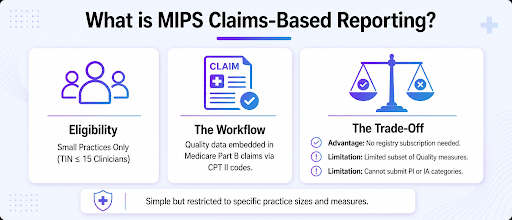
    MIPS Claims-based reporting embeds Quality measure data within regular Medicare Part B claims. The practice uses specific CPT II quality codes and modifiers to flag measure performance directly on the claim form.

    Claims-based reporting is restricted to small practices, TINs with 15 or fewer eligible clinicians. Larger groups must use Registry, EHR, or QCDR reporting.

    Claims-based reporting carries a clear trade-off:

    • Advantage: No Registry subscription is required, and submission happens through the existing claims workflow.
    • Limitation: Only a subset of MIPS Quality measures has established CPT II quality codes.
    • Limitation: PI and IA cannot be submitted via claims.

    The three subsections below cover the workflow, eligibility, and 2026 availability. For end-to-end detail, see the MIPS claims-based reporting workflow.

    How Does Medicare Part B Claims-based MIPS Submission Work?

    Claims-based MIPS submission flags Quality measure performance directly on Medicare Part B claim forms. The practice uses specific CPT Category II (CPT II) quality codes and quality data codes.

    When a clinician provides a service that qualifies for a MIPS Quality measure denominator, the practice adds the appropriate CPT II quality code to the claim line. The code indicates whether the measure was met, not met, or excluded for medical reasons.

    Two features distinguish claims-based timing:

    • Claims-based data is captured continuously throughout the performance year as claims are submitted, unlike the formal window used by Registry or EHR submission.
    • CMS aggregates claims-based MIPS data automatically at year-end, so no separate submission step is required.

    Which Clinicians Are Eligible For Claims-Based Reporting?

    Medicare Part B claims-based MIPS reporting is restricted to small practices, TINs with 15 or fewer eligible clinicians.

    CMS determines small-practice status at the TIN level using the MIPS Determination Period. A practice is small for a performance year if its TIN-level eligible clinician count was 15 or fewer during that period.

    Key Rule: Practice size is fixed at the TIN level for the year, while individual clinicians retain an NPI-level option.

    Larger groups generate too many claims to reliably aggregate via the CPT II quality code workflow. CMS requires Registry, EHR, or QCDR submission for accuracy at scale. Within a small practice, individual clinicians can report at the NPI level via claims if they prefer NPI-level scoring over TIN-level group aggregation.

    Is Claims-Based Reporting Still Available in 2026?

    Yes, CMS retained Medicare Part B claims-based MIPS reporting for small practices, TINs with 15 or fewer eligible clinicians, in the 2026 performance year. Claims-based reporting is the only MIPS submission method with no per-year vendor cost. That keeps it attractive for small practices despite its limitation to a subset of MIPS Quality measures.

    What is the CMS Web Interface, and is it still available for 2026?

    The CMS Web Interface was historically the fifth MIPS reporting method. It was a CMS-operated web portal where large groups, particularly Shared Savings Program (SSP) Accountable Care Organizations (ACOs), submitted Quality and PI measure data directly.

    The CMS Web Interface served as the primary submission path for SSP ACOs and certain large groups through performance year 2024. It supported standardized measure sets with pre-defined sampling protocols.

    The sunsetting of the Web Interface followed a fixed timeline:

    • Performance year 2024 was the final year the CMS Web Interface was available as a collection type for SSP ACOs reporting under the APM Performance Pathway.
    • Beginning in 2025, former users report through a Qualified Registry, the APM Performance Pathway (APP), or MIPS Value Pathways.
    • ACOs now report eCQMs, MIPS CQMs, or Medicare CQMs under the APP.

    For the complete sunset timeline and replacement pathways, see the CMS Web Interface MIPS reporting status page.

    How do MIPS Value Pathways (MVPs) Differ From Traditional reporting methods?

    MIPS Value Pathways (MVPs) are not a sixth reporting method. MVPs are a CMS-designed framework that bundles MIPS measures by specialty or condition. Clinicians reporting an MVP still submit through one of the five reporting methods (Registry, EHR, QCDR, claims, or Web Interface legacy).

    Each MVP pre-selects Quality, IA, and Cost measures relevant to a specialty such as Cardiology or Endocrinology. Promoting Interoperability remains a mandatory foundation layer across all MVPs.

    For 2026, CMS finalized 27 MVPs, including 6 new specialty pathways: Diagnostic Radiology, Interventional Radiology, Neuropsychology, Pathology, Podiatry, and Vascular Surgery. CMS also modified all 21 existing MVPs.

    Registration mechanics for the 2026 performance year:

    • Election window: April 1 through November 30, 2026.
    • Multispecialty groups must register at the subgroup, individual, or APM Entity level, a 2026 change.
    • Multispecialty small practices may still report an MVP at the group level, with subgroup formation optional.

    For the complete 2026 MVP list and per-specialty fit, see the MIPS Value Pathways guide.

    Which MIPS Reporting Method Should a Practice Choose?

    Choosing a MIPS reporting method depends on five practice characteristics: practice size, specialty alignment, CEHRT maturity, measure availability, and tolerance for per-year vendor cost.

    1. Practice size: Small practices (TIN 15 or fewer) qualify for claims-based reporting. Larger groups need Registry, EHR, or QCDR.
    2. Specialty alignment: Specialties with strong specialty-society QCDRs, such as cardiology or ophthalmology, benefit from QCDR non-MIPS measure access.
    3. CEHRT maturity: Practices with 2015 Edition Cures Update CEHRT and in-house IT can use direct EHR submission to skip the Registry layer.
    4. Measure availability: Cross-specialty access via Registry, specialty-only access via QCDR, or the limited claims-based subset.
    5. Per-year cost: Claims-based avoids vendor subscriptions, while Registries and QCDRs carry annual fees.

    Most groups land on Registry as the default. Specialty practices pivot to QCDR. Small practices weigh claims-based against Registry. CEHRT-mature practices add direct EHR submission.

    What Kinds of Practices Use Each MIPS Reporting Method?

    Each MIPS reporting method has a typical practice profile that gravitates toward it. The table below maps the method to profile and the reason for the fit.

    Method Typical practice profile Why it fits
    Qualified Registry Multi-specialty groups, mid-to-large practices, and practices new to MIPS Cross-specialty coverage; benchmark gap reporting; one submission for all four categories
    EHR (CEHRT) CEHRT-mature practices with in-house IT; large health systems Direct API submission; integrated workflow; native PI fit
    QCDR Single-specialty groups (cardiology, ophthalmology, GI, ortho, anesthesia) Specialty-society alignment; non-MIPS measures; specialty benchmark feedback
    Medicare Part B Claims Small practices (TIN 15 or fewer); rural or HPSA practices on tight budgets No vendor subscription; embedded in the existing claims workflow
    CMS Web Interface Legacy SSP ACOs (sunset) Historical fit only; no new enrollment

    Practice size and specialty drive most method decisions, with cost and CEHRT maturity acting as tiebreakers.

    How Does Reporting-Method Choice Affect MIPS Final Score?

    Reporting-method choice does not change the maximum achievable MIPS Final Score (0-to-100 scale). Method choice affects three score-determining factors: measure availability, data-completeness ceilings, and benchmark options.

    1. Measure availability: A QCDR may offer specialty non-MIPS measures that score higher than standard measures in the practice specialty. A Registry offers a broader choice. Claims-based offers the narrowest subset.
    2. Data-completeness ceilings: Registries and EHR-based submission can validate 100 percent data completeness across the calendar year. Claims-based completeness is bounded by the encounters actually billed to Medicare Part B.
    3. Benchmark options: Each measure has separate decile benchmarks for each collection type (MIPS CQM via Registry, eCQM via EHR, claims-based, QCDR-specific). Method choice affects which benchmark applies.

    In practice, QCDR plus Registry often produces the highest achievable Quality score for specialty-aligned practices. Claims-based caps the achievable score for small practices that prefer not to subscribe to a vendor.

    How Does Macralytics Support MIPS Data Submission Across all 5 methods?

    MIPS data submission through a four-step service workflow that adapts to the practice's preferred reporting

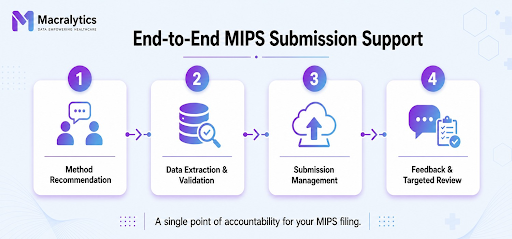
    Macralytics supports MIPS data submission through a four-step service workflow that adapts to the practice’s preferred reporting method.

    1. Method recommendation: Based on practice size, specialty, CEHRT maturity, and budget, Macralytics identifies the highest-yielding reporting method. This is typically the Macralytics Qualified Registry for most groups, or a QCDR partner for specialty practices.
    2. Data extraction and validation: Data is exported from the practice EHR when applicable or entered via the Macralytics portal. The team validates data completeness, case minimums, and audit-prep documentation.
    3. Submission: Data is transmitted to CMS through the chosen method during the January 2 through March 31 submission window.
    4. Feedback review: After CMS releases the annual MIPS feedback report, the team reviews attribution accuracy and files Targeted Reviews if discrepancies appear.

    Practices that prefer a single point of accountability can let Macralytics handle the filing end-to-end, and we submit it for you.

    Will MIPS Value Pathways (MVPs) Replace the Five Traditional MIPS Reporting Methods?

    No, MIPS Value Pathways (MVPs) are not replacing the five traditional MIPS reporting methods.

    MVPs are a measure-bundling framework, not a replacement for the five reporting methods. Clinicians reporting an MVP still submit data through one of the five traditional methods: Registry, EHR, QCDR, claims, or Web Interface legacy.

    Two points define the current direction:

    • CMS has signaled that MVPs will become the preferred MIPS reporting organization over time, to phase out open measure-selection Traditional MIPS for most clinicians. The reporting methods themselves remain in place.
    • For the 2026 performance year, both Traditional MIPS and MVP paths remain available. MVPs are voluntary for the 2026 performance year, except for specific MVP requirements applied to certain APM Entity participants.

    MIPS Reporting Methods at a Glance for 2026

    MIPS Reporting Methods are the five CMS-approved channels for submitting performance data under the Merit-Based Incentive Payment System: Qualified Registry, EHR via CEHRT, QCDR, Medicare Part B claims, and the sunsetting CMS Web Interface. Most groups land on Registry as the default. Specialty practices pivot to QCDR. Small practices weigh claims-based against Registry. CEHRT-mature practices add direct EHR submission. MIPS Value Pathways run alongside as a parallel framework that uses the same five reporting methods underneath. For broader context, see the Merit-Based Incentive Payment System (MIPS) guide.