EHR-based MIPS reporting means submitting MIPS data directly from a Certified EHR (CEHRT) to the Centers for Medicare & Medicaid Services (CMS). Three performance categories move through the EHR: Quality, Promoting Interoperability, and Improvement Activities.
CMS calculates Cost from Medicare Part B claims instead. Submission happens in the QRDA III format, by file upload on qpp.cms.gov or through an API. The submitting EHR must be certified to the ONC health IT certification criteria at 45 CFR 170.315.
What is EHR-based MIPS reporting?
EHR-based MIPS reporting is the direct submission of MIPS data from a Certified EHR (CEHRT) to CMS. The practice keeps quality data inside one system, from point of capture through final submission. No third-party intermediary handles the file and reporting responsibility stays with the clinician and the certified EHR.
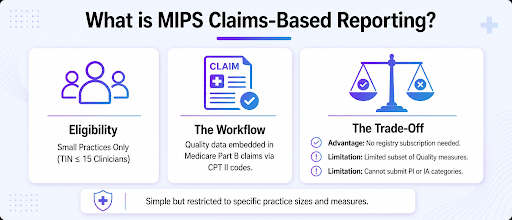
EHR reporting is one of several reporting methods available for the 2026 performance year. The others are the Qualified Registry, a Qualified Clinical Data Registry (QCDR), and Medicare Part B claims measures. Medicare Part B claims measures are limited to small practices of 15 or fewer clinicians.
EHR reporting fits practices that:
Run one certified EHR across the whole tax identification number (TIN)
Want direct control of the data submitted to CMS
Already capture eCQM, Promoting Interoperability and Improvement Activities data in structured fields
Prefer to avoid third-party intermediary fees and submission timelines
The CMS Web Interface no longer appears in that list. CMS retired the CMS Web Interface as a quality collection type beginning with the 2025 performance year. Older MIPS guides that still name five reporting methods are out of date.
What is Certified EHR Technology (CEHRT)?
Certified EHR Technology (CEHRT) is electronic health record software certified under the ONC Health IT Certification Program. For the 2026 performance year, CEHRT functionality must meet the ONC health IT certification criteria at 45 CFR 170.315.
CMS retired the yearly edition naming convention. The CY2024 Physician Fee Schedule final rule aligned the Base EHR definition with the ONC HTI-1 rule. The 2015 Edition Cures Update label gave way to a single, edition-less criteria set at 45 CFR 170.315.
CEHRT does two jobs in MIPS:
Promoting Interoperability cannot be scored without CEHRT, whatever the submission path
Quality reporting through eCQMs requires the CMS EHR Certification ID from the Certified Health IT Product List (CHPL)
Which MIPS categories can you report through an EHR?
Three of the four MIPS performance categories move through the certified EHR. The fourth is calculated by CMS with no practice action.
Performance Category
Reportable Through the EHR?
How the Data Moves
2026 Weight
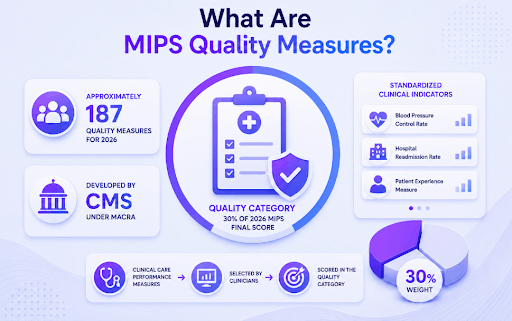
Quality
Yes, as eCQMs
QRDA III file generated by the CEHRT
30%
Promoting Interoperability
Yes, and CEHRT is required
Measure numerators, denominators and attestations
25%
Improvement Activities
Yes, by attestation
Yes or No attestation per activity
15%
Cost
No
CMS calculates from Medicare Part B claims
30%
One submission can carry all three reportable categories. Cost accounts for 30% of the final score without a single submitted record.
Can you report the Cost category through your EHR?
No. The Cost category is never submitted through an EHR, or through any other reporting method. CMS calculates Cost automatically from Medicare Part B claims already on file. Through the certified EHR, the practice submits Quality, Promoting Interoperability and Improvement Activities only.
How does EHR reporting fit into the MIPS reporting methods?
EHR reporting is one of several MIPS reporting methods, and the reporting-methods hub compares each one. The method chosen changes which measures are available and how each measure scores. The same clinical performance can score differently by collection type.
Method choice is not all-or-nothing. A practice can combine collection types inside the Quality category, reporting some measures as eCQMs and others through a registry. CMS scores each submission received and keeps the highest result.
What the method decides:
Which quality measures are available to report
Which benchmark each measure scores against
Who holds responsibility for validating the file before submission
Whether the practice pays a third-party intermediary fee
Compare the full set of options on the MIPS reporting methods hub before locking a submission plan for 2026.
How does EHR-based MIPS reporting work?
EHR-based MIPS reporting runs on a four-step workflow inside the certified EHR. Configuration happens before the performance period. Capture runs across the performance period. Export and submission happen after the performance period closes.
Each step depends on the one before it. An EHR that is not certified by the last day of the performance period cannot produce a scoreable file. Measures that were never mapped will not populate the export.
2026 timeline anchors:
Quality performance period: January 1 to December 31, 2026
Last start date for a 180-day Promoting Interoperability period: July 5, 2026
Submission window: January 4 to March 31, 2027
CEHRT Configuration and Measure Mapping
Step 1 confirms the EHR meets the ONC health IT certification criteria at 45 CFR 170.315. The practice then maps each selected eCQM to the structured fields that feed it. Promoting Interoperability measures and Improvement Activities are configured in the same pass. Unmapped fields produce empty numerators at export.
Data Capture During the Performance Year
Step 2 runs the length of the performance period. The CEHRT captures eCQM data as clinicians document care in structured fields. Free-text documentation does not count toward an eCQM numerator. Monthly measure reports catch capture drift while the data set is still open.
QRDA III File Generation
Step 3 exports the aggregated results as a QRDA III file. QRDA III is the CMS Quality Reporting Document Architecture Category III standard for aggregate MIPS data. The file carries measure results at the TIN or TIN/NPI level, not patient-level detail. The 2026 CMS QRDA III Eligible Clinicians Implementation Guide governs the format.
Direct Submission to CMS (File Upload or API)
Step 4 delivers the file to CMS between January 4 and March 31, 2027. The practice signs in to qpp.cms.gov and uploads the QRDA III file. Direct API submission is a separate path, performed by an authorized third-party intermediary or health IT vendor. CMS scores every submission received and applies the highest score.
What are the direct submission requirements?
Direct submission carries requirements across four areas, and each one is checked before a score is issued. Three concern the technology and the file. One concerns the volume of data behind each quality measure.
Requirement
2026 Standard
Applies To
EHR certification
ONC health IT certification criteria, 45 CFR 170.315
Quality (eCQM), Promoting Interoperability
Certification identifier
CMS EHR Certification ID from the CHPL
Quality (eCQM), Promoting Interoperability
File format
QRDA III, per the 2026 CMS QRDA III EC Implementation Guide
A miss on certification or on the CMS EHR Certification ID zeroes the Promoting Interoperability category outright.
CEHRT Certified to ONC Criteria (45 CFR 170.315)
The EHR must have certified functionality in place on the first day of the performance period. Certification must be complete by the last day of that period. Submission also requires the CMS EHR Certification ID, generated on the Certified Health IT Product List (CHPL).
QRDA III Format
MIPS data leaves the EHR as a QRDA III extensible markup language (XML) file. The 2026 CMS QRDA III Eligible Clinicians Implementation Guide, version 1.1, sets the conformance rules. Files that fail the CMS Schematron validation are rejected before scoring.
Performance Periods (Quality 12 Months / PI 180 Days / IA 90 Days)
Each category carries a different minimum data window in 2026. Quality runs the full calendar year, January 1 to December 31, 2026. Promoting Interoperability requires a minimum of 180 continuous days, making July 5, 2026 the last possible start date. Improvement Activities require a minimum of 90 continuous days.
Data Completeness (75% Threshold)
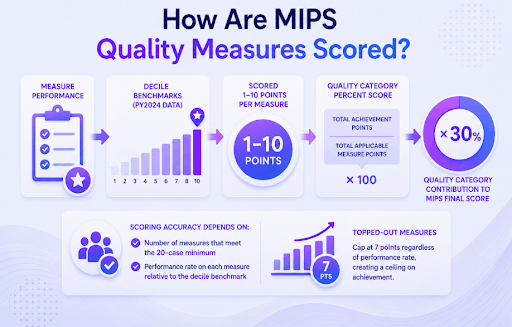
Quality measures submitted as eCQMs must report on at least 75% of eligible encounters. The 75% threshold counts patients across all payers, not Medicare patients alone. CMS holds the threshold at 75% through the 2028 performance year. A measure below 75% scores minimal points.
Does your EHR still need 2015 Edition Cures Update certification for 2026?
Not under that name. CMS retired the edition naming convention starting with the 2024 performance year. The requirement for 2026 is CEHRT functionality meeting the ONC health IT certification criteria at 45 CFR 170.315. Products previously certified to the 2015 Edition Cures Update criteria were folded into that single criteria set. An EHR that never made the update cannot be scored for Promoting Interoperability.
How do you meet Promoting Interoperability (PI) through your EHR?
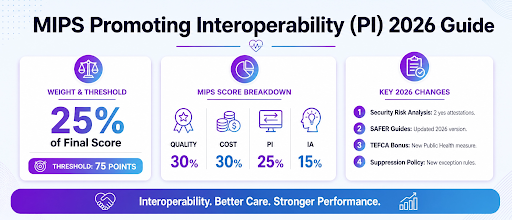
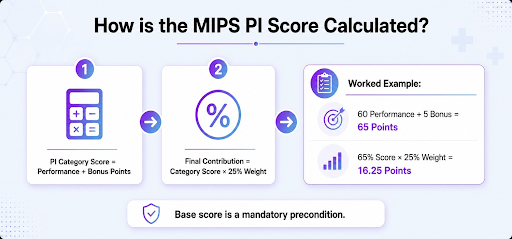
Promoting Interoperability is the MIPS category that requires a Certified EHR, so the EHR method is the natural fit. Promoting Interoperability carries 25% of the final score in 2026 for most participants.
The category covers five objectives. Those objectives are Electronic Prescribing, Health Information Exchange, Provider to Patient Exchange, Public Health and Clinical Data Exchange, and Protect Patient Health Information. Six or seven measures are required, depending on the Health Information Exchange option selected.
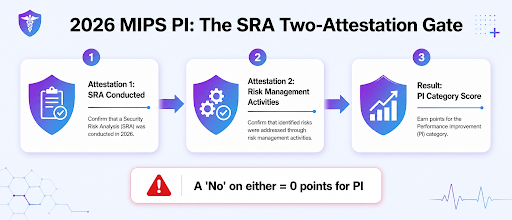
Four attestations gate the category in 2026:
Security Risk Analysis, now carrying a second attestation on security risk management
Annual self-assessment against the 2025 High Priority Practices SAFER Guide
Actions to Limit or Restrict Interoperability of CEHRT
ONC Direct Review
A “No” response on any of these attestations scores the entire category at zero. Measure-level requirements and scoring sit on the Promoting Interoperability category page.
When should you use Registry reporting instead of an EHR?
A Qualified Registry is a done-for-you alternative when a third party should validate and submit the data. The registry collects MIPS CQM data from the practice, applies current CMS specifications, and submits on the practice’s behalf.
Many registries pull directly from the EHR, which is where the confusion starts. A registry submission is not an EHR submission. The collection type changes from eCQM to MIPS CQM, and the benchmark changes with it.
Choose a registry when:
The EHR is not certified, or certification lapses mid-year
Needed measures exist as MIPS CQMs but not as eCQMs
Clinicians span multiple EHRs under one TIN
Data validation should sit with a vendor rather than the practice
A Qualified Clinical Data Registry (QCDR) is the choice when specialty or non-MIPS measures are needed that an EHR cannot report. A QCDR develops and maintains its own measures, approved by CMS each year.
That measures inventory is the difference. QCDR measures are built for specialty workflows where the standard MIPS measure sets scores poorly or does not apply. Surgical, interventional and behavioral health specialties use QCDRs most heavily.
Choose a QCDR when:
Specialty measures outperform the general MIPS measure set
The EHR cannot produce the measures the specialty actually needs
Benchmarks on available eCQMs are topped out and score poorly
Approval status and measure inventories sit on the QCDR MIPS reporting page.
Which EHRs support direct MIPS submission?
Most major certified EHRs support direct MIPS submission, including Epic, athenahealth, eClinicalWorks, Kareo/Tebra and Allscripts. Support means the EHR can generate a conformant QRDA III file for upload to qpp.cms.gov. Certification status is verifiable on the Certified Health IT Product List (CHPL).
One distinction matters at submission time. Uploading a QRDA III file is something the practice does directly.
An EHR vendor can only submit through the API on a practice’s behalf if that vendor is a CMS-approved third-party intermediary.
Vendor-specific configuration steps sit on the MIPS reporting by EHR software pages.
Is a Certified EHR required to report MIPS?
Not for every category. MIPS data can reach CMS through a Qualified Registry, a QCDR, or Medicare Part B claims, with no direct EHR submission involved. The Promoting Interoperability category is the exception. Promoting Interoperability requires Certified EHR Technology (CEHRT) regardless of submission method, because the category measures use of a certified EHR.
A practice without CEHRT can still report Quality and Improvement Activities. Promoting Interoperability then scores zero unless the practice qualifies for automatic reweighting or an approved hardship exception. Small practices, hospital-based clinicians, ASC-based clinicians and non-patient-facing clinicians receive automatic reweighting.
How does Macralytics set up EHR-based MIPS reporting?
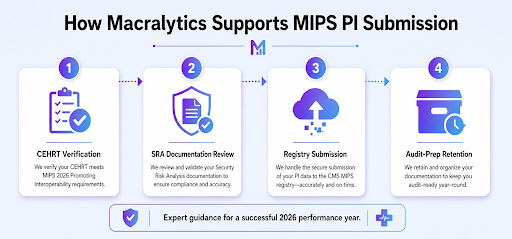
Macralytics connects a certified EHR to CMS for direct MIPS submission. Work runs in four stages across the performance year.
Confirm the EHR meets the ONC health IT certification criteria at 45 CFR 170.315 and pull the CMS EHR Certification ID from the CHPL.
Map eCQM, Promoting Interoperability and Improvement Activities data to the structured fields that feed each measure.
Generate the QRDA III file and validate it against the 2026 CMS Schematron before the submission window opens.
Submit through qpp.cms.gov and confirm acceptance in the submission record.
Scope and timelines for the setup and validation work sit on the EHR integration for MIPS page.
Reporting MIPS through a Certified EHR (CEHRT) puts Quality, Promoting Interoperability and Improvement Activities into one workflow. That workflow ends with a QRDA III file submitted to CMS. Cost stays claims-calculated. The method suits practices running one certified EHR that want direct control of the file. A Qualified Registry or QCDR fits better where measure availability or validation capacity is the constraint. Compare each option on the MIPS reporting methods hub before the 2026 submission window opens.
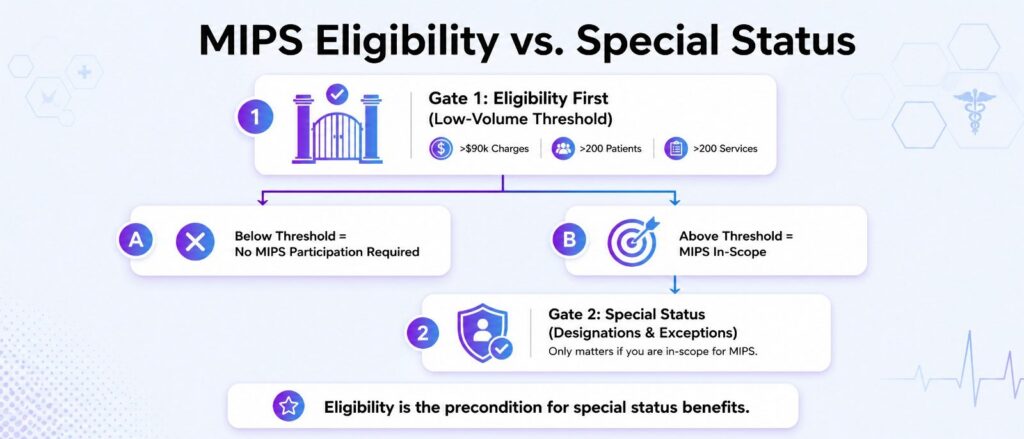
The MIPS low-volume threshold is the Medicare Part B volume test that decides whether an eligible clinician must report MIPS. It has three criteria for 2026. The tests are more than $90,000 in Part B allowed charges, more than 200 Part B beneficiaries, and more than 200 covered professional services. A clinician must exceed all three to be required to report. Falling at or below any one criterion excludes the clinician, who may opt in or report voluntarily.
What Is The MIPS Low-Volume Threshold?
The MIPS low-volume threshold is the volume test that, together with the clinician-type test, determines whether a clinician is required to report MIPS. The low-volume threshold measures Medicare Part B activity across three dimensions: allowed charges, beneficiaries served, and covered professional services furnished. A clinician clears the volume gate only by exceeding every dimension.
The low-volume threshold works alongside the clinician-type test, and a clinician must satisfy both gates. The low-volume threshold is not the MIPS performance threshold. The MIPS performance threshold is a 75-point scoring benchmark that sets payment adjustments, not eligibility.
How Does The Low-Volume Threshold Decide If You Must Report MIPS?
A clinician must exceed all three low-volume criteria and be an eligible clinician type to be required to report MIPS. Exceeding all three volume criteria makes reporting mandatory for that performance year. Sitting at or below any single criterion excludes the clinician from the reporting requirement.
The exclusion applies even when the other two criteria are exceeded by a wide margin. This all-or-nothing structure is the core of the low-volume threshold. The full Required, Excluded, Opt-in, and Voluntary outcomes appear in the decision table further down this page.
Does The Low-Volume Threshold Apply To Your Clinician Type?
Only if your clinician type is MIPS eligible. The low-volume threshold applies after the clinician-type test. If your type is not on the CMS list, you are excluded regardless of volume. If your type qualifies, the low-volume threshold then decides whether reporting is required. Confirm your designation against the current MIPS eligible clinician types before checking volume.
How Does The Low-Volume Threshold Fit Into The MIPS Eligibility Criteria?
The low-volume threshold is one of the tests inside the broader MIPS eligibility criteria, alongside the clinician-type test and the new-enrollee and QP exemptions. The clinician-type test screens the role first. The low-volume threshold screens billing volume second.
Two further exemptions sit inside the same framework:
New Medicare enrollees are excluded for their first partial year of Medicare participation.
Qualifying APM Participants (QPs) are excluded because they report through an Advanced Alternative Payment Model.
The low-volume threshold does not override either exemption, even when a clinician exceeds all three volume criteria.
Each test resolves a different eligibility question, and CMS applies the tests together. For the full framework, including the clinician-type test and both exemptions in depth, see the MIPS eligibility criteria.
What Are The Three Low-Volume Threshold Criteria?
The three low-volume threshold criteria for 2026 are unchanged from 2025. Each criterion uses a “more than” operator, so the exact threshold value alone does not trigger the requirement. The table below lists each criterion, its 2026 threshold, and what CMS counts.
Criterion
2026 Threshold
What CMS Counts
Medicare Part B allowed charges
More than $90,000
Allowed charges for covered professional services
Medicare Part B beneficiaries
More than 200
Distinct Part B-enrolled patients served
Covered professional services
More than 200
Services furnished to Part B beneficiaries
A clinician who bills exactly $90,000, serves exactly 200 beneficiaries, or furnishes exactly 200 services does not exceed that criterion.
Medicare Part B Allowed Charges (More Than $90,000)
Criterion 1 is more than $90,000 in Medicare Part B allowed charges for covered professional services during the determination period. Allowed charges are the CMS-approved amounts, not the amounts a clinician bills. A clinician at or below $90,000 in allowed charges does not exceed this criterion.
Medicare Part B Beneficiaries (More Than 200)
Criterion 2 is care provided to more than 200 Medicare Part B-enrolled beneficiaries during the determination period. CMS counts distinct beneficiaries, so repeat visits by one patient count once. A clinician serving 200 or fewer beneficiaries does not exceed this criterion.
Covered Professional Services (More Than 200)
Criterion 3 is more than 200 covered professional services furnished to Part B beneficiaries during the determination period. Covered professional services are services billed under the Medicare Physician Fee Schedule. A clinician furnishing 200 or fewer covered professional services does not exceed this criterion.
How Are The Three Criteria Combined To Determine Eligibility?
CMS combines the three criteria with AND logic. A clinician is required to report MIPS only when they exceed all three during the determination period. The number of criteria a clinician exceeds sets four distinct outcomes, mapped in the table below.
Volume Result
MIPS Status
Reporting Path and Adjustment
Exceeds all three criteria
Required
Must report; receives a payment adjustment
At or below any one criterion
Excluded
Not required to report
Exceeds one or two criteria
Excluded, opt-in available
May opt in (irrevocable) and receive an adjustment
Exceeds none of the criteria
Excluded, voluntary only
May report voluntarily; no payment adjustment
Exceeding two of three criteria still leaves a clinician excluded, because AND logic requires all three.
Working example. A nurse practitioner bills $120,000 in allowed charges, which exceeds $90,000. The same clinician serves 250 beneficiaries, which exceeds 200. The clinician furnishes 180 covered professional services, which does not exceed 200. This clinician exceeds two of three criteria. The clinician is not required to report, but may opt in.
Two other exclusions sit outside this volume math. New Medicare enrollees and Qualifying APM Participants are excluded on separate grounds, treated in depth within the overall MIPS eligibility criteria.
How Does MIPS Opt-In Work If You Exceed Some But Not All Criteria?
Clinicians who fall below the full threshold have two paths: opt-in or voluntary reporting. The path depends on how many criteria the clinician exceeds. The two paths carry different consequences for payment adjustments.
Opt-In Election (Exceed One or Two Criteria)
Clinicians and groups that exceed one or two criteria may make an opt-in election. The election is submitted in the QPP portal and is irrevocable for the performance year. An opt-in clinician receives a MIPS payment adjustment, positive or negative, based on the final score. Opt-in suits practices confident of scoring above 75 points.
Voluntary Reporting (Exceed None)
Clinicians who exceed none of the three criteria may report voluntarily. Voluntary reporting returns performance feedback and reporting experience. Voluntary reporting does not carry a MIPS payment adjustment, positive or negative. Practices use voluntary reporting to prepare for a future year when volume rises above the threshold.
When Does CMS Determine Your Low-Volume Status?
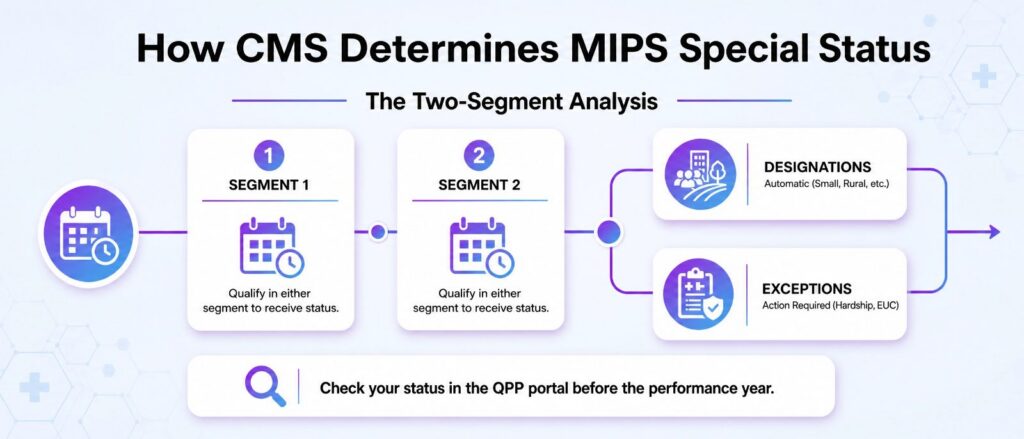
CMS evaluates low-volume status across two 12-month determination segments. Being at or below the threshold in either segment excludes the clinician for the year. CMS draws the data from Medicare Part B claims and PECOS enrollment records. The two 2026 segments use fixed dates.
Determination Segment
Date Range (2026 Performance Year)
Segment 1
October 1, 2024 to September 30, 2025
Segment 2
October 1, 2025 to September 30, 2026
Determination Segment 1 (October 1, 2024 – September 30, 2025)
Segment 1 is the first 12-month claims window CMS uses for 2026 eligibility. CMS released initial 2026 status from Segment 1 in 2025. A clinician below the threshold in Segment 1 is excluded for 2026.
Determination Segment 2 (October 1, 2025 – September 30, 2026)
Segment 2 is the second 12-month window and captures clinicians who join a new practice mid-year. CMS publishes final 2026 eligibility from Segment 2 in December 2026. A new TIN is evaluated in Segment 2 only.
How Does The Threshold Apply To Groups And APM Entities?
The low-volume threshold is calculated at the TIN/NPI level for individuals and at the TIN level for groups. The unit of measurement changes the result. A clinician excluded as an individual can still enter MIPS through a reporting group.
CMS applies three calculation units:
Individual: volume is summed for one TIN/NPI combination.
Group: volume is summed across all clinicians billing under a single TIN.
APM Entity group: volume is assessed collectively for the entity’s participants.
A group that exceeds the low-volume threshold as a whole must report at the group level. Virtual groups follow the same collective calculation. Group-level reporting mechanics sit outside this page.
Did The MIPS Low-Volume Threshold Change For 2026?
No. The three low-volume-threshold criteria are unchanged for the 2026 performance year. More than $90,000 in allowed charges, more than 200 beneficiaries, and more than 200 covered professional services remain the tests. CMS confirmed the stability in the CY2026 Physician Fee Schedule Final Rule, published November 5, 2025.
The low-volume threshold is not the MIPS performance threshold. The MIPS performance threshold remains 75 points and governs scoring, not eligibility. CMS committed to holding the 75-point performance threshold through the 2028 performance year.
How Does Macralytics Check Your Low-Volume Threshold Status?
Macralytics calculates each clinician’s low-volume status before the reporting year. The process follows four steps:
Pull Medicare Part B charges, beneficiaries, and services per TIN/NPI.
Test each figure against the three criteria across both determination segments.
Flag each clinician as required, excluded, opt-in eligible, or voluntary.
Advise on the opt-in decision where a clinician exceeds one or two criteria.
The output tells a practice who must report and where an opt-in election changes the payment outcome. Run a MIPS eligibility check before the performance year begins.
CMS recognizes about 15 clinician types as MIPS eligible for the 2026 performance year. The list runs from physicians and physician assistants to nurse practitioners, therapists, clinical social workers, and registered dietitians.
CMS reads your clinician type from the specialty codes on Medicare Part B claims under each Taxpayer Identification Number and National Provider Identifier (TIN/NPI). You must exceed the low-volume threshold and avoid other exemptions to report MIPS. Being an eligible type is necessary but not sufficient.
What Is a MIPS Eligible Clinician?
A MIPS eligible clinician is a clinician whose professional type appears on the CMS MIPS-eligible list. That clinician must also exceed the low-volume threshold without qualifying for an exemption. Eligibility rests on a three-part test: the correct clinician type, volume above the threshold, and no applicable exemption.
CMS reads each clinician type from the specialty codes on Medicare Part B claims. The MIPS term “eligible clinician” is not the legacy term “eligible professional” from Meaningful Use. Those two terms describe different programs and should not be used interchangeably.
How Does CMS Determine Your Clinician Type?
CMS determines your clinician type from the specialty codes on the Medicare Part B claims billed under your TIN/NPI combination. CMS assigns type at the TIN/NPI level, meaning per clinician per practice.
A clinician who bills under two Tax Identification Numbers holds two separate evaluations. Each TIN/NPI combination receives its own clinician-type reading and its own eligibility result.
Does Being An Eligible Clinician Type Mean You Must Report Mips?
No. Being an eligible clinician type is necessary but not sufficient. You are required to report MIPS only if you also exceed all three low-volume-threshold criteria and avoid other exemptions. Common exemptions include a new Medicare enrollee or a Qualifying APM Participant.
How Do Eligible Clinicians Fit Into The Mips Eligibility Criteria?
The clinician-type list is the first of three eligibility tests CMS applies. The full criteria add the low-volume threshold and the exemption checks. This page owns the type question. It states the other two tests as the border and hands the detail to the parent hub.
Clinician type: your specialty type appears on the CMS MIPS-eligible list.
Low-volume threshold: your Part B volume exceeds all three threshold criteria, which are ($90,000 earned in performance year, 200 services & 200 Medicare Part B patients).
Exemption check: you are not a new enrollee, a QP, or otherwise excluded.
Only clinicians who clear all three tests are required to report MIPS. The MIPS eligibility criteria hub covers the full framework, including the threshold math and the exemption rules.
Which Clinician Types Are Mips Eligible?
CMS recognizes about 15 clinician types as MIPS eligible for the 2026 performance year. The table below lists each type, its acronym, and the year it joined the MIPS-eligible list. The four groups that follow organize these types by clinical function.
CMS groups several doctoral degrees under the physician category. This group covers doctors of medicine (MD) and doctors of osteopathy (DO), including osteopathic practitioners. It also covers dental degrees (DDS, DMD), podiatric medicine (DPM), and optometry (OD). Chiropractors also count as MIPS eligible clinician types. All have been eligible since the 2017 program launch.
Advanced-Practice And Nursing Clinicians (Pa, Np, Cns, Crna, Cnm)
This group covers advanced-practice and nursing clinicians. It includes physician assistants (PA), nurse practitioners (NP), and clinical nurse specialists (CNS). It also includes certified registered nurse anesthetists (CRNA) and certified nurse-midwives (CNM). CMS added certified nurse-midwives to the MIPS-eligible list for the 2022 performance year.
Therapy And Rehabilitation Clinicians (Pt, Ot, Slp, Audiologists)
This group covers therapy and rehabilitation clinicians. It includes physical therapists (PT), occupational therapists (OT), qualified speech-language pathologists (SLP), and qualified audiologists. CMS added all four therapy types to the MIPS-eligible list for the 2019 performance year. Many therapy clinicians bill low Medicare volume and fall below the reporting threshold.
Behavioral-Health And Nutrition Clinicians (Clinical Psychologists, Clinical Social Workers, Rd/Nutrition Professionals)
This group covers behavioral-health and nutrition clinicians. It includes clinical psychologists, clinical social workers (CSW), and registered dietitians or nutrition professionals (RD). CMS added clinical psychologists and registered dietitians for the 2019 performance year. CMS added clinical social workers to the MIPS-eligible list for the 2022 performance year.
Do Nurse Practitioners And Physician Assistants Qualify For Mips?
Yes. Nurse practitioners (NP) and physician assistants (PA) are both MIPS-eligible clinician types. Like every eligible type, an NP or PA is required to report only after exceeding the low-volume threshold under their TIN/NPI.
An NP or PA below the threshold is exempt but may opt in. CMS evaluates each NP and PA separately at every practice they bill under.
Do Therapists And Psychologists Qualify For Mips?
Yes. Physical therapists (PT), occupational therapists (OT), qualified speech-language pathologists (SLP), and clinical psychologists are all MIPS-eligible clinician types. Each type is required to report only after exceeding the low-volume threshold. Many therapy clinicians and psychologists bill low Part B volume. Those below the threshold are exempt or may opt in.
Which Clinicians Are Not Mips Eligible?
Being on the CMS list does not guarantee a reporting requirement. Four groups fall outside MIPS eligibility for the 2026 performance year. The four exclusion zones below cover each case.
Clinician Types Not On The Cms List
Clinicians whose specialty type does not appear on the CMS list are excluded from MIPS. These clinicians receive no MIPS payment adjustment. The specialty codes on their Medicare Part B claims determine this outcome.
New Medicare Enrollees (On Or After January 1, 2026)
Clinicians who enroll in Medicare for the first time on or after January 1, 2026 are excluded from MIPS for the 2026 performance year. The exclusion lasts until the clinician has a full year of Medicare Part B billing history.
Clinicians Below The Low-Volume Threshold
Clinicians who do not exceed all three low-volume-threshold criteria are not required to report MIPS. The three criteria are Part B allowed charges, Part B beneficiaries, and covered professional services. The low-volume threshold page explains each criterion and the exact 2026 values.
Qualifying APM Participants (QPs)
Clinicians who reach Qualifying APM Participant (QP) status through an Advanced Alternative Payment Model are exempt from MIPS. A QP earns Advanced APM incentives instead of a MIPS payment adjustment. CMS makes QP determinations several times each performance year.
How And When Does Cms Determine Your Mips Eligibility?
CMS determines MIPS eligibility at the TIN/NPI level across two determination periods each performance year. Each review analyzes a separate 12-month segment of Medicare Part B claims. The two 2026 review windows appear below.
Determination Review
Claims / Data Period
Status Released
First 2026 review
October 1, 2024 – September 30, 2025
December 2025
Second 2026 review
October 1, 2025 – September 30, 2026
Late 2026
A clinician found exempt in the first 2026 review is not required to report MIPS. CMS pulls enrollment data from the Provider Enrollment, Chain, and Ownership System (PECOS). A virtual group must elect its status before the performance year begins.
Can You Opt In To Mips If You Are Below The Low-Volume Threshold?
Yes, in part. A clinician who exceeds one or two of the three low-volume-threshold criteria may opt in to MIPS. The opt-in runs through an irrevocable election in the QPP portal. An opt-in clinician becomes a MIPS-eligible clinician and earns a payment adjustment.
A clinician who exceeds none of the three criteria cannot opt in. That clinician may still report voluntarily without any payment adjustment.
How Does Macralytics Verify Your Mips Eligibility?
Macralytics confirms each clinician’s MIPS eligibility before the reporting year begins. The process follows four steps.
Check the clinician type for each TIN/NPI against the CMS list.
Run the low-volume-threshold math on Part B claims.
Flag exemptions and opt-in options for each clinician.
Advise on the lowest-burden reporting path.
A MIPS eligibility check confirms status at the TIN/NPI level before the reporting year.
CMS recognizes about 15 MIPS eligible clinician types for 2026, from physicians to clinical social workers. The clinician type is only the first test. Eligibility also depends on the low-volume threshold, the new-enrollee rule, and QP status.
Confirm all of these before you plan your MIPS reporting year. The MIPS eligibility criteria hub covers the full framework in one place.
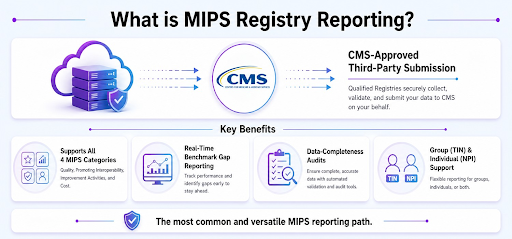
MIPS Registry reportingsubmits performance data to the Centers for Medicare & Medicaid Services (CMS)through a Qualified Registry. It is a CMS-approved third-party vendorthat collects, validates, and transmits MIPS data on behalf of clinicians and groups. Registry is the most commonly used Merit-Based Incentive Payment System (MIPS) reporting methodbecause it supports all four MIPS performance categories and works across specialties.
This guide covers the end-to-end Registry submission workflow, the group-reporting benefits that make Registries the default for TIN-level submission. It will also discuss five acceptance conditionsthat achieve 100 percent data acceptancefor the 2026 performance year.
What Is a Qualified Registry?
A Qualified Registry is a third-party vendor approved annually by the Centers for Medicare & Medicaid Services (CMS)to collect, validate, and submit MIPS performance dataon behalf of eligible clinicians. The Qualified Registry is one of the five MIPS reporting methods under the Quality Payment Program (QPP).
Qualified Registries operate as a data submission channel between the practice’s EHR or measure-tracking system and the CMS Quality Payment Program (QPP) submission infrastructure. The Registry aggregates measure data, validates completeness against CMS thresholds, and transmits the final submission in the QRDA III XML file format.
Most Qualified Registries provide additional value during the performance year. Common services include real-time benchmark gap reporting, measure-selection guidance, audit-prep documentation, and data-completeness audits.
The current CMS designation is Qualified Registry. Older CMS documentation occasionally references the legacy term Data Submission Vendor (DSV). That term has been superseded and no longer applies.
The three sections below cover the QCDR distinction, the annual approved list, and the approved vendor count.
How Is a Qualified Registry Different From a QCDR?
Qualified Registriesand Qualified Clinical Data Registries (QCDRs)both submit MIPS data to CMS through the same Self-Nomination and annual approval process. QCDRs hold an additional authority that Registries lack: submitting non-MIPS specialty measures.
Here is how the two differ:
Qualified Registry:
Submits standard MIPS measures only.
Cross-specialty applicability — one Registry can serve cardiology, ophthalmology, primary care, and others.
Typically, a lower annual subscription cost.
QCDR:
Submits standard MIPS measures plus non-MIPS specialty measures approved annually by CMS.
Narrower specialty focus.
Often higher subscription cost. Specialty-society membership may be required.
Practices needing specialty-specific measures that the standard MIPS inventory does not cover should evaluate the QCDR specialty submission option alongside Registry.
Does CMS Publish an Annual List of Approved Qualified Registries?
Yes. CMS publishes the Registry Qualified Postingannually before each MIPS performance year, listing every Qualified Registry approved to submit data for that year. The list is published on the CMS Quality Payment Program (QPP) Resource Library. The list is updated only when an approved Registry has its certification revoked or amended mid-year. Vendors must reapply through CMS Self-Nomination each year to remain on the list. Approval does not roll over automatically.
How Many Qualified Registries Does CMS Approve for 2026?
CMS approves approximately 60 to 80 Qualified Registrieseach MIPS performance year. The exact number is published in the annual Registry Qualified Posting.
The exact count varies year to year. Some vendors do not reapply. New entrants are approved. A small number of mid-year revocations occur. Recent years have seen approximately 70 approved Qualified Registries.
A single Qualified Registry can serve clinicians across all specialties. The standard MIPS measure inventory covers cross-specialty Quality, Promoting Interoperability, and Improvement Activities categories.
Practices typically evaluate Registry options by measure-set fit, integration with the practice’s EHR, real-time benchmark gap reporting quality, and subscription cost. Raw vendor count is not a useful selection filter.
How Does Data Submission via Registry Work?
Data submission via a Qualified Registry follows a three-step workflow. The three steps are Collection, Validation, and Transmissionof the final QRDA III XML fileto CMS during the official submission window. Practices also rely on EHR direct submission as an alternative workflow for certain collection scenarios.
The three steps run sequentially but overlap in practice. Collection happens throughout the year. Validation happens continuously as data arrives. Transmission concentrates in January through Marchof the year following the performance period.
The sections below develop each workflow step under its own heading. Additional sections cover whether Registry reporting works without an EHR integration, when the 2026 submission window opens and closes, and which MIPS performance categories the Registry submits.
Collection
Step 1 of the Registry workflow is collection. Collection moves MIPS measure data from the practice’s EHR or measure-tracking system into the Qualified Registry. This process runs continuously throughout the MIPS performance year.
Qualified Registries accept measure data through three primary channels:
API-based EHR integration, the most common configuration for CEHRT-equipped practices.
Scheduled file exports, including daily, weekly, or monthly CSV or QRDA-formatted files from the EHR.
Manual portal entries are used by practices without integrated EHRs.
API-based EHR integrationis the most efficient configuration. The EHR exports measure data on a schedule using the Registry’s API or the FHIR-based bulk data exportspecification. The EHR pushes encounters, diagnoses, procedures, and quality-action documentation directly into the Registry without manual export.
Continuous collectionduring the performance year is a key advantage. Collecting throughout the year gives the Registry time to flag data-completeness gaps, case-minimum shortfalls, and specification mismatches early. This is the foundation for the 100 percent data acceptance discipline covered in the Accuracy section below.
Practices without integrated EHRs use Registry portal entry or CSV uploads. That path is covered in the no-EHR Boolean section below.
Validation
Step 2 of the Registry workflow is validation. The Qualified Registry runs every submitted record through a series of checks before the data is packaged into the QRDA III XML submission file.
Continuous validationbegins as soon as data arrives during Step 1 (collection). Validation continues until the submission file is sealed in Step 3 (transmission). Registries do not validate only at year-end. Registries flag issues continuously so practices can correct workflow gaps mid-year.
Each measure record is validated against the five CMS acceptance conditions. Those are data completeness against the 75 percent rule, case minimums (20 cases per Quality measure), measure-specification version match, denominator and exclusion logic accuracy, and QRDA III encoding integrity. The Accuracy section below covers each condition as its own section.
The corrective-feedback loopworks as follows. Records flagged at validation are returned to the practice with a measure-level issue summary. The summary identifies missing denominator data, incomplete exclusion documentation, and measure-version mismatches. The practice corrects the records or updates EHR documentation. The data then re-enters validation.
Registry validation is the validation safety netthat claims-based reporting lacks. Claims-based submissions are evaluated directly by CMS without a pre-submission Registry layer to catch errors before transmission.
Transmission
Step 3of the Registry workflow is transmission. The Qualified Registry packages validate measure data into the QRDA III XML submission fileand transmit the file to the CMS Quality Payment Program (QPP) submission APIduring the official submission window.
CMS requires Registry submissions in the QRDA III XML format. QRDA III stands for Quality Reporting Document Architecture, Category III. This standard is published by HL7 and adopted by CMS for MIPS Quality, PI, and IA category data. The Registry compiles all validated records for the TIN or NPI into a single QRDA III file.
Registries transmit the QRDA III file to the CMS QPP submission API. This is an authenticated machine-to-machine transmission channel that CMS uses for all third-party submission vendors. The transmission carries authentication credentials tied to the Registry’s annual CMS approval.
Transmission concentrates in January through Marchof the year following the performance year. For PY2026, the window runs January 2 through March 31, 2027. Registries typically transmit in early January and resubmit corrected records throughout the window until the March 31 close at 8 p.m. Eastern Time.
CMS returns a per-measure confirmation or measure-level rejection within hours of transmission. Confirmation completes the workflow. Rejections re-enter Step 2 validation for correction and resubmission.
Can a Registry Submit MIPS Data Without an EHR Integration?
Yes, Qualified Registries accept measure data through multiple channels beyond API-based EHR integration. Practices without integrated CEHRT EHRs can submit data via Registry portal manual entry, scheduled CSV uploads, or batch file importsformatted to the Registry’s specification. The trade-off is operational.
Manual entry and file uploads add data-entry overhead during the performance year and increase the validation work the Registry performs before transmission. Most groups with an integrated CEHRT EHR prefer API integration. Small practices and specialty practices without modern EHRs commonly use portal entry.
What Is the Submission Window for Registry Reporting in 2026?
The MIPS submission window for the 2026 performance year (PY2026) opens January 2, 2027, and closes March 31, 2027. This is the same three-month window CMS has used since the program’s inception.
Qualified Registries must transmit completed submissions to the CMS QPP submission API before 8 p.m. Eastern Time on March 31, 2027. Submissions accepted after that timestamp are not counted toward PY2026 scoring.
Most Registries finalize data validation and clinician sign-off during November and December 2026. Registries then begin transmitting submissions in January 2027 to leave buffer time for partial-rejection resubmission before the March 31 deadline.
CMS releases preliminary feedback in spring 2027 and the final PY2026 MIPS Final Score in summer 2027. Payment adjustments apply to 2028 Medicare Part B reimbursement.
Which MIPS Categories Can Be Reported via Registry?
A Qualified Registry can submit data for all four MIPS performance categories, which are Quality, Cost, Promoting Interoperability (PI), and Improvement Activities (IA) — though the mechanism differs by category.
Quality: Submitted directly through the Registry. Practices select from the standard MIPS Quality measure inventory or a specialty measure set. Many Registries offer real-time benchmark gap reportingto guide measure selection. For further details, see quality via registry.
Cost: CMS calculates Cost performance from Medicare Part B claims directly. The Registry does not submit Cost data. Registry feedback often includes Cost score projections sourced from historical Medicare claims.
Promoting Interoperability (PI): Submitted via the Registry by exporting CEHRT-generated PI measure data. PI submission requires 2015 Edition Cures Update CEHRT regardless of submission method.
Improvement Activities (IA): Attested through the Registry portal. The Registry transmits attestations to CMS during the submission window.
Practices submitting an MIPS Value Pathway (MVP) still rely on one of the five reporting methods underneath. Qualified Registry is the most common pathway for MVP submission.
What Are the Benefits of Registry Reporting for Groups?
Qualified Registries offer four core benefitsthat make them the default MIPS reporting method for groups. TIN-level aggregation, broader measure availabilitythan claims-based or direct EHR submission, real-time benchmark gap reportingduring the performance year, and a validation safety netthat catches data issues.
Here is what each benefit means in practice:
TIN-level Aggregation: A Registry aggregates all clinicians billing under one Tax Identification Number (TIN) into a single group submission. This simplifies coordination and standardizes measure selection across the practice.
Broader Measure Choice: Registries can submit any standard MIPS Quality measure. This includes measures with low Medicare Part B claim volume that claims-based reporting cannot capture.
Real-time Benchmark Gap Reporting: Most Qualified Registries display measure-level performance against current CMS decile benchmarks throughout the performance year. The practice can adjust workflows mid-year.
Validation Safety Net: Registry validation catches data-completeness gaps, case-minimum shortfalls, and measure-specification mismatches before the CMS submission deadline.
The three sections below cover the measure-set advantage, whether Registry suits solo clinicians, and how Registry reporting affects MIPS Final Score.
What Measure-Set Advantages Do Registries Offer Over EHR Direct Submission?
Qualified Registries can submit the full standard MIPS Quality measure inventory. This includes measures specified as the MIPS CQM (Clinical Quality Measure) collection type. EHR direct submission is limited to measures specified as eCQM (electronic Clinical Quality Measure) collection type.
MIPS Quality measures have one or more approved collection types. Those types are MIPS CQM (Registry), eCQM (EHR), claims, and QCDR. Some measures exist as MIPS CQM only. Others exist as eCQM only. Some exist as both. Registry submission accesses the broader set.
CMS publishes specialty-specific measure setscovering cardiology, gastroenterology, orthopedic surgery, and other specialties. Registries can submit these sets as a unit. They often match specialty workflows better than ad hoc measure selection.
EHR direct submission remains the natural fit for the Promoting Interoperability category. It also suits practices with mature CEHRT integration where the eCQM measure set covers the practice’s reporting needs.
Does Registry Reporting Suit Solo Clinicians?
Yes, Qualified Registries support NPI-level (individual) reportingin addition to TIN-level (group) reporting. This makes them a workable option for solo clinicians. The trade-off for a solo clinician is cost. Registry subscriptions typically carry an annual fee per clinician or per group.
Medicare Part B claims-based reporting is available to small practices (TIN with 15 or fewer eligible clinicians)at no per-year vendor cost. Solo clinicians weigh Registry’s broader measure access and real-time benchmark gap reporting against claims-based reporting’s zero subscription cost.
How Does Registry Reporting Affect MIPS Final Score?
Choosing Registry as the submission method does not change the maximum achievable MIPS Final Scoreon the 0-to-100 scale. However, the Registry affects three score-determining factors that influence the actual score outcome.
Measure Availability: Registry can submit the full standard MIPS Quality inventory, plus specialty measure sets. This gives more selection optionality and access to higher-benchmarked measures.
Data-Completeness Ceiling: Registries can validate 100 percent data completeness across the calendar year and resubmit on partial rejection. This often achieves fuller completeness than claims-based reporting can match.
Benchmark Match: Each Quality measure has separate decile benchmarks for each collection type. Registry submissions are scored against the MIPS CQM benchmark. That benchmark sometimes scores differently from the eCQM benchmark for the same measure.
For most groups, the practical effect is that Registry submission produces a higher Quality category score than claims-based. Registry is comparable to EHR direct submission when the measure inventory overlaps. Registry scores lower than QCDR submission only when specialty non-MIPS measures would have scored higher than the standard MIPS equivalents.
How Do You Ensure 100% Data Acceptance?
100 percent data acceptance means every submitted measure record is accepted by CMS without rejection. This depends on five conditionsthat a Qualified Registry validates before transmitting the QRDA III XML file to the CMS Quality Payment Program (QPP) submission API.
The five acceptance conditions are Data Completeness (the 75 percent rule), Case Minimum (20 cases per quality measure), and Measure-Specification Version Matchagainst the current CMS-published specifications. They also include Denominator and Exclusion Logic Accuracyaccording to each measure’s definition and QRDA III Encoding Integritybased on the CMS QRDA III Implementation Guide.
All five conditions apply simultaneously. A submission meeting four conditions but missing the fifth will be rejected by CMS at the measure level. Registries validate continuously during the Validation step of the workflow to catch any condition failure before transmission.
The sections below cover each of the five acceptance conditions in its own section — Data Completeness, Case Minimum, Measure-Specification Version Match, Denominator and Exclusion Logic Accuracy, and QRDA III Encoding Integrity — plus what happens if CMS still rejects part of a submission after all five conditions are met.
Data Completeness (75% Rule)
Condition 1is the 75 percent data-completeness rule. CMS requires Registry submissions to include measure data on at least 75 percent of the eligible patient encountersduring the performance year for each Quality measure to qualify for full decile benchmark scoring.
A measure submitted with data on 75 percent or more of eligible encounters scores against the current CMS decile benchmark for the measure. Submissions below 75 percent face reduced scoring. In some cases, the measure defaults to the minimum measure achievement score rather than the standard benchmark.
Here is a worked example. A practice with 500 eligible encounters for a Quality measure must submit data on at least 375 encounters (500 multiplied by 0.75 equals 375) for the measure to score against the standard benchmark.
For most Quality measures, the 75 percent rule applies to all-payer eligible encounters, not Medicare-only. This broadens the data submission requirement beyond Medicare Part B claims.
Qualified Registries track measure-level data completeness during the performance year. The Registry alerts the practice when a measure approaches the 75 percent threshold. This gives time to capture missing documentation before year-end.
Case Minimum (20 Cases per Quality Measure)
Condition 2 is the 20-case minimum. Each MIPS Quality measure must include at least 20 eligible cases in the Registry submission for full decile benchmark scoring.
A case is one eligible patient encounter that meets the measure’s denominator inclusion criteria during the performance year. Encounters excluded by the measure’s exception or exclusion logic are not counted toward the 20-case minimum.
A measure submitted with 19 cases or fewer is still accepted by CMS. The submission is not rejected. However, the measure scores against an alternative low-volume benchmarkrather than the standard decile benchmark. The alternative benchmark typically caps the measure’s achievable score lower than the standard benchmark allows.
The 20-case minimum functions as a measure-selection filter. Practices choose six Quality measures (or a specialty measure set) for MIPS submission. Measures that the practice expects to perform fewer than 20 times in a year should be deprioritized even if they are clinically relevant.
Qualified Registries display per-measure case counts during the performance year. Registries flag measures approaching the 20-case threshold so the practice can substitute a different measure if needed.
Measure-Specification Version Match
Condition 3 is a measure-specification version match. The data submitted for each Quality measure must conform to the current MIPS measure specification version published by CMS for the performance year being reported.
CMS updates measure specifications annually. Revisions cover denominator inclusion criteria, exception logic, numerator definitions, code value sets, and reporting frequency. A practice using PY2025 specifications to submit PY2026 data will see measure-level rejection.
CMS publishes the upcoming performance year’s measure specifications in late fall through the QPP Resource Library. The CY 2026 Final Rule was published on November 5, 2025. EHR vendors and Qualified Registries refresh their measure logic against the new specifications before the performance year begins.
Qualified Registries align internal measure logic to the current performance-year specifications. The Registry validates that the submitted encounter data uses the correct denominator, exclusion, and numerator definitionsfor that year. Mid-year specification corrections from CMS are propagated to the Registry’s validation rules when issued.
Practices submitting via Registry rarely need to track specification versions directly. The Registry abstracts the version match. Practices submitting via direct EHR must independently ensure the EHR’s measure logic matches the current performance-year specifications.
Denominator and Exclusion Logic Accuracy
Condition 4is the denominator inclusion criteriaaccuracy. Every encounter record submitted for a Quality measure must match the measure’s denominator inclusion criteria. Any approved exclusionsor exceptionsused to remove an encounter from the denominator must be documented per the measure specification.
A Quality measure’s denominator defines the population of encounters the measure evaluates. Inclusion criteria cover patient age range, diagnosis codes, procedure codes, encounter setting, and other factors. An encounter included in the denominator that does not meet these criteria is a denominator-accuracy failure.
Measure specifications allow encounters to be removed from the denominator through exclusions (for example, a patient in hospice) or exceptions (for example, a documented medical reason for not meeting the measure). Each exclusion or exception has a specific code or documentation requirement that the Registry validates.
Qualified Registries cross-check submitted encounter data against the measure’s denominator inclusion criteria. The Registry validates diagnosis codes, procedure codes, encounter type, and patient demographics against the specification. The Registry also validates that any exclusions or exceptions have the supporting documentation code present in the encounter record.
Denominator and exclusion errors are among the most common reasons for measure-level rejection. These errors are typically caused by EHR documentation gaps where the clinical action was performed but not coded with the specification-required code value.
QRDA III Encoding Integrity
Condition 5is QRDA III encoding integrity. The Qualified Registry compiles validated measure data into a single QRDA III XML file and validates the file against the CMS QRDA III Implementation Guideschema for the performance year before transmitting to CMS.
QRDA III stands for Quality Reporting Document Architecture, Category III. This standard is published by HL7 and adopted by CMS for MIPS Quality, PI, and IA category data. The Category III standard packages aggregate performance measures, including the numerator, denominator, exclusions, and exceptions, into a single XML document for transmission.
CMS publishes an annual QRDA III Implementation guide that defines the XML schema, required and optional elements, value-set bindings, and validation rules for the performance year. Registries must align their QRDA III output to the current Implementation Guide.
Before transmission, the Qualified Registry runs the compiled QRDA III file through schema validation. The Registry checks element structure, required attributes, code-value-set conformance, and cross-element consistency. Files with encoding errors are corrected before transmission to the CMS QPP submission API.
A QRDA III file that fails schema validation at CMS is rejected at the file level, not the measure level. The entire submission may fail rather than just individual measures. Encoding integrity is the gate conditionbefore measure-level scoring even begins.
What Happens if CMS Rejects Part of a Registry Submission?
Even with all five acceptance conditions validated before transmission, CMS can still flag measure-level issuesat submission. Rejections are returned at the measure level with specific error codes. This allows the Qualified Registry to resubmit the affected measuresbefore the submission window closes.
Each measure record submitted through the QRDA III XML file is validated independently by the CMS QPP submission API. Records that fail validation are returned with measure-level error codes such as missing denominator, invalid exclusion code, and measure-version mismatch.
The Registry corrects rejected records, resubmits the affected measures, and may iterate multiple times until the submission window closes on March 31. This is why Registries advise practices to transmit in early January rather than late March.
Records still rejected after the submission window closes are excluded from MIPS Final Score calculation. Practices who believe their final score does not reflect their actual performance can file a Targeted Reviewwith CMS within 60 days of feedback release.
What Does It Cost to Use a Qualified Registry?
Most Qualified Registries charge an annual subscription fee, billed per clinician (NPI) or per group (TIN), covering the data-collection portal, validation processing, real-time benchmark gap reporting, and CMS submission.
Annual Registry subscription pricing typically ranges from approximately 250 to 600 USD per clinicianfor standard MIPS submission. Volume discounts apply for larger groups. Setup fees of 500 to 2,500 USDmay apply in the first year. Pricing varies based on EHR integration scope, real-time analytics features, and audit-support inclusion.
Smaller groups under 10 clinicians typically see per-clinician billing. Larger groups of 15 or more clinicians often negotiate flat group-level pricing.
The two sections below cover pricing by practice size and whether free Registry options exist for small practices.
What Does Typical Qualified Registry Pricing Look Like by Practice Size?
Qualified Registry pricing scales with practice size and EHR-integration complexity.
Practice Size
Typical Pricing Model
Approximate Annual Cost
Solo or Small (1 to 5 clinicians)
Per-clinician
250 to 500 USD per clinician
Medium (6 to 25 clinicians)
Per-clinician with volume discount
200 to 400 USD per clinician (often 30 to 40 percent below solo pricing)
Large (26 or more clinicians)
Group-level flat fee plus setup
5,000 to 25,000 USD annual (variable by integration scope)
Practices should request itemized pricing covering subscription, setup, EHR integration, real-time analytics, and audit-support modules. Some Registries quote a single bundled price while others itemize.
Are There Free Qualified Registry Options for Small Practices?
Yes, a small number of Qualified Registries operate at no costto clinicians, typically as a member benefit from a specialty-society membershipor as a CMS-funded option for specific clinician populations. Free Registry availability is narrow. Free options usually require specialty society membership or eligibility for a specific CMS-supported initiative.
The free tier may exclude certain value-added features like real-time benchmark gap reporting. Practices considering a free Registry should confirm the Registry remains CMS-approved each year through the annual Registry Qualified Posting.
How Is a Qualified Registry Approved by CMS?
A vendor becomes a CMS-approved Qualified Registry by completing the annual Registry Self-Nomination process. This is a formal CMS evaluation that assesses data-collection capability, measures validation rigor, security posture, and operational readiness.
CMS opens the Registry Self-Nomination windowin late spring each year, typically May or June, for the following performance year. Vendors complete the Self-Nomination Form, document data-collection methods and supported MIPS measures, demonstrate validation processes, and undergo a security and operational-readiness review.
CMS reviews each application against published Qualified Registry criteria. The criteria cover measure coverage, data validation processes, HIPAA-aligned security controls, technical capability to transmit QRDA III XML to the CMS QPP submission API, and the ability to support clinicians from data collection through CMS submission.
Approved Registries are listed on the annual Registry Qualified Posting, published on the QPP Resource Librarybefore the next performance year begins. Approval does not carry over. Vendors must reapply each year.
CMS retains the authority to revoke approval mid-year if a Registry fails to meet ongoing operational or compliance requirements. Revocations are documented on the Qualified Posting.
How Does Registry Reporting Compare to EHR and QCDR?
Qualified Registryis one of three closely related MIPS reporting methods, alongside EHR direct submissionand QCDR specialty submission. The three differ in submission unit, measure scope, typical cost, and best-fit practice profile.
Method
Measure Scope
Typical Cost
Best-Fit Practice Profile
Qualified Registry
Standard MIPS measures (full inventory)
250 to 600 USD per clinician annually
Multi-specialty groups, mid to large practices, and practices new to MIPS
EHR direct submission (CEHRT)
eCQM subset of MIPS Quality plus PI and IA
Bundled in EHR vendor cost (no separate Registry fee)
CEHRT-mature practices with in-house IT and stable workflows
QCDR specialty submission
Standard MIPS plus non-MIPS specialty measures
400 to 1,200 USD per clinician annual; specialty-society membership may be required
Single-specialty groups whose specialty has an active QCDR (cardiology, ophthalmology, GI, ortho, anesthesia)
Practices choosing a method weigh measure-set fit against cost and operational complexity. See EHR direct submission and QCDR specialty submission for detailed coverage of the two sibling methods.
How Does Macralytics Handle MIPS Registry Submission?
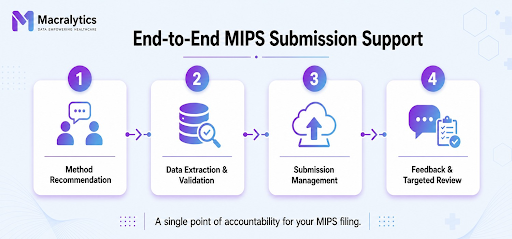
Macralytics submits MIPS data through a CMS-approved Qualified Registry on behalf of partner practices. The team applies a four-step workflow that maps to the collection, validation, and transmission steps described above.
Measure planning: The Macralytics team reviews the practice’s specialty, patient mix, and historical MIPS data. The team identifies the highest-scoring measure mix from the standard MIPS Quality inventory and specialty measure sets.
Data extraction and validation: Data is exported from the practice’s EHR via API where available, or entered through the Macralytics submission portal. The team validates data completeness against the 75 percent rule, case minimums, and measure-specification accuracy throughout the performance year.
CMS submission: The final QRDA III XML file is transmitted to the CMS QPP submission API in January 2027 for PY2026. This leaves buffer time for partial-rejection resubmission before the March 31 deadline.
Feedback review and Targeted Review filing: After CMS releases the annual MIPS feedback report, the team reviews attribution accuracy. The team files Targeted Reviews on the practice’s behalf within the 60-day window if discrepancies appear.
To learn more about how Macralytics manages the end-to-end process, visit our registry submission.
Can a Practice Switch Qualified Registries Mid-Year?
Yes, a practice can switch from one Qualified Registry to another within a MIPS performance year. The condition is that the final submission must contain complete data covering the full reporting period for every submitted measure.
CMS does not constrain mid-year Registry changes directly.The constraint is operational. Data submitted to CMS for a Quality measure must cover the full performance year without gaps. Practices switching Registries must transfer or rebuild the year-to-date measure data in the receiving Registry before the submission window closes.
Practical switching costs are not trivial. EHR reintegration, measure mapping, data re-validation, and a fresh familiarity curve with the receiving Registry’s portal all add up. Most practices that switch do so between performance years rather than mid-year.
If CMS revokes a Qualified Registry’s approval mid-year, CMS publishes guidance to affected practices on transitioning to a different approved Registry to complete submission for that performance year. Mid-year revocations are rare but documented.
MIPS reporting methods are the five CMS-approved paths for submitting performance data under the Merit-Based Incentive Payment System (MIPS). The four mainstream methods are Qualified Registry, CEHRT-equipped EHR, Qualified Clinical Data Registry (QCDR), and Medicare Part B claims.
The fifth is the sunsetting CMS Web Interface. MIPS Value Pathways (MVPs) run alongside as an alternative framework that bundles measures by specialty. CMS publishes 27 MVPs for the 2026 performance year, including 6 new specialty pathways.
What are MIPS reporting methods?
MIPS reporting methods are the five CMS-approved channels clinicians and groups use to submit performance data to CMS. The submissions feed the Merit-Based Incentive Payment System (MIPS), the program run by the Centers for Medicare and Medicaid Services (CMS). MIPS is one of two tracks under the Quality Payment Program (QPP), created by MACRA in 2015.
The choice of method depends on practice size, specialty, and technology maturity. Each method can submit a different mix of MIPS categories, and the four mainstream methods remain broadly available for 2026.
The table below compares the five methods across submission unit, best fit, supported categories, and 2026 status.
Method
Submission unit
Best fit
MIPS categories supported
2026 status
Qualified Registry
TIN or NPI
Most groups
All four (Quality, Cost, PI, IA)
Active
EHR (CEHRT)
TIN or NPI
CEHRT-mature practices
Quality, PI, IA
Active
QCDR
TIN or NPI
Specialty practices
Quality (specialty plus non-MIPS), PI, IA
Active
Medicare Part B Claims
NPI only
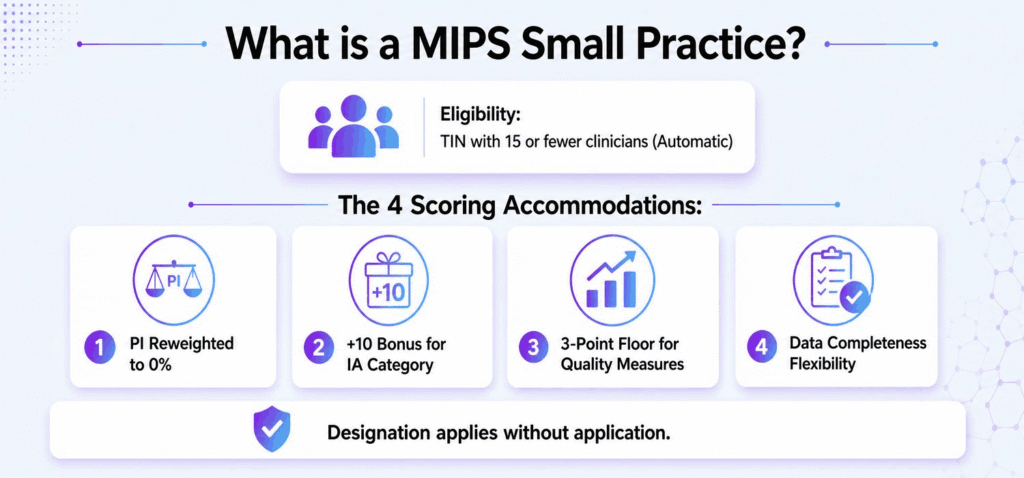
Small practices (TIN 15 or fewer)
Quality (claims-based subset)
Active (limited)
CMS Web Interface
Group
Legacy ACOs
Quality, PI (historical)
Sunsetting
The sections below explain how reporting methods feed the MIPS final score, how many methods CMS approves for 2026, and whether clinicians can mix methods in one performance year.
How Do MIPS Reporting Methods Feed the MIPS Final Score?
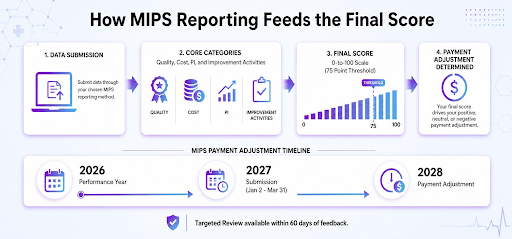
Data submitted through any MIPS reporting method feeds the four MIPS performance categories (Quality, Cost, Promoting Interoperability, and Improvement Activities). These categories combine into a single MIPS Final Score on a 0-to-100 scale. A performance threshold of 75 points separates positive from negative payment adjustments for the 2026 performance year.
Clinicians submit performance-year data through their chosen method during the CMS submission window, January 2 through March 31of the following year. CMS then calculates the MIPS Final Score and releases the annual MIPS feedback report.
CMS applies the payment adjustment two years after the performance year. Performance year 2026 affects 2028 Medicare Part B payments. Clinicians who disagree with the final score can request a Targeted Review within 60 days of feedback release.
Pick the right method, protect your 2028 payment adjustment
How Many MIPS Reporting Methods Does CMS Approve For 2026?
CMS approves five standard MIPS reporting methods for the 2026 performance year: Qualified Registry, EHR via CEHRT, Qualified Clinical Data Registry (QCDR), Medicare Part B claims, and the CMS Web Interface (sunsetting). Four methods remain active and broadly available. The CMS Web Interface is sunsetting and available only to legacy users.
MIPS Value Pathways (MVPs) are not a sixth reporting method. MVPs are a parallel framework for organizing measures by specialty. Clinicians reporting an MVP still submit through one of the five reporting methods.
For 2026, CMS finalized 27 MVPs, including 6 new specialty pathways:
Diagnostic Radiology
Interventional Radiology
Neuropsychology
Pathology
Podiatry
Vascular Surgery
Can Clinicians Mix MIPS Reporting Methods in One Performance Year?
Yes, across MIPS performance categories, but not within a single measure. A clinician can submit Quality measures via a Qualified Registry and PI measures via direct EHR submission. IA attestations can flow through the Registry at the same time. A single measure, for example, Quality measure #001, must be submitted entirely through one method. CMS does not aggregate partial submissions for the same measure from different reporting channels.
What is the MIPS Registry Reporting?
MIPS registry reporting submits performance data to CMS through a Qualified Registry. A Qualified Registry is a CMS-approved third-party vendor that collects measure data, validates it, and transmits the final submission during the submission window.
Registry is the most common MIPS reporting pathbecause it supports all four performance categories. It accommodates both TIN-level (group) and NPI-level (individual) submissions, and it works across specialties.
Beyond data transmission, a qualified registry typically provides:
Measure selection guidance based on the practice specialty
Real-time benchmark gap reporting during the performance year
Data-completeness audits before submission
Audit-prep documentation for CMS validation
The subsections below cover what a qualified registry is, how data submission works, which MIPS categories it supports, and whether Registry reporting suits small practices. For workflow specifics, see the MIPS Registry reporting workflow details.
What is a CMS-approved Qualified Registry?
A Qualified Registryis a third-party vendor approved by CMS each performance year. The vendor collects, validates, and submits MIPS data on behalf of eligible clinicians and groups.
CMS publishes an updated list of approved Qualified Registries before each performance year. Vendors must reapply annually to maintain certification, so the approved list changes year to year.
Qualified Registries and Qualified Clinical Data Registries (QCDRs) overlap in submission capability but differ in measure scope. The QCDR section below covers the distinction.
How Does Data Submission via Registry Work?
Data submission via a qualified registry follows a three-step workflow: collection, validation, and transmission.
Collection: Clinicians or the practice export measure data from the EHR, or enter it via a Registry portal during the performance year. Many Registries support API-based EHR integration.
Validation: The Registry checks data completeness (75 percent for Quality) and measure-specific case minimums (a 20-case minimum for Quality scoring). The Registry flags missing or incomplete records before submission.
Transmission: The Registry transmits the final submission to CMS during the official submission window, January 2 through March 31 of the year following the performance period.
Groups submit at the TIN (Tax Identification Number) level. All clinicians billing under one TIN are aggregated into a single submission. Individuals submit at the NPI (National Provider Identifier) level.
Which MIPS Categories can be Reported via Registry?
Qualified Registries support submission for all four MIPS performance categories, though the mechanism differs by category.
Quality: Submitted directly through the Registry. Clinicians choose individual measures or a complete specialty measure set.
Cost: CMS calculates the cost from Medicare Part B claims. No Registry submission is required, though Registry feedback often includes Cost score projections.
Promoting Interoperability (PI): Submitted via Registry-integrated EHR data export, which requires 2015 Edition Cures Update CEHRT.
Improvement Activities (IA): Attested through the Registry portal. The Registry passes attestations to CMS.
Many Registries also offer real-time benchmark gap reporting for Quality measures during the performance year, which lets practices adjust mid-year.
Does Registry Reporting Suit Small Practices?
Yes, Qualified Registries serve small practices well, though small practices have an additional Medicare Part B claims-based optionnot available to larger groups. Registries offer broader measure availability, real-time benchmark gap reporting, and centralized submission across all four MIPS categories. The trade-off is the Registry subscription cost, which claims-based reporting avoids.
What is MIPS EHR (CEHRT) reporting?
MIPS EHR reporting submits performance data directly from a Certified Electronic Health Record Technology (CEHRT) systemto CMS. Direct submission bypasses third-party Registries when the EHR has the certification and API integration to do so.
EHR direct submission requires the 2015 Edition Cures Update CEHRT, certified by the Office of the National Coordinator for Health Information Technology (ONC).
The three subsections below cover:
The CEHRT requirement that applies to EHR reporting
Which MIPS categories fit the EHR submission best
Whether a practice can submit without leaving the EHR
EHR direct submission suits practices with mature CEHRT integration, in-house IT capability, and predictable workflows. Practices without these often submit through a Registry that imports EHR data instead. For the requirement details, see the MIPS EHR direct submission requirements.
What CEHRT Requirement Applies to EHR Reporting?
EHR-based MIPS reporting in 2026 requires 2015 Edition Cures Update CEHRT, the current standard published by the Office of the National Coordinator (ONC).
The Cures Update extends the original 2015 Edition with three additions:
Information-blocking compliance
API-based patient data access
Updated USCDI (United States Core Data for Interoperability) data classes
EHR vendors publish ONC certification IDs, such as the CMS EHR Certification ID, that clinicians use to attest to CEHRT use in MIPS submissions.
Which MIPS Categories Work Best via EHR Direct Submission?
EHR direct submission best supports Quality, Promoting Interoperability (PI), and Improvement Activities (IA), the three categories that involve clinician-submitted data.
Promoting Interoperability (PI): The natural fit. PI already requires the 2015 Edition Cures Update CEHRT, regardless of submission method, so submitting PI directly from CEHRT keeps one workflow.
Quality (eCQM): Electronic Clinical Quality Measures (eCQMs) are extracted directly from CEHRT data using ONC-published eCQM specifications.
Improvement Activities (IA): Attested through the CEHRT vendor MIPS portal, where available, otherwise via a Registry.
Cost is calculated by CMS from Medicare Part B claims. No EHR submission is required for the Cost category.
Can a Practice Submit MIPS Without Leaving the EHR?
Yes, when the CEHRT vendor offers an API-based MIPS submission. Most major EHR platforms certified to the 2015 Edition Cures Update include a built-in MIPS submission module. That module exports eCQM data, PI measure attestations, and IA attestations directly to CMS during the submission window. Practices using older or smaller EHRs without this capability typically submit through a Qualified Registry that imports EHR data instead.
What is MIPS QCDR Reporting?
MIPS QCDR reporting submits performance data through a Qualified Clinical Data Registry (QCDR). A QCDR is a specialty-aligned reporting vendorapproved by CMS to submit standard MIPS measures plus non-MIPS measures specific to a clinical specialty.
QCDRs typically focus on a clinical domain such as cardiology, gastroenterology, or ophthalmology. They offer measure sets that go beyond the standard MIPS Quality inventory.
The four subsections below cover:
What a Qualified Clinical Data Registry is
How a QCDR differs from a Qualified Registry
Which specialties benefit most from QCDR reporting
Whether QCDR measures can replace standard MIPS measures
QCDR-specific measures can substitute for standard MIPS Quality measures when they more accurately reflect specialty clinical work. For specialty measure detail, see MIPS QCDR reporting and specialty measures.
What is a Qualified Clinical Data Registry?
A Qualified Clinical Data Registry (QCDR) is a CMS-approved reporting vendor certified annually. A QCDR submits MIPS performance data and non-MIPS measures specific to a clinical specialty.
CMS publishes an updated QCDR list before each performance year. The QCDR list is typically smaller than the Qualified Registry list because QCDRs serve narrower specialty audiences.
Many QCDRs are operated by professional medical societies, including:
American College of Cardiology PINNACLE Registry
American Academy of Ophthalmology IRIS Registry
How Does QCDR Differ From a Qualified Registry?
Qualified Registries and Qualified Clinical Data Registries (QCDRs) both submit MIPS data to CMS. QCDRs hold an additional authority that Registries lack: submitting non-MIPS measures specific to a clinical specialty.
The table below contrasts the two registry types across measure scope, specialty focus, cost, and measure relevance.
Attribute
Qualified Registry
QCDR
Measure scope
Standard MIPS measures only
Standard MIPS measures plus non-MIPS specialty measures
Specialty focus
Broad cross-specialty
Narrow specialty focus
Typical cost
Lower subscription cost
Higher cost; society membership may be required
Measure relevance
General MIPS measures
Specialty measures often align with the clinician’s work
A Registry fits cross-specialty groups, while a QCDR fits practices whose specialty measures score better than the standard inventory. For a side-by-side decision aid, see the QCDR vs Registry comparison.
Which Specialties Benefit Most From QCDR Reporting?
QCDR reporting benefits clinical specialties with two characteristics: limited applicable standard MIPS Quality measures, and an active specialty-society QCDR offering non-MIPS measures that better reflect specialty work.
Cardiology: American College of Cardiology PINNACLE Registry
Ophthalmology: American Academy of Ophthalmology IRIS Registry
Gastroenterology: American Gastroenterological Association GIQuIC Registry
Orthopedic Surgery: American Joint Replacement Registry
Anesthesiology: National Anesthesia Clinical Outcomes Registry (NACOR)
Otolaryngology: American Academy of Otolaryngology Reg-ent Registry
Specialties without a dedicated QCDR typically use a Qualified Registry that covers cross-specialty MIPS measures.
Can QCDR-Specific Measures Replace Standard MIPS Measures?
Yes. QCDR-specific non-MIPS measures count toward the MIPS Quality performance category, alongside or in place of standard MIPS measures. CMS approves QCDR non-MIPS measures annually. Clinicians can mix-and-match standard MIPS measures with QCDR non-MIPS measures to fill the 6-measure Quality selection rule. The total still must include at least one outcome or high-priority measure, the same rule that applies to standard MIPS submission.
What is MIPS Claims-based Reporting?
MIPS Claims-based reporting embeds Quality measure data within regular Medicare Part B claims. The practice uses specific CPT II quality codesand modifiers to flag measure performance directly on the claim form.
Claims-based reporting is restricted to small practices, TINs with 15 or fewer eligible clinicians. Larger groups must use Registry, EHR, or QCDR reporting.
Claims-based reporting carries a clear trade-off:
Advantage: No Registry subscription is required, and submission happens through the existing claims workflow.
Limitation: Only a subset of MIPS Quality measures has established CPT II quality codes.
Limitation: PI and IA cannot be submitted via claims.
The three subsections below cover the workflow, eligibility, and 2026 availability. For end-to-end detail, see the MIPS claims-based reporting workflow.
How Does Medicare Part B Claims-based MIPS Submission Work?
Claims-based MIPS submission flags Quality measure performance directly on Medicare Part B claim forms. The practice uses specific CPT Category II (CPT II) quality codes and quality data codes.
When a clinician provides a service that qualifies for a MIPS Quality measure denominator, the practice adds the appropriate CPT II quality code to the claim line. The code indicates whether the measure was met, not met, or excluded for medical reasons.
Two features distinguish claims-based timing:
Claims-based data is captured continuously throughout the performance year as claims are submitted, unlike the formal window used by Registry or EHR submission.
CMS aggregates claims-based MIPS data automatically at year-end, so no separate submission step is required.
Which Clinicians Are Eligible For Claims-Based Reporting?
Medicare Part B claims-based MIPS reporting is restricted to small practices, TINs with 15 or fewer eligible clinicians.
CMS determines small-practice status at the TIN level using the MIPS Determination Period. A practice is small for a performance year if its TIN-level eligible clinician count was 15 or fewer during that period.
Key Rule: Practice size is fixed at the TIN level for the year, while individual clinicians retain an NPI-level option.
Larger groups generate too many claims to reliably aggregate via the CPT II quality code workflow. CMS requires Registry, EHR, or QCDR submission for accuracy at scale. Within a small practice, individual clinicians can report at the NPI level via claims if they prefer NPI-level scoring over TIN-level group aggregation.
Is Claims-Based Reporting Still Available in 2026?
Yes, CMS retained Medicare Part B claims-based MIPS reporting for small practices, TINs with 15 or fewer eligible clinicians, in the 2026 performance year. Claims-based reporting is the only MIPS submission method with no per-year vendor cost. That keeps it attractive for small practices despite its limitation to a subset of MIPS Quality measures.
What is the CMS Web Interface, and is it still available for 2026?
The CMS Web Interface was historically the fifth MIPS reporting method. It was a CMS-operated web portal where large groups, particularly Shared Savings Program (SSP) Accountable Care Organizations (ACOs), submitted Quality and PI measure data directly.
The CMS Web Interface served as the primary submission path for SSP ACOs and certain large groups through performance year 2024. It supported standardized measure sets with pre-defined sampling protocols.
The sunsettingof the Web Interface followed a fixed timeline:
Performance year 2024 was the final year the CMS Web Interface was available as a collection type for SSP ACOs reporting under the APM Performance Pathway.
Beginning in 2025, former users report through a Qualified Registry, the APM Performance Pathway (APP), or MIPS Value Pathways.
ACOs now report eCQMs, MIPS CQMs, or Medicare CQMs under the APP.
For the complete sunset timeline and replacement pathways, see the CMS Web Interface MIPS reporting status page.
How do MIPS Value Pathways (MVPs) Differ From Traditional reporting methods?
MIPS Value Pathways (MVPs) are not a sixth reporting method. MVPs are a CMS-designed framework that bundles MIPS measures by specialty or condition. Clinicians reporting an MVP still submit through one of the five reporting methods (Registry, EHR, QCDR, claims, or Web Interface legacy).
Each MVP pre-selects Quality, IA, and Cost measures relevant to a specialty such as Cardiology or Endocrinology. Promoting Interoperability remains a mandatory foundation layer across all MVPs.
For 2026, CMS finalized 27 MVPs, including 6 new specialty pathways: Diagnostic Radiology, Interventional Radiology, Neuropsychology, Pathology, Podiatry, and Vascular Surgery. CMS also modified all 21 existing MVPs.
Registration mechanics for the 2026 performance year:
Election window: April 1 through November 30, 2026.
Multispecialty groups must register at the subgroup, individual, or APM Entity level, a 2026 change.
Multispecialty small practices may still report an MVP at the group level, with subgroup formation optional.
For the complete 2026 MVP list and per-specialty fit, see the MIPS Value Pathways guide.
Which MIPS Reporting Method Should a Practice Choose?
Choosing a MIPS reporting method depends on five practice characteristics: practice size, specialty alignment, CEHRT maturity, measure availability, and tolerance for per-year vendor cost.
Practice size: Small practices (TIN 15 or fewer) qualify for claims-based reporting. Larger groups need Registry, EHR, or QCDR.
Specialty alignment: Specialties with strong specialty-society QCDRs, such as cardiology or ophthalmology, benefit from QCDR non-MIPS measure access.
CEHRT maturity: Practices with 2015 Edition Cures Update CEHRT and in-house IT can use direct EHR submission to skip the Registry layer.
Measure availability: Cross-specialty access via Registry, specialty-only access via QCDR, or the limited claims-based subset.
Per-year cost: Claims-based avoids vendor subscriptions, while Registries and QCDRs carry annual fees.
Most groups land on Registry as the default. Specialty practices pivot to QCDR. Small practices weigh claims-based against Registry. CEHRT-mature practices add direct EHR submission.
What Kinds of Practices Use Each MIPS Reporting Method?
Each MIPS reporting method has a typical practice profilethat gravitates toward it. The table below maps the method to profile and the reason for the fit.
Method
Typical practice profile
Why it fits
Qualified Registry
Multi-specialty groups, mid-to-large practices, and practices new to MIPS
Cross-specialty coverage; benchmark gap reporting; one submission for all four categories
EHR (CEHRT)
CEHRT-mature practices with in-house IT; large health systems
Direct API submission; integrated workflow; native PI fit
QCDR
Single-specialty groups (cardiology, ophthalmology, GI, ortho, anesthesia)
Small practices (TIN 15 or fewer); rural or HPSA practices on tight budgets
No vendor subscription; embedded in the existing claims workflow
CMS Web Interface
Legacy SSP ACOs (sunset)
Historical fit only; no new enrollment
Practice size and specialty drive most method decisions, with cost and CEHRT maturity acting as tiebreakers.
How Does Reporting-Method Choice Affect MIPS Final Score?
Reporting-method choice does not change the maximum achievable MIPS Final Score (0-to-100 scale). Method choice affects three score-determining factors: measure availability, data-completeness ceilings, and benchmark options.
Measure availability: A QCDR may offer specialty non-MIPS measures that score higher than standard measures in the practice specialty. A Registry offers a broader choice. Claims-based offers the narrowest subset.
Data-completeness ceilings: Registries and EHR-based submission can validate 100 percent data completeness across the calendar year. Claims-based completeness is bounded by the encounters actually billed to Medicare Part B.
Benchmark options: Each measure has separate decile benchmarks for each collection type (MIPS CQM via Registry, eCQM via EHR, claims-based, QCDR-specific). Method choice affects which benchmark applies.
In practice, QCDR plus Registry often produces the highest achievable Quality score for specialty-aligned practices. Claims-based caps the achievable score for small practices that prefer not to subscribe to a vendor.
How Does Macralytics Support MIPS Data Submission Across all 5 methods?
Macralytics supports MIPS data submission through a four-step service workflow that adapts to the practice’s preferred reporting method.
Method recommendation: Based on practice size, specialty, CEHRT maturity, and budget, Macralytics identifies the highest-yielding reporting method. This is typically the Macralytics Qualified Registry for most groups, or a QCDR partner for specialty practices.
Data extraction and validation: Data is exported from the practice EHR when applicable or entered via the Macralytics portal. The team validates data completeness, case minimums, and audit-prep documentation.
Submission: Data is transmitted to CMS through the chosen method during the January 2 through March 31 submission window.
Feedback review: After CMS releases the annual MIPS feedback report, the team reviews attribution accuracy and files Targeted Reviews if discrepancies appear.
Practices that prefer a single point of accountability can let Macralytics handle the filing end-to-end, and we submit it for you.
Will MIPS Value Pathways (MVPs) Replace the Five Traditional MIPS Reporting Methods?
No, MIPS Value Pathways (MVPs) are not replacing the five traditional MIPS reporting methods.
MVPs are a measure-bundling framework, not a replacement for the five reporting methods.Clinicians reporting an MVP still submit data through one of the five traditional methods: Registry, EHR, QCDR, claims, or Web Interface legacy.
Two points define the current direction:
CMS has signaled that MVPs will become the preferred MIPS reporting organizationover time, to phase out open measure-selection Traditional MIPS for most clinicians. The reporting methods themselves remain in place.
For the 2026 performance year, both Traditional MIPS and MVP paths remain available. MVPs are voluntary for the 2026 performance year, except for specific MVP requirements applied to certain APM Entity participants.
MIPS Reporting Methods at a Glance for 2026
MIPS Reporting Methodsare the five CMS-approved channelsfor submitting performance data under the Merit-Based Incentive Payment System: Qualified Registry, EHR via CEHRT, QCDR, Medicare Part B claims, and the sunsetting CMS Web Interface. Most groups land on Registry as the default. Specialty practices pivot to QCDR. Small practices weigh claims-based against Registry. CEHRT-mature practices add direct EHR submission. MIPS Value Pathways run alongside as a parallel framework that uses the same five reporting methods underneath. For broader context, see the Merit-Based Incentive Payment System (MIPS) guide.
MIPS Small Practiceis a CMS-defined Merit-Based Incentive Payment System (MIPS) special status assigned automatically to Taxpayer Identification Numbers (TINs) with 15 or fewer eligible clinicians. The designation triggers four scoring accommodations: Promoting Interoperability (PI) reweighting to zero, a +10 Improvement Activities (IA) category bonus, data-completeness threshold flexibility, and a 3-point minimum on Quality measures below the 20-case minimum.
This article covers the criteria CMS uses to determine small-practice status, the +10 IA bonus mechanic, and the reweighting effects that apply throughout the 2026 performance year (PY2026).
What Is a MIPS Small Practice?
A MIPS small practiceis a CMS-defined MIPS special status that is automatically applied to Taxpayer Identification Numbers (TINs) with 15 or fewer eligible clinicians, providing scoring accommodations across the four MIPS performance categories.
Small-practice status affects how MIPS scoring is calculated for the TIN. The PI category is reweighted to zero. The IA category receives a +10 bonus. The Quality category applies a 3-point floor for measures below the 20-case minimum. CMS also gives small practices flexibility on the standard 75 percent data-completeness rule for certain measures.
Together, these are the four scoring accommodationsthat define the designation in practice. Each accommodation operates at a different point in the MIPS Final Score calculation. Each accommodation applies without any practice election.
CMS assigns small-practice status during the MIPS Determination Period. Practices do not apply to the designation. CMS evaluates eligible-clinician counts at the TIN level and confirms status through the Quality Payment Program (QPP) portal.
The designation carries through the full 2026-2028 MIPS cycle. PY2026 performance is scored under small-practice accommodations, reported back in MIPS feedback during 2027, and paid out as the calendar year 2028 Medicare Part B payment adjustment.
Three questions define the boundaries of the designation. Does CMS notify clinicians of the status? Can a multispecialty TIN qualify? How does CMS define an eligible clinician for the 15-clinician count? The three H3 sections below answer each question directly.
Does CMS Notify Clinicians of Small-Practice Status?
Yes– CMS notifies clinicians of small-practice status through the Quality Payment Program (QPP) portalat qpp.cms.gov, accessed with HARP credentials. The notification appears in the MIPS feedback section once CMS completes the Determination Period analysis, typically before the performance year begins. Clinicians do not receive separate email or paper notifications.
The QPP portal is the authoritative source. Practices confirm the status by logging in with HARP credentials, opening the eligibility view for the TIN, and checking the special-status indicators listed against each National Provider Identifier (NPI).
Can a Multispecialty TIN Qualify as a MIPS Small Practice?
Yes – a multispecialty TIN with 15 or fewer eligible clinicians qualifies for MIPS small-practice status the same way a single-specialty TIN does. CMS counts eligible clinicians at the TIN level, not by specialty. A multispecialty group of 12 clinicians qualifies as a small practice. A group of 4 primary care physicians, 4 cardiologists, and 4 endocrinologists under one TIN meets the threshold.
CMS applies no specialty-mix restrictions to the 15-clinician threshold. Specialty composition affects Quality measure selection and Cost measure attribution, but specialty composition never affects the small-practice determination itself.
How Does CMS Define ‘Eligible Clinician’ for the 15-Clinician Threshold?
CMS defines an eligible clinicianfor the small-practice 15-clinician threshold as a Medicare-enrolled clinician whose clinician type falls within the MIPS-eligible clinician list. The list covers physicians, physician assistants (PAs), nurse practitioners (NPs), clinical nurse specialists (CNSs), certified registered nurse anesthetists (CRNAs), and additional clinician types added by CMS in recent rule cycles.
CMS counts each unique eligible clinician by National Provider Identifier (NPI) billing under the TIN during the Determination Period. Non-clinical billing staff is not counted. Contractors not enrolled in Medicare are not counted. Clinicians outside the MIPS clinician-type list are not counted.
Two edge cases matter for practices near the threshold. Clinicians who joined the practice during the Determination Period count if the clinicians billed Medicare under the TIN. Locum tenens and short-term contracted clinicians count if the clinicians are billed under the practice TIN. A practice at 14 permanent clinicians that ran 2 locum NPIs through the TIN during the Determination Period counts 16 and misses the threshold.
How Does MIPS Small Practice Fit Into MIPS Special Statuses?
MIPS small practiceis one of seven MIPS Special Statusesrecognised by CMS – five designations(Small Practice, Rural Practice, Non-Patient-Facing, Hospital-Based, APM) plus two exception paths(Hardship and EUC).
MIPS small practice sits in the designations group. The designation applies automaticallybased on practice characteristics, specifically the TIN-level eligible-clinician count. The other four designations also apply automatically. The two exception paths require clinician action or a CMS declaration.
Multi-status overlap is common. A small practice that also qualifies for Rural Practice or Non-Patient-Facing status receives all applicable designations simultaneously. CMS applies the combined effects without double-counting any single accommodation. The rural and non-patient-facing overlaps are covered in the two sibling-status sections later on this page.
What Criteria Define a MIPS Small Practice?
The MIPS small-practice designation rests on three CMS-defined criteria– a TIN-level eligible-clinician threshold, a Determination Period evaluation window, and an automatic-application mechanicthat applies the designation without requiring practice action.
The three criteria together determine whether and when small-practice status applies for a performance year. The threshold criterion answers the “who qualifies” question. The Determination Period criterion answers the “when is qualification measured” question. The automatic-application criterion answers the “what must the practice do” question, and the answer is nothing.
Each criterion carries operational detail that decides borderline cases. A practice at 15 or 16 clinicians’ lives or dies on how the count works. A practice that grew mid-year lives or dies on the evaluation segment CMS uses. A practice unaware of the designation still receives every accommodation because no election exists to miss.
The three noun-phrase sections below develop each criterion at specialist depth: the TIN-Level 15-Eligible-Clinician Threshold, the Determination Period Evaluation, and Automatic Application by CMS.
TIN-Level 15-Eligible-Clinician Threshold
The primary MIPS small-practice criterion is the TIN-level 15-eligible-clinician threshold. A Taxpayer Identification Number (TIN) qualifies as a small practice when 15 or fewer eligible clinicians bill Medicare under that TIN during the MIPS Determination Period.
The threshold applies at the TIN level, not the individual NPI level. A clinician working under multiple TINs is counted separately under each TIN. Solo clinicians billing under their own NPI/TIN combination are small practices by default.
The count itself is strict, not an average. CMS counts all eligible clinicians who billed Medicare under the TIN during the Determination Period. A TIN with 15 clinicians qualifies. A TIN with 16 does not. No rounding, proration, or full-time-equivalent conversion applies.
One edge case matters for reporting-unit selection.Small-practice status applies to the TIN. Within a small-practice TIN, individual clinicians can still report at the NPI level for individual MIPS scoring. The small-practice accommodations apply to whichever reporting unit the clinician uses, TIN or NPI.
A solo cardiologist inside a 12-clinician TIN who reports individually still receives the +10 IA bonus, the PI reweighting, and the 3-point Quality floor, because the TIN holds the designation and the designation follows the clinician’s reporting unit.
Determination Period Evaluation
CMS evaluates small-practice status during the MIPS Determination Period – a two-segment analysis of TIN-level eligible-clinician counts conducted during the year preceding the performance year.
The Determination Period uses two non-overlapping 12-month segments, a primary segment and a secondary segment. CMS assigns small-practice status if the TIN meets the 15-or-fewer threshold during either segment. The practice does not need to qualify in both.
The two-segment design protects practices from edge-case fluctuations. A TIN that grew to 16 clinicians during the secondary segment but had 14 during the primary segment still qualifies as a small practice for the performance year.
Hiring decisions are made mid-Determination-Period; therefore, they rarely strip a practice of the designation in the same cycle. The reverse pattern also holds. A TIN at 16 clinicians in the primary segment that dropped to 15 in the secondary segment qualifies on the secondary segment alone. Either qualifying window is sufficient.
CMS communicates the Determination Period result through the QPP portal MIPS feedback section once the analysis is complete. Practices near the 15-clinician line should check the portal at the start of each performance year rather than assume the prior year’s status carried over.
Automatic Application by CMS
MIPS small-practice status applies automaticallyonce CMS completes the Determination Period evaluation. No application, opt-in election, or practice action is requiredto receive the designation.
The contrast with the exception paths is the defining feature. CMS Hardship Exceptions require a filed application. Extreme and Uncontrollable Circumstances (EUC) determinations require a CMS declaration or an individual application.
The small-practice designation triggers automatically based on the TIN-clinician count. Practices take no action to receive the designation, and practices cannot decline the designation.
Verification Remains the Practice’s Responsibility
Practices should confirm the designation appears in the QPP portal once CMS publishes Determination Period results. Missing or incorrect designations can be challenged through Targeted Review after the MIPS feedback release.
A small practice whose feedback report shows no +10 IA bonus and full PI scoring has a misclassification worth filing on. Automatic application also stacks with every other special status. Small-practice status applies alongside any other special status the TIN qualifies for.
A small practice in a CMS-designated rural area receives both designations and the combined effects of each. Neither designation displaces nor dilutes the other.
What Is the MIPS Small-Practice IA Bonus?
The MIPS small-practice IA bonusadds +10 points to the Improvement Activities (IA) categoryscore for clinicians and groups under the small-practice special status – the most direct scoring benefit of the designation.
CMS applies the +10 bonus automatically once small-practice status is confirmed. The bonus stacks with the practice’s reported IA activities up to the IA category’s 100-point maximum. No attestation names the bonus, no submission carries the bonus, and no reporting method changes the bonus.
The bonus is simple at the headline level and specific at the mechanical level. The mechanics decide how much of the +10 actually lands.
A practice that reported 95 IA points receives only 5 effective bonus points because the category caps at 100. A practice that reported 50 receives the full 10.
Four sections below develop the bonus at that mechanical level: the +10 IA Category Bonus itself, the Automatic Bonus Application Mechanic, the IA Category Ceiling Effect with a worked example, and a Boolean on whether the bonus stacks with other MIPS bonuses.
+10 IA Category Bonus
The +10 IA category bonusis the headline MIPS small-practice scoring benefit. CMS adds 10 points to the practice’s Improvement Activities (IA) category score once small-practice status is confirmed.
The IA category context frames the size of the benefit. The IA category has a default weight of 15 percentin the MIPS Final Score formula and a 100-point internal scoring scale. The +10 bonus represents a 10-percentage-point lift on the IA category before category weighting.
Final Score impact is smaller than the raw +10 suggests, but still material. A small-practice +10 IA bonus typically translates to approximately 1.5 points on the MIPS Final Score on the 0-100 scale, depending on category-weight re-normalization.
PI is reweighted to zero for small practices, which shifts IA’s effective weight upward from 15 percent to 20 percent, covered in the reweighting section below. At the reweighted 20 percent IA weight, the +10 category bonus is worth up to 2 Final Score points when uncapped.
The bonus faces no separate cap at the category level beyond the ceiling itself. A practice that reported 90 IA category points reaches exactly 100 with the +10 bonus. A practice that reported more than 90 losses the excess above 100, a dynamic developed in the IA Category Ceiling Effect section below.
Automatic Bonus Application Mechanic
CMS applies the +10 IA bonus automatically once small-practice status is confirmed. No practice claim, attestation, or supplemental submission is required.
The trigger is the status itself. The bonus triggers automatically when CMS confirms small-practice status during the Determination Period evaluation. CMS adds the bonus to the IA category score during MIPS Final Score calculation. Practices do nothing to claim the bonus, and practices cannot forfeit the bonus by omission.
Verification follows the standard feedback cycle.Practices verify the bonus was applied by checking the MIPS feedback report after CMS releases the report, typically in the summer of 2027 for PY2026, ahead of the calendar year 2028 payment adjustment.
A missing bonus indicates a misclassified small-practice status. Misclassifications can be challenged through Targeted Review during the review window that follows the feedback release.
The bonus is also reporting-method independent. The bonus applies regardless of which of the five MIPS reporting methods the practice uses: Qualified Registry, EHR, QCDR, claims, or Web Interface. The bonus applies regardless of which IA activities the practice submitted.
A small practice attesting to a single IA activity receives the same +10 as a small practice attesting to four activities, subject only to the 100-point category ceiling.
IA Category Ceiling Effect
The +10 IA bonus is subject to the IA category’s 100-point ceiling. The practice’s combined reported IA points plus the +10 bonus cannot exceed 100 within the IA category.
The ceiling mechanic is easiest to see in a worked example. A practice that reported 95 IA category points and qualifies for the +10 small-practice bonus does not reach 105 points.
The IA category caps at 100. The effective bonus in this case is only +5 points, the gap between 95 and 100. A practice with 50 reported IA points receives the full +10 bonus and reaches 60.
The following table shows the ceiling effect across three reporting levels:
Reported IA Points
+10 Bonus Applied
Final IA Score
Effective Bonus
50
+10
60
+10 (full)
90
+10
100
+10 (full, exact fit)
95
+10
100 (capped)
+5 (partial)
The table shows that 90 reported points is the efficiency frontier: the last level at which the full bonus lands.
The strategic implication is a 90-point IA target. Small practices targeting maximum MIPS scoring should select IA activities that bring the reported IA score to approximately 90, leaving 10 points of headroom that the small-practice bonus fills exactly. Over-reporting IA does not reward the practice beyond the 100-point ceiling. Attestation effort spent above 90 is wasted effort.
Does the Small-Practice IA Bonus Stack With Other MIPS Bonuses?
Yes – the +10 IA category bonus stacks alongside other MIPS bonuses that apply at the Quality category level: the complex-patient bonus, the end-to-end electronic reporting bonus, and the high-priority Quality measure bonus. The bonuses operate in different categories, IA versus Quality, so the bonuses do not compete for the same cap. Quality-category bonuses are subject to their own 10-point cap.
The small-practice IA bonus has only the 100-point IA-category ceiling. A small practice can therefore receive +10 IA from the small -practice bonus AND up to +10 Quality bonus points from the Quality -category bonuses simultaneously. The two bonus streams reinforce each other in the Final Score without offsetting anywhere in the calculation.
How Is MIPS Small-Practice Scoring Reweighted?
MIPS small-practice scoring is reweighted in three ways beyond the +10 IA bonus – Promoting Interoperability (PI) is reweighted to zero, data-completeness thresholds are applied flexibly for certain Quality measures, and Quality measures below the 20-case minimum receive a 3-point floor instead of the standard 0-1 low-volume scoring.
The three reweighting effects operate at three different layers of the MIPS calculation. PI reweighting operates at the category-weight layer, removing an entire category from the Final Score formula. The data-completeness adjustment operates at the measure-submission layer, softening the penalty for borderline completeness. The 3-point floor operates at the measure-scoring layer, setting a minimum score for low-volume measures.
The layered design matters because the effects compound. A small practice with a limited patient panel benefits from all three simultaneously: no PI burden, partial credit on borderline-completeness measures, and 3 points per below-case-minimum measure.
Competitor pages typically bury these effects inside general scoring content. This page develops each effect as a discoverable section of specialist depth.
Four sections follow: PI Reweighting to Zero, the Data-Completeness Threshold Adjustment, the Quality Measure 3-Point Floor Below Case Minimum, and a Boolean on voluntary PI reporting under the reweighted status.
Promoting Interoperability (PI) Reweighting to Zero
Promoting Interoperability (PI) is automatically reweighted to zero for MIPS small practices. The practice is not required to report PI measures, and PI’s default 25 percent weight in the MIPS Final Score formula redistributes proportionally to the remaining categories.
The rationale is burden relief. PI requires the 2015 Edition Cures Update Certified EHR Technology (CEHRT) and detailed measure attestation. CMS recognises the CEHRT and attestation requirements as a disproportionate burden for small practices. Automatic reweighting removes the burden while preserving small practices’ ability to compete on Quality, Cost, and IA.
The re-normalization math determines the new category weights.When PI is reweighted to zero, the remaining 75 percent of the weighting re-normalizes to 100 percent proportionally:
Category
Default Weight
Small-Practice Reweighted
Quality
30%
40%
Cost
30%
40%
Promoting Interoperability
25%
0%
Improvement Activities
15%
20%
Each surviving category’s share is its default weight divided by the remaining 75 percent: Quality moves from 30 percent to 40 percent, Cost from 30 percent to 40 percent, and IA from 15 percent to 20 percent, summing to 100 percent. Full re-normalization mechanics live on the scoring and payment hub.
The practical consequence is concentration. Quality and Cost together carry 80 percent of a small practice’s Final Score. Small practices that report PI voluntarily can earn points back into the Final Score, covered in the voluntary PI Boolean below.
Data-Completeness Threshold Adjustment
The data-completeness threshold adjustment for MIPS small practices applies the standard 75 percent data-completeness rule with operational flexibility. CMS treats small-practice Quality measure submissions favourably when measure-level completeness falls just below 75 percent, recognising the smaller patient panels small practices serve.
The standard rule sets the baseline. CMS requires Quality measure data on at least 75 percent of eligible encounters during the performance year for full benchmark scoring. The 75 percent rule applies to all clinicians regardless of special status. Small practices are not exempt from the rule itself.
The adjustment changes what happens below the line. Small practices that fall just below 75 percent completeness still receive partial credit rather than the default 0 score that non-small practices would face.
CMS applies sliding-scale scoringfor small practices in the 50-75 percent completeness band, where larger practices would score 0 or 1 point on the same submission.
The adjustment is a safety net, not a target. Small practices pursuing Quality category points should still aim for 75 percent or higher data completeness on every submitted measure.
The sliding-scale band protects measures where a small patient panel made full completeness genuinely difficult. A 4-clinician practice submitting a measure at 68 percent completeness keeps partial credit that a 40-clinician group at the same completeness level loses entirely.
Quality Measure 3-Point Floor Below Case Minimum
A MIPS Quality measure submitted by a small practice with fewer than 20 cases during the performance year receives a 3-point minimum measure score – the small-practice 3-point floor – instead of the default 0-1 point low-volume benchmark CMS applies to non-small practices.
The standard rule sets the context. CMS requires at least 20 cases per Quality measure for full decile benchmark scoring. Measures below the 20-case minimum normally fall back to a low-volume benchmark that caps the measure score at 1 point in many cases.
The small-practice variant substitutes a floor for the cap. For small practices, CMS applies a 3-point measure-score floor in place of the 0-1 low-volume treatment. The floor applies automatically. No practice action is required, and no separate attestation invokes the floor.
The practical effect protects Quality performance when patient – mix limits case counts. Small practices reporting Quality measures with smaller patient panels still earn 3 points per below-case-minimum measure. A dermatology solo practice whose sixth measure reached only 14 cases banks 3 points on that measure instead of 1.
Across a six-measure Quality submission with two low-volume measures, the floor is worth up to 4 additional Quality points versus the non-small-practice treatment. The floor turns the 20-case minimum from a scoring cliff into a manageable slope for small patient panels.
Can a MIPS Small Practice Voluntarily Report PI?
Yes , a MIPS small practice can voluntarily report Promoting Interoperability even though the category is reweighted to zero. Voluntary PI reporting earns the practice additional MIPS Final Score points, because PI is scored normally if voluntarily submitted, without removing the small-practice reweighting safety net.
If the voluntary PI score would reduce the Final Score, CMS keeps the reweighted-to-zero treatment. The practice faces upside with no downside on the submission decision.
Voluntary reporting is appropriate when the small practice already has the 2015 Edition Cures Update CEHRT in place and can submit PI measures without significant additional burden. A practice with strong e-prescribing and health information exchange numbers converts existing workflow data into Final Score points.
How Does the MIPS Improvement Activities (IA) Category Credit Small Practices?
The MIPS Improvement Activities (IA) Categoryis the destination of the +10 small-practice bonuscovered above. This section explains how the IA Category credits small practices at the category level.
The IA Category measures clinician-attested practice-improvement activities: care coordination, patient engagement, population health, and expanded access. The category carries a default weight of 15 percentin the MIPS Final Score and a 100-point internal scoring scale. Under small – practice PI reweighting, the effective IA weight rises to 20 percent, which raises the Final Score value of every IA point a small practice earns.
The small-practice credit exists to close a resource gap. CMS designed the +10 IA bonus to lift IA category performance for clinicians who may have fewer resources to attest to high-weight IA activities. Larger groups can distribute attestation work across administrative staff.
A 6-clinician practice cannot. The bonus closes part of the gap between small practices and larger groups on the IA category without requiring additional attestation effort.
Category-level strategy still matters beyond the bonus. Activity selection, attestation documentation, and the 90 – day continuous performance requirement all sit at the category level.
What Is MIPS Rural Practice?
MIPS Rural Practice is the CMS-defined MIPS special status assigned to clinicians practicing in CMS-designated rural areas or Health Professional Shortage Areas (HPSAs) – a sibling designation that often applies alongside MIPS small practice.
Dual-status overlap is the operative point for readers of this page. A small practice located in a rural area receives BOTH designations simultaneously. CMS applies the combined effects without double -counting any single reweighting.
A rural small practice does not receive two PI reweightings or two IA bonuses. The practice receives the union of applicable accommodations once.
The two designations rest on independent criteria. MIPS small practice depends on TIN-level clinician count: 15 or fewer eligible clinicians. MIPS Rural Practice depends on practice location: a CMS -designated rural ZIP code or HPSA.
Neither criterion references the other. A 40-clinician rural health system holds rural status without small-practice status. A 10-clinician suburban group holds small-practice status without rural status.
Rural status carries its own eligibility mechanics, scoring modifiers, and PI exemptions that sit outside this page’s scope.
What Is MIPS Non-Patient-Facing?
MIPS Non-Patient-Facing is the CMS-defined MIPS special status assigned to clinicians with 100 or fewer patient-facing encounters during the Determination Period.
Dual-status overlap follows the same pattern as the rural sibling. A small practice whose clinicians have 100 or fewer patient-facing encounters receives BOTH designations. Both statuses reweight PI to zero. CMS applies the reweighting once, with no double-counting, so the combined effect on the category weights is identical to holding either status alone.
The two statuses differ in the unit of measurement. MIPS small practice is TIN-level: the 15-or-fewer eligible-clinician count attaches to the Taxpayer Identification Number.
MIPS Non-Patient-Facing is measured at the individual-clinician level: the 100-or-fewer patient-facing encounter count attaches to each NPI, with a separate group-level test when more than 75 percent of a TIN’s NPIs qualify. Pathologists, radiologists, and anesthesiologists commonly hold non-patient-facing status inside TINs of every size.
A 9-clinician pathology group typically holds both designations at once: small practice by TIN count, non-patient-facing by encounter count.
How Does Macralytics Support MIPS Small Practices?
Macralytics offers a dedicated MIPS Small-Practice Package – a four-step service workflow tailored to the +10 IA bonus, PI reweighting, data-completeness, and 3-point Quality floor accommodations covered above.
The four steps run in sequence across the performance year:
Small-practice verification – the team confirms small-practice status via the QPP portal and flags any misclassifications that need Targeted Review filing.
IA-maximization planning – the team selects IA activities that bring reported IA points to approximately 90, leaving 10 points of headroom that the +10 bonus fills exactly, capped at 100.
Quality measure selection – the team chooses Quality measures that work within the practice’s patient panel, favouring measures that the practice can reach 20 or more cases on.
Voluntary PI evaluation – the team evaluates whether voluntary PI reporting would lift the Final Score for the practice CEHRT configuration.
Each step maps to one of the scoring accommodations documented on this page. Verification protects the designation itself. IA planning captures the full bonus. Measure selection minimises reliance on the 3-point floor. The PI evaluation converts the no-downside voluntary option into a scored decision.
Should a Small Practice Opt In to MIPS Reporting If Exempt Under the Low-Volume Threshold?
It depends – whether a small practice should opt in to MIPS reporting depends on the practice’s confidence in scoring above the 75-point Performance Threshold. Opt-in elections lock the practice into the full MIPS scoring cycle for the performance year.
The opt-in mechanic defines who faces the question. Small practices that exceed only one or two of the three low-volume threshold criteria – $90,000 in Medicare Part B billings, 200 patients, 200 covered services – but not all three are eligible to opt in to MIPS. Practices exceeding all three are MIPS-eligible with no election required. Practices exceeding none are excluded entirely.
The favourable case is a confident scorer. A small practice confident of scoring above the 75-point Performance Threshold should consider opting in. The small-practice accommodations make threshold-clearing significantly easier: PI reweighted to zero, +10 IA points, the 3-point Quality floor, and data-completeness flexibility. Clearing the threshold in PY2026 earns a positive Medicare Part B payment adjustment in calendar year 2028 under the standard two-year lag.
The unfavourable case is a Quality unknown. A small practice uncertain about Quality category performance may face a negative-adjustment outcome in 2028, plus a full year of reporting burden. Opting in is a binding commitment for the performance year. The practice cannot opt out mid-cycleonce the election is submitted, regardless of how mid-year Quality data trends. Practices should model a projected Final Score against the 75-point line before electing.
MIPS small practiceis a CMS-defined Merit-Based Incentive Payment System (MIPS) special status that applies automatically to TINs with 15 or fewer eligible clinicians. The designation triggers four scoring accommodations: a +10 Improvement Activities (IA) category bonus, Promoting Interoperability (PI) reweighting to zero, a data-completeness threshold adjustment, and a 3-point Quality measure floor below the 20-case minimum.
The criteria are TIN-level and automatic, the bonus is capped only by the 100-point IA ceiling, and the reweighting concentrates 80 percent of the Final Score into Quality and Cost. All four accommodations run through the full 2026-2028 cycle, from PY2026 reporting to the 2028 payment adjustment.
MIPS Special Statusesare CMS-defined designations and exception paths within the Merit-Based Incentive Payment System (MIPS) that reduce reporting burden, reweight performance categories, or substitute alternative scoring methodologies for clinicians who meet specific criteria. CMS recognizes five designations: Small Practice, Rural Practice, Non-Patient-Facing, Hospital-Based, and APM.
It also includes two exception paths: the CMS Hardship Exceptionand Extreme and Uncontrollable Circumstances (EUC). For the 2026 performance year, all special-status determinations apply once CMS confirms eligibility through the MIPS Determination Period.
What are MIPS Special Statuses?
MIPS special statuses are CMS-recognized designations and exception paths that change a clinician’s MIPS reporting requirements, scoring methodology, or eligibility for full participation, applied automatically by CMS during the MIPS Determination Period or, in the case of exceptions, requested by the clinician through a formal application.
The five status categories are: Small Practice, Rural Practice, Non-Patient-Facing, Hospital-Based, and APM. CMS determines these automatically based on practice characteristics measured during the Determination Period. Two status categories are exceptions – Hardship and EUC. These require either a filed application or a CMS-declared circumstance, and they excuse reporting in specific categories rather than reclassifying the practice.
The practical distinction matters for planning: designations are something CMS assigns to you based on billing data you already generate, while exceptions are something you have to act on before a deadline. Missing that distinction is the most common reason practices leave a favorable status unclaimed or miss a filing window.
Does CMS Notify Clinicians of Their MIPS Special Status?
Yes, CMS notifies clinicians of their assigned MIPS special status via the Quality Payment Program (QPP) portal at qpp.cms.gov, which is accessed with HARP credentials. The notification appears in the MIPS feedback section once CMS completes the Determination Period analysis.
Clinicians do not receive separate email or paper notifications, and the QPP portal is the authoritative source. In practice, status assignments can also be checked before the performance year starts using CMS’s MIPS Participation Status Tool, which reflects preliminary Determination Period data before the final feedback release.
Can a Clinician Hold Multiple MIPS Special Statuses Simultaneously?
Yes,a clinician or group can hold multiple MIPS designations at the same time. Common combinations include Small Practice plus Rural Practice, a small practice in a rural area. Hospital-Based plus Non-Patient-Facing describes an inpatient-only specialist.
Small Practice plus Non-Patient-Facing describes a small specialty practice with limited patient-facing encounters. When multiple statuses apply, CMS applies the most favorable combinationof effects. Reweighting is additive up to the point where a single category hits zero; it does not go negative or compound past that floor.
How Does CMS Determine MIPS Special Status?
CMS determines MIPS special status through the MIPS Determination Period, a two-segment analysis of clinician characteristics during the prior year, completed before the performance year begins.
The Determination Period uses two non-overlapping 12-month segments– a primary segment and a secondary segment, each roughly a year long and offset from each other. CMS classifies a practice as small, rural, hospital-based, or non-patient-facing based on whichever segment supports the designation; a practice only needs to qualify in one of the two windows, not both, to receive the status.
Designations, all five categories, apply automaticallybased on that analysis – no application, no attestation. Exceptions, Hardship, and EUC require clinician action: a filed Hardship Exception application by December 31, or a CMS-declared EUC determination that still requires an application for individual (non-blanket) cases. Determinations are communicated through the QPP portal, covered above.
What are the 5 MIPS Designations?
CMS recognizes five MIPS designationsthat change reporting requirements based on practice characteristics, each applied automatically during the MIPS Determination Period.
Designation
Qualifying Threshold
Primary Scoring Effect
Small Practice
TIN with 15 or fewer eligible clinicians
+10 IA bonus; automatic PI reweighting if PI not submitted
Rural Practice
Practice location in a CMS-designated rural area or HPSA
Reweighting and bonus consideration alongside other statuses
Non-Patient-Facing
100 or fewer patient-facing encounters in the Determination Period
PI automatically reweighted to zero
Hospital-Based
75% or more of covered services in inpatient, HOPD, or ER settings
Eligible for Facility-Based Scoring
APM Participant
Participation in a CMS-recognized APM Entity
Eligible for the APM Performance Pathway (APP)
How do MIPS Special Statuses Affect Scoring and Reporting?
MIPS special statuses produce six categories of effectson MIPS reporting and scoring: Category Reweighting, Performance Threshold Application, Bonus Points, Facility-Based Scoring, the APM Performance Pathway, and Automatic Application by CMS.
No single special status produces all six. Small Practice triggers Category Reweighting, Bonus Points, and Automatic Application. Hospital – Based triggers Category Reweighting plus Facility-Based Scoring eligibility plus Automatic Application.
The six sections below cover each effect and, where the mechanics genuinely change the math, show the numbers.
1. Category Reweighting
Category Reweightingis the most common effect of a MIPS special status. One or more performance categories are reweighted to zero, and the remaining categories absorb the freed-up weight proportionally under CMS’s re-normalization rule.
Promoting Interoperability (PI)is the category reweighted most often – to zero for Small Practice (when no PI data is submitted), Hospital -Based, Non – Patient- Facing, and ASC-Based clinicians. Here is what that actually does to the score, using the standard default weighting of Quality 30%, Cost 30%, IA 15%, PI 25%:
If PI is reweighted to zero and Cost is still calculable:Quality moves to 40%, Cost stays functionally unchanged relative to Quality’s gain, and IA moves to 30%.
If PI is reweighted to zero and Cost cannot be calculated(common for specialties without enough attributed cost measures), Quality and IA each move to 50%.
That second scenario is worth flagging to clients directly: a specialist who loses both PI and Cost is now scored almost entirely on Quality and IA.
A weak Quality measure set at that point does far more damage than it would under standard weighting. Quality and IA are reweighted only under a Hardship Exception or EUC determination, not under any of the five automatic designations.
2. Performance Threshold Application
Performance Threshold Applicationis the second cross-cutting effect. CMS finalized the Performance Threshold at 75 points for the 2026 performance year and confirmed it will hold at 75 points through the 2028 performance year– the first multi-year stability commitment since MIPS launched. The threshold applies identically to every clinician regardless of special status.
Performance year 2026 determines the 2028 payment adjustmentunder MIPS’s standard two-year lag – the score a practice posts this year is not felt in Medicare Part B remittances until 2028. What special status changes is not the threshold itself but how easily a practice reaches it.
With a category reweighted to zero, the surviving categories carry more of the Final Score. That is a real advantage for a practice that performs well in Quality and IA, and a real liability for one that does not.
The upside has shrunk regardless of special status. CMS retired the exceptional performance bonus pool after the 2022 performance year, and the program’s budget-neutrality math – a scaling factor capped at 3.0 applied to a pool funded entirely by penalties collected from clinicians who score below 75 – has compressed positive adjustments in every cycle since.
The most recently finalized cycle (PY2024 performance, paid out in 2026) capped the maximum positive adjustment at +1.05%, against a statutory ceiling of ±9%. That figure belongs to the prior cycle, not this one – CMS will not finalize the 2028 payment adjustments for the current PY2026 cycle until the national performance distribution is in. But the trend it reflects is the reason a badly-reweighted category still matters far more on the downside, which runs the full -9%, than the upside currently rewards on the way up.
3. Bonus Points (Small Practice IA Bonus)
Bonus Pointsis the third cross-cutting effect, and it applies specifically to Small Practice. CMS awards a flat +10 Improvement Activities (IA) category bonusto clinicians under small-practice status, added on top of the practice’s attested IA score.
The bonus lands differently than it used to. CMS retired the high/medium activity-weighting tiers starting with the 2025 performance year – every attested Improvement Activity now carries an equal, flat point value rather than the old 10/20 – point split by weight class. That simplifies the math for small practices choosing which activities to attest: activity selection no longer needs to chase “high – weighted” activities specifically, since all activities now contribute the same amount before the +10 bonus is layered on top.
Rural Practice does not carry an automatic IA bonus of its own, though rural clinicians frequently qualify for Small Practice simultaneously and pick up the bonus through that designation instead. Non-Patient-Facing, Hospital-Based, and APM designations carry no category-level bonus at all.
Facility-Based Scoringis the fourth effect and is available to Hospital-Based clinicians. The hospital’s Hospital Value-Based Purchasing (HVBP)score substitutes for the clinician’s MIPS Quality and Cost category scores whenever that substitution produces a higher MIPS Final Score than Traditional MIPS reporting would.
CMS runs both calculations automatically and applies whichever score is higher – the clinician does not elect this, and no separate submission is required to activate it. Two conditions have to hold: the clinician needs Hospital-Based status (75% or more of covered services in HOPD, inpatient, or ER settings), and a facility-based score has to exist for their affiliated hospital in the first place. A hospital-based clinician affiliated with a facility that has no HVBP score on file simply reports Traditional MIPS with no substitution available.
5. APM Performance Pathway
The APM Performance Pathway (APP)is the fifth effect, available to clinicians under APM status. It swaps out the standard Quality measure-selection process for the APM Entity’s pre-aligned measure set, which is the main source of the reduced reporting burden associated with APM participation.
PI and IA continue to be reported on the standard MIPS basis under APP; there is no APM-specific modification to those two categories. Cost is still calculated normally from Medicare Part B claims. The practical effect is that APP mainly compresses the Quality-reporting workload, not the whole MIPS submission.
6. Automatic Application by CMS
Automatic Application by CMSis the sixth effect, and it is a statement about who must act. The five designations apply automatically once CMS’s Determination Period analysis confirms eligibility. The two exceptions require it – a filed Hardship Exception by December 31, or an EUC application for individual (non-blanket) circumstances.
Because designations are automatic, misclassification happens more often than practices expect – a small practice misclassified as non – small, or a rural location CMS’s system fails to recognize. These are correctable, but only through Targeted Review, filed after CMS releases performance feedback, not before. Practices that check their QPP portal status only once, at year-end, are the ones most likely to catch a misclassification too late to fix it for that payment year.
What MIPS exceptions are available?
CMS recognizes two MIPS exception pathsthat excuse a clinician from reporting one or more performance categories when specific circumstances apply, independent of whether any of the five designations also apply.
CMS Hardship Exception: A filed application that reweights the affected category or categories to zero for CMS-approved circumstances: decertified CEHRT, insufficient internet connectivity, a Public Health Emergency, or Extreme and Uncontrollable Circumstances filed individually rather than under an automatic blanket policy. The PY2026 filing deadline is December 31, 2026.
Extreme and Uncontrollable Circumstances (EUC): It applies automatically to clinicians in a CMS-declared PHE or disaster area, with no application needed for blanket-designated areas or via individual application for clinicians outside a blanket declaration who were still affected.
Whether these two can be combined for the same category is a separate question, covered below.
How do MIPS Special Statuses tie into Eligibility?
MIPS special statuses are tied to MIPS eligibility, and the confusion between the two is common enough to warrant a clean separation. The same Determination Period that classifies special status also evaluates a clinician against the low – volume threshold: more than $90,000 in Medicare Part B allowed charges, more than 200 patients, and more than 200 covered professional services, all three, in both segments of the Determination Period.
A clinician who does not exceed all three elements of that threshold in bothsegments is not required to participate in MIPS at all – special status is irrelevant to them, because they are out of scope for reporting in the first place.
A clinician who exceeds the threshold and also carries a small-practice designation participates fully, but with the bonus and reweighting attached. Eligibility comes first; special status only matters once a clinician is already in scope.
How Does Macralytics Check Your MIPS Special Status?
Macralytics verifies a practice’s MIPS special status through a four -step consultation workflowthat confirms automatic designations, identifies missed status opportunities, and stages exception applications ahead of deadlines.
Determination Period review: Pull the practice’s historical Medicare Part B claims, NPI/TIN – level eligibility data, and current QPP portal feedback to confirm which automatic designations CMS has assigned, or should have assigned, for the current performance year.
Missed-status identification: Flag designations the practice qualifies for but CMS has not applied: a misclassified small practice, an unrecognized rural location, or an underused Hospital-Based or APM pathway.
Exception staging: For clinicians facing PI reporting gaps, decertified CEHRT, or PHE-affected operations, prepare Hardship Exception or EUC documentation ahead of the December 31 deadline rather than after it.
QPP portal verification: Monitor status throughout the performance year and file Targeted Reviews after feedback release if a designation was misapplied.
Can a clinician stack the CMS Hardship Exception with an EUC determination?
No, a clinician cannot stack the CMS Hardship Exception with an EUC determination for the same MIPS performance category in the same reporting cycle. CMS applies whichever exception produces the more favorable outcome when both could apply, but reweighting a category to zero is the ceiling either exception can produce. There is nothing to stack past that floor.
That non-stacking rule applies per category, not per clinician. A clinician can hold a Hardship Exception for Promoting Interoperability while an EUC determination separately affects Quality in the same cycle – those are two different categories, so both apply independently. What cannot happen is filing both a Hardship Exception and an EUC claim for the same category, expecting a compounded effect; CMS treats this as a single zero-weight outcome and disregards the redundant filing.
The practical takeaway: File whichever exception actually matches the circumstance- hardship for a CEHRT decertification, EUC for a declared PHE- rather than filing both defensively. Redundant filings create audit overhead with no upside in scoring.
The MIPS eligibility criteria are the CMS-defined rules that determine mandatory reportingunder the Merit-Based Incentive Payment System (MIPS). The criteria apply per performance year to clinicians billing Medicare Part B under the Physician Fee Schedule.
The MIPS eligibility criteria require two tests for mandatory reporting in the 2026 performance year (January 1 to December 31, 2026). The first test is clinician type, and the second test is exceeding the low-volume threshold ($90,000 / 200 / 200).
CMS determines PY2026 eligibility across two segments, with preliminary status posted in December 2025 and final status in December 2026. Clinicians who exceed one or two threshold elements, but not all three, may opt in.
What Does MIPS Eligibility Mean?
MIPS eligibility means CMS has determined that a clinician must reportunder the Merit-Based Incentive Payment System for a given performance year. The Merit-Based Incentive Payment System (MIPS) is one track of the CMS Quality Payment Program (QPP), the Medicare Part B value program created under MACRA.
MIPS eligibility is a status, not a score. CMS calculates MIPS eligibility status across two determination periods, called segment 1 and segment 2. The status sits at the TIN/NPI level and feeds the QPP Participation Status Lookup tool.
A clinician confirmed as MIPS eligible faces a Medicare Part B payment adjustment of up to plus or minus 9 percent. The adjustment applies two years after the performance year, so 2026 performance affects 2028 Medicare payments.
CMS uses two criteria to determine MIPS eligibility, and a clinician must meet both. The first criterion is clinician type. The second criterion is exceeding the low-volume threshold. The following table shows both criteria and their source.
Criterion
Test
Source
Eligible clinician type
Clinician role appears on the CMS eligible-clinician list
qpp.cms.gov
Low-volume threshold
All three LVT elements exceeded ($90,000 Part B AND 200 patients AND 200 services)
PFS Final Rule
A clinician failing either criterion is not subject to mandatory MIPS reporting. That clinician may still be eligible to opt in or to report voluntarily. The next two sections drill into each criterion.
Which Clinician Types Are MIPS Eligible?
CMS recognizes the following clinician types as MIPS eligible for performance year 2026. The list below counts physicians as one umbrella category covering MD, DO, DDS, DMD, DPM, and OD. CMS also lists osteopathic practitioners and chiropractors as distinct clinician types.
Physicians (MD, DO, DDS, DMD, DPM, OD)
Osteopathic practitioners
Chiropractors
Physician assistants (PAs)
Nurse practitioners (NPs)
Clinical nurse specialists (CNSs)
Certified registered nurse anesthetists (CRNAs)
Physical therapists (PTs)
Occupational therapists (OTs)
Qualified speech-language pathologists (SLPs)
Qualified audiologists
Clinical psychologists
Registered dietitians or nutrition professionals
Clinical social workers
Certified nurse-midwives
Clinician type is determined by the specialty codes in Medicare claims billed under a TIN/NPI combination. A clinician whose role does not appear on the CMS list is excluded from MIPS and the MIPS payment adjustment.
One edge case applies. A Medicare Diabetes Prevention Program (MDPP) supplier is carved out and does not count as a MIPS-eligible clinician type. For the full breakdown, see the MIPS eligible clinician types complete list.
What Is the MIPS Low-Volume Threshold?
The MIPS low-volume threshold has three criteria. A clinician must exceed all threein the determination period to be required to report MIPS. The 2026 Medicare Physician Fee Schedule Final Rule kept the same three values.
$90,000 in Medicare Part B allowed charges for covered professional services
200 Medicare Part B patients
200 covered professional services
The logic is AND, not OR. A clinician must exceed $90,000 AND 200 patients AND 200 services to trigger mandatory reporting. Falling below any single value removes the mandatory-reporting requirement.
A short example clarifies the threshold. A clinician billing $80,000 in Medicare Part B allowed charges falls below the low-volume threshold, regardless of patient or service counts. For the deeper drill-down, see the MIPS low-volume threshold 3 criteria.
How Is MIPS Eligibility Determined for a Performance Year?
CMS determines MIPS eligibility by checking each clinician against the eligible-clinician list and the low-volume threshold across two 12-month determination-period segments. The 2026 performance year runs from January 1 to December 31, 2026. The table below maps the full PY2026 eligibility cycle with each exact date.
Stage
Date or window
What happens
Determination Segment 1
Oct 1, 2024 – Sep 30, 2025
First low-volume threshold check against Part B claims and PECOS data
Preliminary eligibility published
December 2025
Initial PY2026 status posted to the QPP Participation Status Lookup tool
Performance period
Jan 1 – Dec 31, 2026
MIPS-eligible clinicians collect performance data
Determination Segment 2
Oct 1, 2025 – Sep 30, 2026
Second low-volume threshold check
Final eligibility published
December 2026
Reconciled PY2026 status, treated as final
Data submission window
Jan 2 – Mar 31, 2027
Eligible clinicians submit 2026 performance data
Payment adjustment year
Jan 1 – Dec 31, 2028
Adjustment of up to plus or minus 9 percent applied to Part B claims
A clinician who bills Medicare Part B in both segments must exceed the low-volume threshold in both segments to be required to report. Falling below the threshold in either segment results in exemption. Eligibility can change between the preliminary December 2025 result and the final December 2026 result.
CMS publishes each determination through the QPP Participation Status Lookup tool, which is queryable by NPI. The tool returns MIPS eligibility, special statuses, and APM affiliation. Practices with mid-year volume changes can verify MIPS eligibility before the March 31, 2027, submission window closes.
Who Is Exempt From MIPS Reporting?
Five categories of clinicians are exempt from MIPS reporting. Exemption removes the mandatory-reporting requirement and the associated payment-adjustment exposure. The five categories appear below.
Below-threshold clinicians who do not exceed all three low-volume threshold elements
Newly enrolled Medicare clinicians in their first year of Medicare enrollment
Qualifying APM Participants (QPs) who meet Advanced APM participation thresholds
Clinician roles not on the CMS eligible-clinician list
MDPP suppliers, carved out from the eligible-clinician list
Exemption differs from special status. A special status, such as small practice or rural, adjusts the scoring or reporting load but does not remove eligibility. For the distinction in detail, see MIPS special statuses and exemptions.
Can a Clinician Opt In to MIPS Voluntarily?
Yes. A clinician who exceeds one or two low-volume threshold elements, but not all three, may opt in to MIPS. Opt-in is distinct from voluntary participation, and the payment-adjustment consequence is the main difference. The table below separates the two.
Feature
Opt-in
Voluntary participation
Who qualifies
Exceeds 1 or 2 (not all 3) LVT elements
Exceeds none of the 3 LVT elements
Payment adjustment
Yes, positive, negative, or neutral
No adjustment applied
Data submission
Required once the clinician opts in
Optional, for feedback only
Reversible
No, the clinician is bound for the PY
Yes, no binding effect
A clinician who opts in becomes a MIPS-eligible clinician for that performance year. A voluntary participant submits data for feedback and receives no payment adjustment. The two paths carry different financial stakes, so the opt-in decision is irreversible once elected.
How Does MIPS Eligibility Differ for Individuals vs Groups?
MIPS eligibility is determined at the individual NPI level or at the aggregated TIN level, depending on the reporting election. Individual eligibility tests one TIN/NPI combination. Group eligibility aggregates all NPIs billing under a single TIN. The table compares both units.
Feature
Individual (NPI)
Group (TIN)
Data unit
One TIN/NPI combination
All NPIs under one TIN
Threshold test
NPI-level against the LVT
Aggregated TIN-level against the LVT
Eligibility scope
One clinician
Every clinician billing under the TIN
Adjustment attribution
The individual NPI
All NPIs in the group
Group aggregation can change the outcome. A clinician exempt as an individual may become eligible when the practice reports as a group because TIN-level volume exceeds the threshold. Reporting unit selection therefore affects both eligibility and payment exposure. For the mechanics, see MIPS group reporting.
What Happens After MIPS Eligibility Is Confirmed?
A clinician confirmed as MIPS eligible for the 2026 performance year must report data across the four MIPS performance categories. Data collection runs January 1 to December 31, 2026. The four categories carry fixed weights for traditional MIPS in 2026, shown below.
Performance category
2026 weight
Quality
30%
Cost
30%
Promoting Interoperability (PI)
25%
Improvement Activities (IA)
15%
The four weighted scores combine into a MIPS Final Score from 0 to 100. CMS set the 2026 performance threshold at 75 points and committed to hold 75 points through the 2028 performance year. Clinicians submit 2026 data by March 31, 2027, and CMS applies the Medicare Part B adjustment in 2028. A Final Score below 75 produces a negative adjustment. For category-level detail, see the MIPS performance categories deep-dive.
What Is MIPS Facility-Based Scoring Eligibility?
A MIPS-eligible clinician qualifies for facility-based scoring when 75 percent or more of covered professional services occur in inpatient, on-campus outpatient, or emergency-department settings. CMS applies the hospital Value-Based Purchasing measures as the scoring source for these clinicians.
CMS auto-applies facility-based scoring when the facility-based result is higher than the clinician’s submitted MIPS data. The clinician does not elect facility-based scoring manually. This path suits hospital-based clinicians whose service mix concentrates in facility settings. For the workflow, see the facility-based scoring path.
What MIPS Eligibility Considerations Apply by Practice Type?
CMS treats five practice-type considerations as eligibility-adjacent. The eligibility rules apply uniformly, while special statuses adjust the scoring outcome for certain practice types. The five considerations appear below.
Solo practitioners, tested at the individual NPI level
Small practices of 15 or fewer clinicians under one TIN, which receive a 6-point Quality bonus and automatic PI reweighting
Large groups, tested at the aggregated TIN level
Federally Qualified Health Center (FQHC) clinicians, eligible when billing Part B covered professional services
Rural Health Clinic (RHC) clinicians, eligible under the same Part B billing rule
Practice type does not change the two core criteria. Practice type changes the scoring relief a clinician receives after eligibility is confirmed. For practice-specific guidance, see MIPS by practice type.
How Does Virtual Group Eligibility Differ From Individual or TIN-Level Eligibility?
A Virtual Group combines two or more solo or small-practice TINs that elect to report MIPS together. Virtual Group eligibility aggregates Medicare claims across all elected TINs, which differs from both individual and single-TIN group eligibility. The table compares all three units.
Feature
Individual
Group TIN
Virtual Group
Eligibility unit
One TIN/NPI
One TIN
2 or more TINs combined
Election deadline
Not applicable
Not applicable
December 1 before the PY
Threshold test
NPI-level
TIN-level
Combined across elected TINs
Scoring attribution
The NPI
All NPIs in the TIN
All NPIs across the Virtual Group
A Virtual Group election binds the participating TINs for the full performance year. The election deadline is December 1 of the year before the performance year. For the formation rules, see MIPS virtual groups.
What Is the Determination Period for the MIPS Low-Volume Threshold?
CMS assesses the MIPS low-volume threshold across two determination-period segments. Segment 1 covers October 1, 2024, through September 30, 2025, for performance year 2026. Segment 2 covers October 1, 2025, through September 30, 2026.
A clinician billing in both segments must exceed the low-volume threshold in both segments to be required to report. CMS releases segment 1 results as preliminary eligibility and reconciles segment 2 into the final determination in December of the performance year.
What Roles Count as Non-Patient-Facing for MIPS Eligibility?
CMS designates a clinician as non-patient-facing when 100 or fewer covered professional services occur in the determination period. The roles most often falling into this status appear below.
Pathologists
Radiologists
Anesthesiologists (in many practice settings)
Non-patient-facing status triggers automatic performance-category reweighting. Non-patient-facing status does not remove MIPS eligibility. A non-patient-facing clinician who exceeds the low-volume threshold remains an MIPS-eligible clinician.
When Does Group Reporting Eligibility Outperform Individual Reporting Eligibility?
Group reporting eligibility outperforms individual reporting eligibility in two scenarios. The two scenarios appear below with their deciding conditions.
Lower-performing NPIs benefit from aggregation with stronger peers, raising the group Final Score above what weak NPIs would earn alone.
A TIN with a mix of below-threshold and above-threshold NPIs wants every NPI to receive a payment adjustment, which group reporting applies across the full TIN.
Group reporting also spreads measurement burden across the practice. Individual reporting isolates each clinician’s Final Score and adjustment. The choice depends on the practice’s score distribution and adjustment goals.
Are MIPS Eligibility Criteria the Same as the MIPS Bicycle or Ski Helmet Protection System?
No. MIPS eligibility (Merit-Based Incentive Payment System eligibility) is a CMS Medicare program rule. MIPS-helmet (Multi-directional Impact Protection System) is an unrelated cycling and ski helmet safety brand. This article covers only the CMS Medicare entity.
Are CRNAs and Certified Nurse-Midwives MIPS-Eligible Clinicians?
Yes. Certified registered nurse anesthetists (CRNAs) and certified nurse-midwives both appear on the CMS eligible-clinician list. Eligibility still requires exceeding the low-volume threshold in the determination period.
Does the MIPS Low-Volume Threshold Update Each Performance Year?
Yes. CMS reviews the low-volume threshold annually in the Physician Fee Schedule Final Rule. The 2026 values stayed at $90,000 in Medicare Part B allowed charges, 200 patients, and 200 covered services. For current-year timing, see the MIPS performance year calendar.
Can an Opt-In Clinician Earn MIPS Payment Adjustments?
Yes. Opt-in clinicians are eligible for MIPS payment adjustments, positive, negative, or neutral. Voluntary participation clinicians receive no payment adjustment and submit data for feedback only. Once a clinician opts in, the election binds that clinician for the performance year.
Can a Hardship Exemption Override MIPS Eligibility?
No. Hardship exceptions do not remove MIPS eligibility. Approved hardship and Extreme and Uncontrollable Circumstances (EUC) applications reweight performance categories rather than removing eligibility status. Practices needing hardship support can verify MIPS hardship eligibility.
Does CMS Notify Clinicians of Their MIPS Eligibility Status?
CMS publishes eligibility status through the QPP Participation Status Lookup tool, not through individual notification letters. Clinicians check status proactively by entering an NPI. Group and TIN administrators access aggregated status reports for all clinicians billing under the TIN.
MIPS Promoting Interoperability (PI) is the EHR-driven information-exchange category within the Merit-Based Incentive Payment System (MIPS). It is worth 25 percent of the 2026 MIPS final score. Clinicians report PI data across a minimum 180-day continuous period using the 2015 Edition Cures Update CEHRT. The category score builds from a mandatory base score, scored performance objectives, and optional bonus measures. Each clinician must also pass a Security Risk Analysis (SRA) attestation as a HIPAA Security Rule compliance check.
Simplify MIPS Reporting and Maximize Reimbursement Outcomes.
MIPS Promoting Interoperability (PI) is the EHR-driven information-exchange performance category CMS uses to measure clinician use of certified EHR technology. It operates under the Merit-Based Incentive Payment System. PI is one of four MIPS performance categories, alongside Quality, Cost, and Improvement Activities.
PI accounts for 25 percent of the 2026 MIPS final score. The category replaced the Medicare EHR Incentive Program (Meaningful Use) in 2017, when the MACRA Quality Payment Program took effect.
Key point: PI keeps the same 25 percent weight in 2026 that it carried in prior performance years.
How does PI contribute to the MIPS final score?
The PI category contributes up to 25 points to the MIPS final score. CMS calculates this by multiplying the clinician PI category percent score by the 25 percent weight. The four MIPS categories combine into a single score from 0 to 100.
Category
Weight
Max Points
Quality
30%
30
Cost
30%
30
Promoting Interoperability
25%
25
Improvement Activities
15%
15
MIPS Final Score
100%
100
A clinician must clear the 75-point performance threshold to avoid the -9 percent Medicare Part B penalty. The threshold remains at 75 points through the 2028 performance year.
Did the MIPS Promoting Interoperability Change for 2026?
Yes. CMS finalized four PI changes for the 2026 performance year:
The Security Risk Analysis now requires two yes attestations, covering the SRA itself and risk-management activities.
Clinicians must use the updated SAFER Guides for the High Priority Practices measure self-assessment.
A new TEFCA bonus measure was added under the Public Health and Clinical Data Exchange objective.
CMS finalized a measure suppression policy for circumstances that prevent reporting specific PI measures.
What are MIPS PI measures and objectives?
MIPS Promoting Interoperability uses a three-tier measure structure built around a single gate. A base score gates the entire category before any points count. Performance score points follow, tied to specific measure objectives. Bonus measures add optional points on top of base and performance.
The base score covers four required objectives that every reporting clinician must satisfy:
e-Prescribing, which tracks the electronic transmission of prescriptions.
Health Information Exchange (HIE), which covers sending and receiving patient records.
Provider to Patient Exchange, which gives patients electronic access to their data.
Public Health and Clinical Data Exchange, which reports data to public-health agencies.
Performance scoring is the second tier, where clinicians earn points based on actual measure rates. Bonus measures form the third tier and add up to 5 points across four available pathways.
The sections below cover the base score gate, the performance-score objectives, bonus measures, the TEFCA bonus measure for 2026, and whether points are possible without the base score. For the complete inventory, see the full 2026 MIPS PI measures and objectives list.
What is the PI Base Score Requirement?
The PI base score is the mandatory minimum performance requirement across four required objectives. A clinician must meet it to earn any PI points at all. The four base-score objectives are:
e-Prescribing for electronic prescription transmission.
Health Information Exchange (HIE) for record exchange between providers.
Provider to Patient Exchange for patient electronic access.
Public Health and Clinical Data Exchange for reporting to public-health systems.
Failure to meet any required measure produces a PI category score of zero for the entire performance period. The zero applies regardless of strong performance or bonus results. The base score functions as a pass-or-fail gate, not a partial-credit tier.
What are the PI Performance-score Objectives?
After meeting the base score, clinicians earn performance-score points based on the rates they achieve. Each measure carries a denominator and a numerator. Higher numerator-to-denominator ratios earn more points, up to each measure’s maximum. Clinicians select among three HIE objective options for 2026:
Send/Receive & Reconcile measures, the traditional exchange pathway.
HIE Bi-Directional Exchange is a single consolidated exchange measure.
Enabling Exchange under TEFCA, a network-based exchange pathway.
The HIE objective lets clinicians match their EHR exchange capabilities to the most achievable option. Practices with limited connectivity often choose the bidirectional or TEFCA route. The choice does not affect the base-score requirement, which remains mandatory.
Bonus measures are optional pathways under the Public Health and Clinical Data Exchange objective. They add up to 5 points on top of a clinician’s base and performance score. A clinician earns a maximum of 5 bonus points across all four available bonus measures. Reporting more than one bonus measure does not raise the total beyond the cap.
The four bonus measures are the original three Public Health and Clinical Data Exchange measures, plus the new 2026 TEFCA bonus measure. Bonus measures are voluntary, and skipping them does not affect base or performance scoring. They function purely as additive points within the fixed cap.
How Does the TEFCA Bonus Measure Work?
The Public Health Reporting Using TEFCA bonus measure is new for the 2026 performance year. It joins three pre-existing bonus measures under the Public Health and Clinical Data Exchange objective. TEFCA (the Trusted Exchange Framework and Common Agreement) is a national framework ONC published to standardize health information exchange across networks.
A clinician earns the bonus by reporting public-health data through a Qualified Health Information Network (QHIN) that participates in TEFCA. This can replace or supplement reporting through traditional public-health registries. The TEFCA bonus shares the same 5-point cap that applies to all four bonus measures. Reporting via TEFCA does not stack points beyond that cap.
TEFCA reporting is voluntary. Clinicians not yet connected to a QHIN can still earn full PI points through the original three bonus measures.
Can a Clinician Earn PI Points Without Completing the Base Score?
No. The PI base score is a gate, not a contributor. Failure to meet any required base-score measure produces a PI category score of zero for the entire performance period. This holds regardless of performance-score results or the number of bonus measures completed.
What CEHRT requirement applies to MIPS PI?
MIPS Promoting Interoperability requires Certified Electronic Health Record Technology (CEHRT) for reporting. Specifically, clinicians must use the 2015 Edition Cures Update CEHRT for a minimum of 180 continuous days during 2026. CEHRT is EHR software certified by the Office of the National Coordinator (ONC) to meet defined functional and interoperability standards.
The 2026 requirement is the Cures Update edition, not earlier 2015 Edition variants. Clinicians choose any 180 consecutive days that end on or before December 31. The last possible 180-day start date is July 5 for a full-year submission. CEHRT is also the submission mechanism, so clinicians report MIPS PI via your CEHRT-equipped EHR.
What is the 2015 Edition Cures Update CEHRT?
2015 Edition Cures Update CEHRT is the current Office of the National Coordinator (ONC) certified EHR standard required for MIPS PI in 2026. It builds on the original 2015 Edition by adding requirements from the 21st Century Cures Act. The Cures Update introduces three additional capability areas:
Information-blocking compliance under the Cures Act rule.
API-based data access for patients.
Updated USCDI (United States Core Data for Interoperability) data classes.
EHR vendors publish ONC certification identifiers, such as the CMS EHR Certification ID. Clinicians use that identifier to attest to CEHRT use in PI submissions. The next section covers how long a clinician must run CEHRT during the year.
How Long is the PI Performance Period?
The PI performance period is a minimum of 180 continuous days within the 2026 calendar year. Clinicians choose any 180-day window that ends on or before December 31. The last possible 180-day start date is July 5, 2026. Any later start means the window cannot be completed by December 31, and PI reporting is forfeited.
Clinicians who installed CEHRT mid-year can still report PI if their window completes by year-end. The PI window differs from other categories. Quality measures use the full calendar year, while Improvement Activities require only 90 continuous days.
Do I need a 2015 Edition Cures Update CEHRT for PI?
Yes. MIPS PI for 2026 requires 2015 Edition Cures Update CEHRT, not the earlier 2015 Edition base variant. Clinicians using non-Cures-Update CEHRT cannot meet the base-score requirement and will score zero on PI. Most major EHR vendors completed the Cures Update transition during 2023 and 2024.
What is the MIPS PI Security Risk Analysis requirement?
The MIPS PI Security Risk Analysis (SRA) is an annual review of the practice’s security risk management posture. It is required under the HIPAA Security Rule and gated for PI by attestation. The SRA is a documented evaluation of risks to electronic protected health information (ePHI). It covers administrative, physical, and technical safeguards across the practice.
Beginning in 2026, clinicians must attest yes to two separate questions. The first confirms that the SRA was conducted or reviewed during the performance period. The second confirms that security risk management activities were performed during that same period. A no on either attestation yields a PI score of zero, so the SRA acts as a hard gate.
The H3 sections below cover the two-attestation rule, the SAFER Guide attestation, common audit findings, and the zero-out effect. For documentation guidance, see how to document the MIPS Security Risk Analysis.
What Does the 2026 Two-attestation SRA Require?
For the 2026 performance year, CMS requires clinicians to answer yes to two separate Security Risk Analysis attestations. Neither triggers a zero PI score. The two attestation questions are stated explicitly below:
Attestation 1: Was a Security Risk Analysis conducted or reviewed during the 2026 performance period?
Attestation 2: Were security risk management activities performed during the 2026 performance period under the HIPAA Security Rule?
A no on either attestation yields a PI category score of zero for the entire period. Prior years required only the first attestation. The second attestation is new for 2026 and reflects an emphasis on risk-management actions, not just the analysis document.
In practice, clinicians should retain documentation of both items. That includes the SRA report and evidence of risk-management activities, such as mitigation plans, policy updates, and training records.
How Does the SAFER Guide Attestation Work?
The SAFER Guide attestationis a separate yes or no requirement under the PI High Priority Practices measure. It asks clinicians to confirm an annual self-assessment using the updated ONC-published SAFER Guides. ONC publishes nine SAFER Guidescovering EHR safety domains. Examples include system configuration, contingency planning, and patient identification.
Clinicians must use the updated SAFER Guidespublished by ONC for 2026. The previous-year version is not accepted. A no on the SAFER Guide attestation produces zero points on the High Priority Practices measure. This effect is separate from the SRA attestation but carries the same binary consequence.
What are Common MIPS PI Security Risk Analysis Audit Findings?
CMS audit findings for MIPS PI Security Risk Analysis typically fall into four categories:
Missing risk-management activities documentation, where the SRA exists but shows no evidence of follow-through, such as mitigation plans or staff training.
Outdated SRA, completed more than 12 months before the start of the performance period.
An incomplete asset inventory, where the SRA scope omitted systems handling ePHI, such as the patient portal or mobile device access.
SAFER Guide attestation submitted without underlying self-assessment documentation.
Practices should retain SRA documentation for at least 6 years per HIPAA retention requirements. They should also keep all evidence of risk-management activities completed during the performance year.
Does a Missed SRA Attestation Zero Out PI?
Yes. A no on either of the two SRA attestations yields a PI category score of zero for the entire 2026 performance period. This applies to the SRA-conducted attestation and the risk-management-activities attestation alike. The zero holds even when the clinician completed all base-score measures and earned high performance and bonus scores.
How is the MIPS PI Score Calculated?
The PI Category Percent Score sums performance-score points and bonus-measure points. CMS divides that sum by 100 maximum possible points, then multiplies by 100. This calculation applies only after the base score is met.
PI Contribution to MIPS Final Score = PI Category Percent Score × 25 percent weight
A worked example shows the math in practice. Suppose a clinician completes all base-score measures, earns 60 of 70 performance-score points, and earns 5 bonus points.
Weighted contribution: 65 percent × 25 percent = 16.25 of 25 possible MIPS Final Score points.
The base score remains the precondition. Without it, none of these calculations apply, and the PI score is zero.
Which Special Statuses Trigger Automatic PI Reweighting?
CMS automatically reweights PI to 0 percent for clinicians in four special-status categories. These clinicians do not need to submit PI data. The 25 percent PI weight then redistributes to other performance categories.
Special Status
Qualifying Threshold
ASC-based clinician
75 percent or more of services billed under the Place of Service code 24
Hospital-based clinician
75 percent or more of services billed under inpatient, ED, or observation codes
Non-patient-facing clinician
100 or fewer patient-facing encounters per year
Small practice
15 or fewer eligible clinicians under one TIN
A clinician with auto-reweighted PI can still voluntarily submit PI data. Voluntary submission overrides the automatic reweighting, and the clinician is scored on the submitted data.
Other clinicians can apply for a Hardship Exception or an Extreme and Uncontrollable Circumstances (EUC) exception. If approved, either exception also reweights PI to 0 percent.
What changed for MIPS PI in 2026?
CMS finalized four MIPS PI changes for the 2026 performance year in the November 5, 2025, Physician Fee Schedule Final Rule. The four changes are listed below:
The Security Risk Analysis now requires two yes attestations, one for the SRA conducted or reviewed and one for risk-management activities performed. Neither yields a zero PI score.
Clinicians must use the updated SAFER Guides for the High Priority Practices measure self-assessment.
The new TEFCA bonus measure was added under the Public Health and Clinical Data Exchange objective, joining three existing bonus measures within the 5-point cap.
CMS finalized a measure suppression policy that allows full credit when defined circumstances prevent reporting specific PI measures, such as paused electronic case reporting registries.
Standard PI weighting remains 25 percent of the MIPS Final Score. The four changes affect requirements within PI but not its weight contribution.
How Does Macralytics Support MIPS PI Submission?
Macralytics supports MIPS PI submission through a four-step EHR consulting service workflow:
CEHRT verification. Confirm that the practice EHR holds the 2015 Edition Cures Update certification and can generate PI measure data.
SRA documentation review. Validate that the Security Risk Analysis is current, complete, and supports both required 2026 attestations.
PI submission via Macralytics Qualified Registry. Extract measure data from CEHRT and submit during the CMS window, January 2 to March 31 of the following year.
Audit-prep retention. Retain the SRA, SAFER Guide self-assessments, and submission records for the 6-year HIPAA retention period.
This workflow keeps documentation aligned with the 2026 attestation rules. See how we set up your EHR for MIPS PI.
Do MIPS Value Pathway (MVP) Requirements Include PI measures?
Yes. PI is the foundation layer of every MIPS Value Pathway (MVP). Each MVP includes the entire PI measure set as a mandatory foundation. It sits alongside MVP-specific Quality measures, Improvement Activities, and Cost measures.
MVP clinicians follow the same PI base score, performance score, bonus measures, CEHRT, and SRA two-attestation rules as Traditional MIPS clinicians. A clinician with auto-reweighted PI keeps that reweighting under MVP reporting. This applies to ASC-based, hospital-based, non-patient-facing, and small-practice statuses.
MIPS Promoting Interoperability is the EHR-driven information-exchange component of the MIPS final score. It is 25 percent in2026, scored over a 180-day continuous performance period usingthe 2015 Edition Cures Update CEHRT, and gated by the Security Risk Analysis two-attestation requirement. Clinicians in ASC-based, hospital-based, non-patient-facing, or small-practice statuses see PI auto-reweighted to 0 percent. Everyone else must clear the base score before earning any PI points. For the full framework, see our overview of the four MIPS performance categories.
MIPS Quality measures are the clinical-care performance measures CMS uses to score the Quality category, the largest component of the MIPS final score at 30 percent in 2026. Under the Merit-Based Incentive Payment System (MIPS), clinicians select six measures(including at least one outcome or high-priority measure) from approximately 187finalized for the 2026 performance year.
Each measure requires data on 75 percent of eligible encounters, submitted through a Registry, QCDR, eCQM, or Medicare Part B claims. Each measure earns 1 to 10 points on decile benchmarks.
What Are MIPS Quality Measures?
MIPS Quality measures are the clinical-care performance measures the Centers for Medicare and Medicaid Services (CMS) uses to score the Quality category of MIPS, one of four MIPS performance categories under the Quality Payment Program (QPP). The Quality category is weighted at 30 percent ofthe 2026 MIPS final score. CMS finalized approximately 187 quality measures forthe 2026 performance year under the Medicare Access and CHIP Reauthorization Act of 2015 (MACRA).
Each quality measure is a standardized clinical indicator, such as blood-pressure control rate or hospital readmission rate, assigned a measure ID by CMS. Clinicians select measures from the full inventory based on specialty, patient population, and reporting mechanism. The Quality category percent score feeds up to 30 points into the 100-point MIPS Final Score.
How Do Quality Measures Contribute to the MIPS Final Score?
The Quality category contributes up to 30 points to the 100-point MIPS Final Score. CMS calculates a Quality category percent score using earned achievement points across all submitted measures. That percent score is multiplied by the 30% weight to produce the Quality category’s contribution to the MIPS Final Score. The four-category weight distribution for 2026 is: Quality 30%, Cost 30%, Promoting Interoperability 25%, and Improvement Activities 15%.
The MIPS performance threshold for 2026 is 75 points. Clinicians scoring at or above 75 points earn a positive Medicare Part B payment adjustment. Clinicians below that threshold face a negative adjustment of up to 9 percent. The three Quality bonus paths (small-practice, complex-patient, and improvement scoring) all help clinicians clear or exceed the 75-point threshold.
How Many Quality Measures Does CMS Publish for 2026?
CMS finalized approximately 187 quality measuresfor the 2026 performance year per the November 5, 2025, Physician Fee Schedule Final Rule. The 2026 inventory reflects 5 newly added measures, 10 measures retired from 2025, and 30 measures that received substantive modifications. Additional measures approved outside rulemaking by Qualified Clinical Data Registry (QCDR) vendors supplement the 187-measure base inventory.
The 187-measure count represents the pool from which clinicians select their 6 reporting measures. Not every measure applies to every specialty or care setting. Specialty measure sets group pre-selected measures relevant to a given specialty, narrowing the selection decision for clinicians whose patient mix matches an available set.
Did MIPS Quality Measures Change for 2026?
Yes, CMS finalized 5 new measures, retired 10, substantively modified 30, and removed “health equity” from the high-priority measure definition for the 2026 performance year. The total inventory remained near 187 after accounting for additions and retirements. The full breakdown of 2026 Quality changes, including which measures were retired and which were modified, is detailed in the H2.6 section below.
How Do Clinicians Select MIPS Quality Measures?
Clinicians select MIPS Quality measures through two paths: individual measure selection (choosing 6 from the full ~187 inventory, including at least 1 outcome or high-priority measure) or submission of a complete specialty measure set in lieu of individual selection. The Eligible Measure Applicability (EMA) process applies when a clinician’s specialty or case mix does not support 6 applicable measures.
Measure selection determines the scoring ceiling for the Quality category. Choosing measures where the clinician’s performance rates exceed national benchmarks produces more achievement points per measure. Topped-out measures cap at 7 points regardless of performance rate, so measure selection directly affects the maximum attainable Quality category percent score.
What Is the 6-Measure Selection Rule?
Clinicians reporting under traditional MIPS select 6 measuresfrom the full Quality measure inventory for the 2026 performance year. At least 1 of the 6 measures must be an outcome measure. If no applicable outcome measure exists for the clinician’s case mix, at least 1 measure must be a high-priority measure instead. All 6 selected measures are reported across the full calendar-year performance period (January 1 through December 31, 2026).
Selecting 6 measures that the clinician can consistently exceed on decile benchmarks produces the highest Quality category percent score. Measures with flat benchmarks (topped-out measures) cap at 7 points and reduce the maximum possible achievement. Measure selection is the single highest-impact decision point in MIPS Quality preparation.
What Counts as an Outcome or High-Priority Measure?
Outcome measures track the direct clinical results of patient care, such as HbA1c control rate (Measure #1), blood-pressure control in patients with hypertension (Measure #236), or 30-day hospital readmission rate. High-priority measures cover patient experience, appropriate use, patient safety, resource use, and care coordination. For the 2026 performance year, CMS removed “health equity” from the high-priority measure definition per the November 5, 2025, Physician Fee Schedule Final Rule.
The distinction matters for selection compliance. Submitting 6 measures without at least 1 outcome (or 1 high-priority if no outcome applies) results in a selection penalty under CMS scoring rules. CMS publishes a measure-type flag in the QPP Quality measure specifications to identify which measures qualify as outcome or high-priority.
How Does a Specialty Measure Set Differ from Individual Measure Selection?
A specialty measure set is a pre-built list of Quality measures that CMS or a QCDR vendor assembles for a defined specialty, such as Cardiology, Orthopedic Surgery, or Internal Medicine. Clinicians who submit the complete specialty measure set report every measure in that set rather than choosing 6 individually. Specialty sets reduce the effort of selection by removing the need to evaluate 187 measures.
The table below compares the two selection paths across key dimensions:
Dimension
Individual Selection
Specialty Measure Set
Measure count
6 measures chosen from ~187 inventory
All measures in the pre-built specialty set
Outcome requirement
At least 1 outcome or high-priority measure
Set satisfies outcome requirement if built to spec
Flexibility
High — clinician selects measures targeting higher decile performance
Low — measure list is fixed by the set
Best fit
Clinicians with varied case mix or multiple specialties
Clinicians whose patient mix maps cleanly to one specialty
If a specialty measure set contains fewer than 6 measures, the clinician submits all measures in the set. CMS scores the clinician on the full set without penalizing the smaller measure count.
What Is the 75% Data Completeness Requirement?
Each selected MIPS Quality measure requires performance or exception data on at least 75 percentof denominator-eligible encounters across the 2026 performance year. A measure that falls below 75% data completeness scores zero points, regardless of the clinician’s actual performance rate on the encounters that were reported. The 75% data completeness threshold is unchanged from 2025 per the November 5, 2025 Final Rule.
Data completeness affects every reporting mechanism. Registry and QCDR vendors track completeness in real time during the performance year, allowing clinicians to identify measures at risk before the submission window opens. Claims-based reporters must rely on practice billing data to estimate completeness before the final submission deadline.
Can a Clinician Report Fewer Than Six MIPS Quality Measures?
Yes, in limited cases. The Eligible Measure Applicability (EMA) process allows CMS to score a clinician fairly when fewer than 6 applicable measures exist for the clinician’s specialty or case mix. EMA applies automatically when the QPP system identifies that a clinician’s patient population does not support 6 eligible measures. Outside EMA-qualifying situations, reporting 6 measures (including at least 1 outcome or high-priority measure) is the standard rule for traditional MIPS reporting.
How Are MIPS Quality Measures Scored?
MIPS Quality measures are scored 1 to 10 pointsper measure on decile benchmarks derived from PY2024 actual performance data. The Quality category percent score equals total achievement points divided by total applicable measure points, multiplied by 100. That percent score is then multiplied by the 30% weightto produce the Quality category’s contribution to the MIPS Final Score.
Scoring accuracy depends on two variables: the number of measures that meet the 20-case minimum, and the performance rate on each measure relative to the decile benchmark. Topped-out measures cap at 7 points regardless of performance rate, creating a ceiling on achievement from those measures.
What Is a Decile Benchmark?
A decile benchmark divides the national performance distribution for a given Quality measure into 10 equal buckets using actual submitted data from the PY2024 performance year. A clinician’s performance rate on the measure is compared to those 10 deciles to assign a point score from 1 (lowest decile) to 10 (highest decile). Performing at the top decile on a measure earns the maximum 10 pointsfor that measure.
Decile benchmarks are calculated separately for each measure and for each reporting mechanism (Registry, QCDR, eCQM, claims). A clinician switching from claims-based to Registry reporting may land in a different decile for the same performance rate because the benchmark populations differ by mechanism. The 2026 benchmarks use PY2024 submitted data, published annually by CMS through the QPP resource library.
How Is the Quality Category Percent Score Calculated?
The Quality category percent score is calculated using this formula: Quality % Score = (Total Achievement Points / Total Applicable Measure Points) x 100. That result is then multiplied by the 30% weight to produce the category’s contribution to the MIPS Final Score. Quality Improvement Scoring, if applicable, adds up to 10 percentage points to the Quality % Score before the weight multiplication.
Worked example:A clinician submits 6 measures, all meeting the 20-case minimum. Decile scores earned per measure: 8, 7, 6, 9, 5, 8. Total achievement points = 43. Total applicable measure points = 60 (6 measures x 10 points each). Quality % Score = 43 / 60 x 100 = 71.7%. Weighted Quality contribution = 71.7% x 30% = 21.5 of 30 available Quality points toward the MIPS Final Score.
What Is the 20 Denominator-Eligible Case Minimum?
A MIPS Quality measure requires at least 20 denominator-eligible casesbefore CMS scores the measure against the national benchmark. A denominator-eligible case is a patient encounter that qualifies under the measure’s denominator criteria. If the attributed case count falls below 20 for a given measure, CMS excludes the measure from the Quality category score entirely without applying a scoring penalty for the exclusion.
Low-volume specialties or practices in smaller markets commonly fall below the 20-case threshold on some selected measures. In that situation, only the measures with 20 or more eligible cases contribute to the Quality % Score. Selecting measures with sufficient patient volume in the practice’s case mix reduces the risk of exclusion.
What Happens When a MIPS Quality Measure Becomes Topped-Out?
A topped-out measure is one where the national performance distribution shows that most clinicians already perform at or near the top of the benchmark range. CMS applies a 7-point capto topped-out measures: regardless of performance rate, no clinician earns more than 7 points on a topped-out measure in 2026.
Certain topped-out measures use a flat-benchmarking methodology, which replaces the decile structure with a fixed performance-rate-to-points table. Clinicians holding topped-out measures in their 6-measure selection face a lower maximum Quality % Score than clinicians holding non-topped-out measures. Reviewing the topped-out designation annually, which CMS updates with each Final Rule, is part of effective measure selection strategy.
Are All MIPS Quality Measures Weighted Equally?
Yes. Within the Quality category, each selected measure earns up to 10 points on its decile benchmark regardless of measure ID, specialty category, or clinical complexity. A measure’s contribution to the Quality category percent score equals its earned points divided by the total applicable measure points across all submitted measures. The single exception applies to topped-out measures, which cap at 7 points instead of 10.
What MIPS Quality Bonuses Can Clinicians Earn?
Three bonus paths exist under MIPS Quality for the 2026 performance year. The small-practice bonus adds +6 pointsdirectly to the MIPS Final Score. The complex-patient bonus adds up to +10 pointsto the MIPS Final Score. The Quality Improvement Scoring bonus adds up to +10 percentage pointsto the Quality category percent score before the 30% weight is applied. All three bonuses are stacked in the table below.
Bonus
Maximum Value
Applied To
Eligibility Gate
Small-practice bonus
+6 points
MIPS Final Score
TIN with 15 or fewer clinicians; at least 1 Quality measure submitted
Complex-patient bonus
Up to +10 points
MIPS Final Score
HCC risk score and dual-eligible ratio at or above the median threshold
Quality Improvement Scoring
Up to +10 percentage points
Quality category percent score
Year-over-year improvement in Quality achievement from prior performance year
All three bonuses are calculated automatically by CMS from submitted data. No separate bonus application is required. Stacking all three is possible when a small practice serving a complex patient population also shows year-over-year Quality improvement.
What Is the Small-Practice Bonus?
The small-practice bonus adds +6 pointsdirectly to the MIPS Final Score for practices with a Tax Identification Number (TIN) covering 15 or fewer eligible clinicians. The bonus is triggered automatically when the small practice submits at least one Quality measure for the performance year. No separate application, attestation, or threshold of Quality performance is required to receive the small-practice bonus.
The small-practice bonus applies at the TIN level. A solo clinician billing under a TIN alone qualifies. A group practice with 16 or more clinicians billing under the same TIN does not qualify. The +6 points are added to the MIPS Final Score after all four category scores are combined and weighted.
How Does the Complex-Patient Bonus Work?
The complex-patient bonus adds up to +10 pointsto the MIPS Final Score based on the complexity of the clinician’s attributed patient population. CMS calculates the bonus using two inputs: the average Hierarchical Condition Category (HCC) risk score across attributed patients, and the proportion of dual-eligible beneficiaries (patients enrolled in both Medicare and Medicaid) in the attributed population. Clinicians at or above the national median on both inputs receive the full bonus.
The complex-patient bonus addresses the structural disadvantage that clinicians serving high-acuity or socially vulnerable populations face in cost and quality performance scoring. The bonus applies at the TIN-NPI level. It does not require any action from the clinician and is calculated automatically from Medicare claims and enrollment data after the performance year ends.
What Is the Quality Improvement Scoring Bonus?
Quality Improvement Scoring adds up to +10 percentage pointsto the Quality category percent score when the clinician’s year-over-year Quality achievement improves. The improvement bonus formula is: Improvement Points = 10 x (Current Year Achievement Points – Prior Year Achievement Points) / Prior Year Achievement Points. The result is capped at 10 percentage points and added to the Quality % Score before the 30% weight is applied.
Unlike the small-practice and complex-patient bonuses, the Quality Improvement Scoring bonus is added to the Quality category percent score, not to the MIPS Final Score directly. The impact on the MIPS Final Score equals the improvement percentage points multiplied by the 30% weight. A clinician earning the full 10-percentage-point improvement bonus gains an additional 3 points on the MIPS Final Score.
Is the Small-Practice Bonus Applied to MIPS Quality Alone?
No, the +6 small-practice bonus is added to the MIPS Final Score, not to the Quality category percent score. The bonus applies to the total MIPS Final Score regardless of individual category performance, as long as the small practice submits at least one Quality measure. The bonus applies regardless of the practice’s Cost, Promoting Interoperability, or Improvement Activities scores.
How Do Clinicians Report MIPS Quality Data?
Clinicians report MIPS Quality data through five CMS-approved mechanisms for the 2026 performance year. The selected reporting mechanism determines the available measure inventory, the benchmark population used for scoring, and the data completeness tracking method.
Reporting mechanism selection affects score outcomes independently of measure selection. The same measure may benchmark differently across mechanisms because CMS calculates separate decile benchmarks for each mechanism using that mechanism’s submitted data from PY2024.
What Are the Five MIPS Quality Reporting Mechanisms?
CMS approves five reporting mechanisms for MIPS Quality data submission in 2026. Each mechanism supports a different collection type and fits a different practice profile:
Mechanism
Collection Type
Best Fit
2026 Status
Qualified Registry
MIPS CQM
Groups of any size, widest measure access
Active
Qualified Clinical Data Registry (QCDR)
MIPS CQM (specialty-aligned)
Specialty practices with QCDR-specific measures
Active
EHR (eCQM)
eCQM via CEHRT
Practices with Certified Electronic Health Record Technology (CEHRT)
Active
Medicare Part B Claims
Claims-based measure
Small practices only (15 or fewer clinicians)
Active (small practice only)
CMS Web Interface
Group-level web submission
Large groups; limited measure set
Deprecated for most; limited eligibility
Qualified Registry reporting offers the broadest measure access across all practice sizes. Claims-based reporting is restricted to small practices (15 or fewer clinicians) and covers a limited subset of MIPS Quality measures available through the claims mechanism.
How Does eCQM Differ from MIPS CQM?
An electronic Clinical Quality Measure (eCQM) is collected directly from Certified Electronic Health Record Technology (CEHRT)-certified EHR data using standardized eCQM logic specifications published by CMS. A MIPS CQM (Clinical Quality Measure) is collected through a Qualified Registry or QCDR using measure-specific data submission that does not require CEHRT certification.
Both measure types can cover the same underlying clinical concept, but the collection mechanism, data source, and benchmark population differ. Clinicians using CEHRT-equipped EHR systems can choose eCQM reporting, which eliminates the need for a separate Registry vendor. Practices without CEHRT or with EHR systems that do not support eCQM export use MIPS CQM reporting through a Registry or QCDR.
Decile benchmarks for eCQMs and MIPS CQMs are calculated separately, so a clinician’s point score for the same clinical measure may differ across collection types.
When Does Registry Reporting Outperform Claims-Based Reporting?
Registry reporting produces higher Quality scores than claims-based reporting in four specific scenarios:
The practice has 16 or more clinicians, claims-based reporting is restricted to small practices only, so Registry is the only available mechanism for larger groups.
Higher-decile measures are accessible only via Registry, the claims measure inventory is a subset of the full Registry measure list.
The Registry vendor offers real-time benchmark gap reporting Registry vendors alert clinicians to low-performing measures during the year, allowing corrective action before submission.
The practice submits a hybrid eCQM/Registry report, some clinicians combine eCQM and Registry submissions across their 6 measures to access the broadest benchmark set.
Claims-based reporting carries the advantage of zero Registry vendor cost and no additional data collection infrastructure. For practices that qualify and whose claims already reflect the required quality indicators, claims reporting is the lowest-overhead option.
What Changed for MIPS Quality in 2026?
CMS finalized 2026 Quality category updates in the November 5, 2025 Physician Fee Schedule Final Rule. Four changes affect measure selection, scoring, and reporting for the 2026 performance year:
5 New Measures Added:CMS added 5 measures to the 2026 Quality inventory. The full list appears in the Final Rule and the QPP Quality measure specifications published annually by CMS.
10 Measures Retired:Ten measures were removed from the 2026 inventory. Clinicians who reported any of the 10 retired measures in 2025 must replace those measures with eligible 2026 alternatives.
30 Measures Substantively Modified:CMS revised measure specifications, denominator definitions, or performance benchmarks for 30 existing measures. Practices that track measure performance internally must review updated 2026 specifications before the performance year begins.
Health Equity Removed from High-priority Definition:CMS removed “health equity” as a qualifying category for high-priority measure designation for 2026. Clinicians relying on a health equity measure to satisfy the 1 outcome/high-priority requirement must confirm the measure retains high-priority status or identify a replacement.
Which MIPS Quality Measures Were Retired for 2026?
Ten MIPS Quality measures were retired for the 2026 performance year per the November 5, 2025 Physician Fee Schedule Final Rule. Examples of retired measures include:
Measure #185 (Colonoscopy Interval for Patients with a History of Adenomatous Polyps)
Measure #264 (Sentinel Lymph Node Biopsy for Invasive Breast Cancer)
Measure #322 (Cardiac Stress Imaging Not Meeting Appropriate Use Criteria for Low-Risk Surgery)
Measure #443 (Non-Recommended Cervical Cancer Screening in Adolescent Females)
Measure #487 (Screening for Social Drivers of Health), and Measure #508 (Adult COVID-19 Vaccination Status).
Clinicians who selected any retired measure in their 2025 set must rebuild their 6-measure selection for 2026. The full retired-measure list lives on the 2026 MIPS Quality measures page at /quality/measures/ and in the QPP Quality measure specifications document published by CMS after Final Rule release each year.
Did MIPS Quality Data Completeness Change for 2026?
No. CMS held the data completeness threshold at 75 percent of denominator-eligible encounters for the 2026 performance year, unchanged from 2025 per the November 5, 2025 Physician Fee Schedule Final Rule. Measures that fall below 75% data completeness score zero points regardless of the actual performance rate on reported encounters.
How Does Macralytics Support MIPS Quality Measure Selection and Submission?
Macralytics runs measure-selection audits by modeling each practice’s patient mix against the full 2026 Quality measure inventory. The audit identifies which measures the practice’s case data supports, projects the decile score range for each eligible measure using PY2024 benchmarks, and flags any topped-out measures that cap at 7 points. Macralytics then manages data-completeness monitoring through the performance year and submits final Quality data through the Macralytics Qualified Registry.
The selection audit process identifies the 6-measure combination with the highest projected Quality category percent score before the performance year begins, not after submission closes. Practices that complete a measure-selection audit in Q4 of the prior year or Q1 of the performance year have the full year to collect qualifying encounters on the optimal measure set.
Do MIPS Quality Measures Apply to MIPS Value Pathway (MVP) Reporting?
Yes. MIPS Value Pathways (MVPs) include Quality measures as a required component, but MVP reporting uses 4 Quality measures instead of the 6 required under traditional MIPS. The 4 MVP Quality measures are drawn from the MVP’s pre-defined specialty-aligned subset rather than the full ~187-measure inventory.
At least 1 of the 4 measures must be an outcome measure. The decile-benchmark scoring method (1 to 10 points per measure) applies unchanged across both traditional MIPS and MVP reporting. MVP-specific Quality measures share the same underlying clinical concepts as traditional MIPS measures but are pre-selected by CMS to match the clinical focus of each MVP. Clinicians who participate in an MVP cannot substitute measures from outside the MVP’s pre-defined subset.
The Quality category weight (30% of the MIPS Final Score) and the data completeness requirement (75% of eligible encounters) apply equally to MVP and traditional MIPS Quality reporting. MIPS Quality measures are the clinical-care performance measures CMS uses to score the Quality category, the 30%-weighted component of the MIPS Final Score for approximately 187 finalized measures in 2026.