Category: Mips

  • MIPS Improvement Activities: Scoring, Attestation & Special-Status Rules

    MIPS Improvement Activities: Scoring, Attestation & Special-Status Rules

    MIPS Improvement Activities (IA) is the attestation-based practice-improvement performance category under the Merit-Based Incentive Payment System (MIPS), accounting for 15 percent of the 2026 MIPS final score. Clinicians attest to performing activities for a minimum of 90 continuous days

    Standard clinicians attest to 2 activities; small-practice, rural, non-patient-facing, and HPSA clinicians attest to 1 activity for full credit. Activities no longer carry high or medium weights.

    What are MIPS Improvement Activities?

    MIPS Improvement Activities (IA) are practice-improvement attestations clinicians complete to earn points toward the IA performance category of the Merit-Based Incentive Payment System (MIPS). IA is one of four MIPS performance categories, alongside Quality, Cost, and Promoting Interoperability. The IA category carries a 15 percentweight for the 2026 performance year.

    IA is the smallest weight component but the lowest-lift category to complete. Attestation alone earns credit, with no continuous measure-level data collection required. CMS finalized more than 100 activities for 2026 across seven active subcategories.

    How do Improvement Activities contribute to the MIPS final score?

    The IA category contributes up to 15 points to the MIPS final score, calculated by multiplying the clinician’s IA category percent score by the 15 percent category weight. The four MIPS categories combine as Quality 30 percent, Cost 30 percent, Promoting Interoperability 25 percent, and IA 15 percent, totaling a final score of 0 to 100.

    A clinician must clear the 75-point performance threshold in 2026 to avoid the -9 percent Medicare Part B penalty. IA is often the easiest category to maximize, which makes it a strategic anchor for clinicians starting below the threshold. CMS maintains the 75-point threshold through the 2028 performance year.

    How many Improvement Activities does CMS publish for 2026?

    CMS finalized more than 100 Improvement Activities for the 2026 performance year. The year-over-year change includes 3 new activities, 7 modified activities, and 8 removed activities, plus 4 additional activities previously finalized for removal effective 2026.

    CMS finalized the 2026 inventory in the Physician Fee Schedule Final Rule published November 5, 2025. The full activity list with subcategories appears on the 2026 MIPS Improvement Activities list page. 

    Did MIPS Improvement Activities change for 2026?

    Yes. CMS finalized 3 new Improvement Activities, removed 8, substantively modified 7, and replaced the Achieving Health Equity (AHE) subcategory with a new Advancing Health and Wellness (AHW) subcategory for the 2026 performance year. The total inventory remains above 100 activities. 

    How are MIPS Improvement Activities scored in 2026?

    MIPS Improvement Activities use a flat-point scoring model in 2026, with each activity worth 20 points and a maximum IA category score of 40 points. Beginning in the 2025 performance year, CMS removed the high-weighted and medium-weighted designations. All activities now carry equal point value.

    A standard MIPS clinician reaches the 40-point maximum by attesting to 2 activities. Small-practice and other special-status clinicians reach the maximum by attesting to 1 activity. The IA category percent score then feeds the 15 percent category weight.

    How many activities earn full Improvement Activities credit?

    Standard MIPS clinicians earn full IA credit by attesting to 2 activities performed for at least 90 continuous days. Special-status clinicians earn full credit with 1 activity. The special statuses are small practice, rural, non-patient-facing, and Health Professional Shortage Area (HPSA).

    Partial attestation earns partial credit. A standard clinician who attests to 1 of the 2 required activities earns 50 percent of the IA category score, which equals 7.5 of the 15 possible final-score points. Attesting to more than the required number of activities does not increase the category score.

    What is each Improvement Activity worth in 2026?

    Each MIPS Improvement Activity is worth 20 points in 2026, regardless of subcategory or scope. The IA category caps at 40 points, which equals a 100 percent category score. CMS sets these values in the annual Physician Fee Schedule Final Rule.

    A standard clinician needs 2 activities at 20 points each to reach the 40-point cap. The flat-point model replaced the prior system, where activities earned either 20 points (high) or 10 points (medium). The change reduced selection complexity for clinicians choosing activities.

    Are Improvement Activities still high-weighted or medium-weighted?

    No. CMS removed the high-weighted and medium-weighted designations starting with the 2025 performance year. All Improvement Activities now carry the same point value, and no activity ranks above another for scoring purposes. Clinicians select activities by relevance to their workflow, not by weight tier. Many third-party pages still reference the retired high-and-medium model, which no longer applies in 2026.

    How do clinicians attest to MIPS Improvement Activities?

    MIPS Improvement Activities are attestation-based: clinicians declare that they performed selected activities for at least 90 continuous days during the 2026 performance year. No measure-level data submission is required. Standard clinicians attest to 2 activities; special-status clinicians attest to 1.

    Each activity must run for a minimum of 90 continuous days within the calendar year. The last possible 90-day start date is October 3, 2026. Group reporting carries an added rule: at least 50 percent of clinicians in the group must perform the same activity during the same window.

    How many activities must a clinician attest?

    Standard MIPS clinicians must attest to 2 Improvement Activities to earn the full 40-point IA category score. Special-status clinicians attest to 1 activity of any type for full credit. The special statuses are small practice, rural, non-patient-facing, and HPSA.

    Clinicians can attest to additional activities, but the IA category caps at 40 points. Extra activities earn no additional category-level credit. Most practices select 2 activities that align with existing workflows to limit added administrative cost.

    What is the 90-day continuous attestation period?

    Each MIPS Improvement Activity must be performed for a minimum of 90 continuous days within the 2026 calendar year. Clinicians choose any 90-day window that ends by December 31, 2026. The 90-day window is the minimum; clinicians can perform an activity longer.

    The last possible 90-day start date is October 3, 2026. Starting later means the window cannot be completed by year-end, and the clinician forfeits IA credit for that activity. For group reporting, all attesting clinicians perform the activity during the same 90-day window. 

    What is the 50% group-attestation rule?

    For group reporting at the TIN level, MIPS Improvement Activities require at least 50 percent of the MIPS-eligible clinicians in the group to perform the same activity during the same continuous 90-day period. In a group of 20 eligible clinicians, at least 10 must perform the attested activity.

    Groups retain documentation showing which clinicians participated and during which window. Clinician rosters with start and end dates per activity satisfy this requirement. Virtual groups apply the same 50 percent rule across the virtual group’s combined clinician roster.

    Can a single clinician’s attestation cover the whole group?

    No. Under group reporting, at least 50 percent of MIPS-eligible clinicians in the group must perform the same activity during the same 90-day window. A single clinician’s attestation does not satisfy the group requirement, even when the rest of the group holds special status. The group either meets the 50 percent threshold or earns zero credit for that activity.

    What special-status rules reduce the Improvement Activities requirement?

    MIPS Improvement Activities apply a reduced-requirement rule for special-status clinicians: these clinicians attest to 1 activity instead of 2 to earn the full 40-point IA category score. The rule lets eligible clinicians reach the maximum with half the standard activity count.

    The reduced requirement applies to clinicians designated small practice (15 or fewer eligible clinicians), rural, non-patient-facing, or HPSA. The rule is specific to the IA category and does not change Quality, Cost, or Promoting Interoperability scoring.

    Which special statuses qualify for the reduced Improvement Activities requirement?

    Four MIPS special statuses reduce the Improvement Activities requirement from 2 activities to 1:

    1. Small practice – a TIN with 15 or fewer eligible clinicians.
    2. Rural – a practice delivering the majority of services in a ZIP code designated rural under CMS’s rural definition.
    3. Non-patient-facing – a clinician billing 100 or fewer patient-facing encounters per year, or a group where 75 percent of clinicians meet that threshold.
    4. Health Professional Shortage Area (HPSA) – a practice located in a federally designated HPSA per the Health Resources and Services Administration (HRSA).

    CMS applies the reduced requirement automatically based on TIN-level status determination. No separate application is required.

    How does the reduced-requirement rule work?

    The reduced-requirement rule lets special-status clinicians earn the full 40-point IA category score by attesting to a single activity. A standard clinician needs 2 activities at 20 points each. A special-status clinician’s single activity earns full category credit.

    The practical effect is a 50 percent reduction in attestation burden. A small-practice clinician selects 1 activity that fits an existing workflow, performs it for 90 continuous days, and reaches a 100 percent IA category score. The category percent score still caps at 100 percent regardless of how many activities the clinician completes.

    Does the reduced IA requirement stack with the small-practice MIPS bonus?

    Yes. The IA reduced-requirement rule and the separate small-practice MIPS bonus apply independently. The IA rule lets a small practice reach the full IA category score with 1 activity. The small-practice bonus then adds points to the Quality performance category score, separate from any IA-category math. The two mechanisms operate at different scoring layers and do not cancel each other.

    How is the MIPS Improvement Activities score calculated?

    The IA category percent score equals total IA points earned divided by the 40-point maximum, multiplied by 100. That percentage is then multiplied by the 15 percent category weight to determine the IA contribution to the MIPS final score.

    IA Category Percent Score = (Total IA Points / 40) × 100, capped at 100%

    IA Contribution to MIPS Final Score = IA Category Percent Score × 15% weight

    Example 1, standard clinician (2 activities): completes 2 activities at 20 points each = 40 IA points. IA category percent score: 40 / 40 × 100 = 100 percent. Contribution to MIPS final score: 100% × 15% = 15 of 15 possible points.

    Example 2, special-status clinician (1 activity): completes 1 activity, which earns full category credit = 40 IA points. IA category percent score: 100 percent. Contribution to MIPS final score: 100% × 15% = 15 of 15 possible points from a single activity.

    A standard clinician who attests to only 1 of the 2 required activities earns 20 of 40 points, a 50 percent category score, and 7.5 of 15 final-score points.

    Patient-Centered Medical Home (PCMH) recognition earns the maximum IA category score automatically, without per-activity attestation. A practice holding PCMH recognition completes IA scoring by default for the entire category. For deeper scenarios, see our worked MIPS IA scoring examples for small practices and groups.

    How are MIPS Improvement Activities organized by subcategory?

    CMS organizes the 2026 MIPS Improvement Activities into eight subcategories that group activities by improvement focus. The 2026 inventory replaced one subcategory and retained the rest.

    1. Advancing Health and Wellness (AHW) – NEW for 2026, replaces the previous Achieving Health Equity (AHE) subcategory. Focuses on chronic and preventive care management for empaneled patients.
    2. Care Coordination (CC) – care transitions, referral loops, and post-discharge follow-up.
    3. Population Management (PM) – outcomes tracking across a defined population, including registries and panel management.
    4. Patient Safety and Practice Assessment (PSPA) – harm reduction, medication safety, infection control, and practice self-assessment.
    5. Beneficiary Engagement (BE) – patient involvement in care decisions and self-management.
    6. Expanded Practice Access (EPA) – telehealth access, language access, and after-hours availability.
    7. Behavioral and Mental Health (BMH) – behavioral health integration, depression management, and substance-use intervention.
    8. Emergency Response and Preparedness (ERP) – public-health emergency response and practice continuity.

    The 2026 inventory carries the highest activity counts in Population Management and Care Coordination. The AHW subcategory launched with a single activity, IA_AHW_1 (Chronic Care and Preventative Care Management for Empaneled Patients), and will expand in future rules. The full subcategory breakdown lives on the 2026 MIPS Improvement Activities list page.

    What changed for MIPS Improvement Activities in 2026?

    CMS finalized four MIPS Improvement Activities changes for the 2026 performance year in the Physician Fee Schedule Final Rule published November 5, 2025.

    1. Three new IAs added for 2026:
    • IA_PM_27 – Improving Detection of Cognitive Impairment in Primary Care.
    • IA_PM_28 – Integrating Oral Health Care in Primary Care.
    • Patient Safety in Use of Artificial Intelligence (AI) – a new Patient Safety and Practice Assessment activity.
    • Eight IAs removed, plus 4 previously finalized for removal effective 2026. The removed activities include several former Achieving Health Equity activities (such as IA_AHE_8, Create and Implement an Anti-Racism Plan) and outdated Care Coordination measures (IA_CC_1 and IA_CC_2).
    • Seven existing IAs substantively modified, with updated activity descriptions, performance-period clarifications, or documentation requirements.
    • The Achieving Health Equity (AHE) subcategory was removed and replaced with the new Advancing Health and Wellness (AHW) subcategory.

    The IA category weight remains 15 percent of the MIPS final score for 2026. The changes affect the activity inventory and subcategory taxonomy, not the category’s contribution to scoring. Many competitor pages still cite pre-2026 activity counts or the retired AHE subcategory.

    How does Macralytics support MIPS Improvement Activities selection and attestation?

    Macralytics supports MIPS Improvement Activities selection and attestation through a four-step service workflow.

    1. Activity audit – review the clinician’s practice workflows to identify the 1 or 2 activities most likely already in place, applying any special-status reduced requirement.
    2. 90-day attestation plan – set the start date, documentation cadence, and group roster to meet the 90-day continuous-period and 50 percent group rules.
    3. Attestation documentation – assemble workflow logs, training rosters, and meeting minutes that support the attestation in an audit.
    4. Submission via Macralytics Qualified Registry – submit IA attestations alongside Quality and Promoting Interoperability data during the CMS submission window.

    For the activity-selection method in detail, see how we pick MIPS Improvement Activities.

    Do MIPS Value Pathway (MVP) requirements include Improvement Activities?

    Yes, with a simplified requirement compared with Traditional MIPS. Each MIPS Value Pathway (MVP) requires the clinician to attest to 1 Improvement Activity from the MVP-specific inventory, regardless of special status. The 90-day continuous-period and 50 percent group-attestation rules apply to MVP IA reporting identically to Traditional MIPS. Practices considering MVP reporting find the single-activity IA requirement attractive given the reduced administrative burden.

  • MIPS Cost Category: Measures, Attribution, and Risk

    MIPS Cost Category: Measures, Attribution, and Risk

    The MIPS Cost category is the CMS-calculated, claims-based performance category that measures resource use under the Merit-Based Incentive Payment System (MIPS). The Cost category accounts for 30 percent of the 2026 MIPS final score across 35 measures: the Total Per Capita Cost (TPCC), the Medicare Spending Per Beneficiary (MSPB) Clinician measure, and 32 episode-based measures. Clinicians submit no Cost data; CMS calculates each score directly from Medicare Part B claims using attribution rules and risk adjustment.

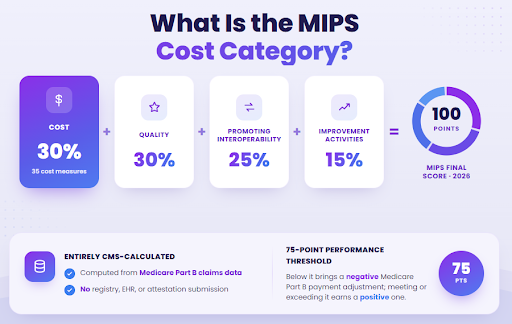
    What Is the MIPS Cost Category?

    The MIPS Cost category is one of four MIPS performance categories under the Quality Payment Program (QPP), alongside Quality, Promoting Interoperability, and Improvement Activities. The Cost category is weighted at 30 percentof the 2026 MIPS final score and covers 35 cost measures in total. Unlike the other three categories, the Cost category is entirely CMS-calculated from Medicare Part B claims data. Clinicians do not submit Cost data through a registry, EHR, or attestation portal.

    The MIPS Cost Category 15% to 100%

    The four MIPS performance categories together form a 100-point MIPS Final Score. The 2026 weight distribution is: Cost at 30%, Quality at 30%, Promoting Interoperability at 25%, and Improvement Activities at 15%. The MIPS performance threshold for 2026 is 75 points. Clinicians scoring below the threshold face a negative payment adjustment; those above earn a positive adjustment to their Medicare Part B payments.

    How Does Cost Contribute to the MIPS Final Score?

    The Cost category contributes up to 30 points to the 100-point MIPS Final Score. CMS calculates a Cost category percent score by averaging the measure-level scores for each cost measure attributed to the clinician. That percent score is then multiplied by the 30% weight to produce the category’s point contribution to the MIPS Final Score. A clinician who scores 90% on Cost contributes 27 of the 30 available Cost points.

    The remaining 70 points come from Quality (30%), Promoting Interoperability (25%), and Improvement Activities (15%). Each category is scored separately, and the four category scores are combined to produce the MIPS Final Score. Clinicians use their annual MIPS feedback report to review Cost performance before the applicable payment adjustment year.

    Do Clinicians Submit MIPS Cost Data?

    No, CMS calculates Cost performance directly from Medicare Part B claims. Clinicians do not submit any Cost data through a registry, EHR vendor, or the QPP portal. The no-submission rule applies only to Cost; the other three MIPS categories (Quality, Promoting Interoperability, and Improvement Activities) require active data submission by the clinician or the reporting group.

    What MIPS Cost Measures Does CMS Use?

    The 2026 MIPS Cost measure inventory contains 35 measures across three classes: 1 Total Per Capita Cost (TPCC) measure, 1 Medicare Spending Per Beneficiary (MSPB) Clinician measure, and 32 episode-based cost measures. CMS attributes each measure to a clinician based on the type of care delivered and the applicable attribution rules. 

    Clinicians may be attributed one, several, or all three measure classes depending on practice type and patient population. The three measure classes differ by trigger type, patient population, and attribution window:

    Measure Class Count (2026) Attribution Trigger Care Focus
    Total Per Capita Cost (TPCC) 1 Primary-care E/M visits (plurality) Primary care, annual
    Medicare Spending Per Beneficiary (MSPB) Clinician 1 Inpatient admission (admitting clinician) Inpatient, episode window
    Episode-based cost measures 32 Procedure or condition trigger code Condition/procedure-specific
    Total 35    

    Each measure class uses a distinct attribution mechanism, and a single patient can generate attribution across multiple measure classes and TIN-NPIs in the same performance year.

    What Is the Total Per Capita Cost (TPCC) Measure?

    The Total Per Capita Cost (TPCC) measure is the primary-care-attributed cost measure that calculates the average annual Medicare Parts A and B costs across all patients attributed to a clinician through primary-care visits. TPCC attribution is based on the plurality of primary-care evaluation and management (E/M) visits. The clinician who bills the highest share of a patient’s primary-care E/M visits over the performance year receives TPCC attribution for that patient.

    TPCC measures the total cost of care across all services, not only services that the attributed clinician delivers personally. That design reflects TPCC’s role as a resource-use measure: the attributed primary-care clinician is accountable for the full cost associated with coordinating care for attributed patients.

    How Did TPCC Change for 2026?

    CMS modified the TPCC measure for 2026 in the November 5, 2025, Physician Fee Schedule Final Rule. Candidate events initiated by Advanced Care Practitioner (ACP) TIN-NPIs are excluded when all non-ACP TIN-NPIs in the group are specialty-excluded. In practice, mixed physician-ACP groups where the physicians fall outside primary-care specialties are less likely to accumulate TPCC attribution under the 2026 rule. 

    Groups with mixed physician-ACP staffing should audit their TIN-NPI composition to determine whether the 2026 TPCC modification changes their attribution exposure before the performance year closes.

    What Is the Medicare Spending Per Beneficiary (MSPB) Clinician Measure?

    The Medicare Spending Per Beneficiary (MSPB) Clinician measure attributes inpatient-care spending to the clinician who serves as the admitting physician for a Medicare hospitalization. The MSPB Clinician episode window spans 3 days before the inpatient admission through 30 days after discharge. All Medicare Parts A and B claims within that window are included in the episode cost calculation.

    MSPB Clinician is distinct from TPCC in both trigger and scope. TPCC is a longitudinal measure across a full performance year of primary-care visits. MSPB Clinician is an episode measure triggered by a single inpatient admission. A hospitalist or attending physician who regularly admits Medicare patients is likely to accumulate MSPB Clinician attribution; a primary-care-only outpatient practice typically does not.

    What Are Episode-Based Cost Measures?

    Episode-based cost measures attribute the total cost of a defined clinical episode to the clinician who billed the trigger code that initiated the episode. The 32 episode-based cost measures active for 2026 include Hip Replacement, Acute Myocardial Infarction (AMI), COPD Exacerbation, Knee Replacement, and Revascularization, among others. Each measure has a specific trigger code, an attribution rule, and a defined episode cost window.

    Episode-based measures fall into two types:

    • Procedure-triggered episodes: The trigger is a specific procedure code, such as a total hip arthroplasty CPT code for the Hip Replacement measure.
    • Condition-triggered episodes: The trigger is a condition-related claim code, such as a COPD-related hospitalization code for the COPD Exacerbation measure.

    The episode cost window includes all Medicare Parts A and B spending from the trigger date through the end of the defined episode period, regardless of which clinician delivered those services.

    How Many MIPS Cost Measures Exist for 2026?

    The 2026 MIPS Cost measure inventory contains 35 total measures: 1 TPCC measure, 1 MSPB Clinician measure, and 32 episode-based measures. CMS finalized one additional claims-based measure for 2026, but that measure carries informational-only status and does not contribute to the Cost category score. 

    The count of scoring-eligible measures is 35, unchanged from 2025 per the November 5, 2025, Physician Fee Schedule Final Rule.

    Can a New MIPS Cost Measure Lower a Clinician’s 2026 Final Score?

    No. Beginning with performance year 2026, any new cost measure CMS finalizes enters a 2-year informational-only feedback period before contributing to the Cost category score or MIPS Final Score. Clinicians receive performance feedback on a new measure during the two informational years, but the measure carries zero scoring weight during that period. Standard scoring for a new measure begins in year 3 of the measure’s existence under MIPS.

    How Does CMS Attribute a MIPS Cost Measure to a Clinician?

    Attribution is the process CMS uses to assign a patient (for TPCC) or a clinical episode (for episode-based measures) to a specific clinician at the TIN-NPI level. CMS assigns attribution based on candidate-event rules that differ across the three measure classes. The unit of attribution is always the TIN-NPI combination: the clinician’s individual National Provider Identifier (NPI) paired with the Tax Identification Number (TIN) of the practice under which the service was billed.

    The attribution process runs automatically from Medicare Part B claims data after the performance year ends. Clinicians do not submit attribution requests. Attribution results are published in the annual MIPS Cost feedback report from CMS and are available through the QPP portal.

    Attribution is the process CMS uses to assign a patient

    What Is a Candidate Event in MIPS Cost Attribution?

    A candidate event is a billed service that triggers the attribution logic for a given MIPS Cost measure. For TPCC, the candidate event is a primary-care evaluation and management (E/M) visit billed by the clinician during the performance year. For episode-based measures, the candidate event is the procedure or condition trigger code that initiates the episode cost window.

    Specialty exclusion rules apply to candidate events. If a clinician’s specialty code appears on CMS’s specialty-exclusion list for a given measure, candidate events billed by that clinician do not trigger attribution for that measure. The 2026 TPCC modification adds a specific exclusion: ACP TIN-NPI candidate events are excluded when all non-ACP TIN-NPIs in the group are specialty-excluded from TPCC.

    How Does TPCC Attribution Differ from Episode-Based Attribution?

    TPCC attribution and episode-based attribution use different triggers, time windows, and attribution logic. The table below compares the two approaches across key attribution dimensions.

    Dimension TPCC Attribution Episode-Based Attribution
    Attribution trigger Plurality of primary-care E/M visits across the performance year A single procedure or condition trigger code
    Time window Full performance year (12 months) Condition- or procedure-specific episode window
    Attribution unit TIN-NPI with the most primary-care E/M visits for the patient TIN-NPI that billed the trigger code
    Typical clinician attributed Primary care physician or ACP with the highest E/M visit share Surgeon, hospitalist, or specialist who performed the trigger procedure

    Worked attribution example: A Medicare patient undergoes total hip replacement surgery. The surgeon’s TIN-NPI billed the hip arthroplasty CPT code, so the surgeon is attributed the Hip Replacement episode-based measure cost for that patient. The same patient sees a primary-care physician for annual management throughout the year. 

    The primary-care physician’s TIN-NPI holds the plurality of primary-care E/M visits, so the primary-care physician is attributed TPCC cost for that same patient. One patient generates two separate cost attributions to two different TIN-NPIs.

    What Is the TIN-NPI Level in MIPS Cost Attribution?

    The TIN-NPI is the attribution unit CMS uses for MIPS Cost. A TIN-NPI is the pairing of a clinician’s individual National Provider Identifier (NPI) with the Tax Identification Number (TIN) of the practice or group through which the clinician billed Medicare. Cost attribution sits at the TIN-NPI level: if the same NPI bills under two different TINs during the performance year, each TIN-NPI pair accumulates attribution and scoring separately.

    TIN-NPI-level attribution matters most for clinicians who practice at multiple locations or switch groups mid-year. Each TIN-NPI combination produces a separate Cost performance result. Group-level reporting combines the TIN-NPI results of all clinicians billing under the group TIN into a single group-level Cost score.

    Can Clinicians Dispute MIPS Cost Attribution?

    Yes. Clinicians can dispute MIPS Cost attribution through the CMS Targeted Review process after the MIPS Final Score is released. Common grounds for a Targeted Review request include incorrect TIN-NPI attribution (for example, claims billed under the wrong TIN), specialty exclusion rules misapplied to the clinician, and candidate events miscoded in the underlying Medicare claims data. Targeted Review requests are submitted through the QPP Help Desk after final scores are published each year.

    How Is Risk Adjustment Applied to MIPS Cost?

    Risk adjustment normalizes raw cost figures for patient mix so that clinicians treating sicker or more complex patients are not penalized for the higher costs associated with that population. CMS applies risk adjustment to MIPS Cost scores using Hierarchical Condition Category (HCC) scores, demographic factors, and dual-eligibility status. 

    Risk adjustment operates at the measure level: each attributed patient’s expected cost is adjusted before comparing actual cost to the performance-period benchmark.

    Without risk adjustment, a primary-care practice serving a high-acuity geriatric population would consistently show higher raw costs than a practice serving healthier Medicare patients, even with identical care quality. Risk adjustment corrects for that population-mix difference before scoring.

    What Is a Hierarchical Condition Category (HCC) Score?

    A Hierarchical Condition Category (HCC) score is a CMS-administered risk model that converts a patient’s ICD-10 diagnosis codes into a numeric risk score. Higher HCC scores indicate greater patient complexity and higher expected Medicare costs. CMS uses HCC scores as the primary input for MIPS Cost risk adjustment: each attributed patient’s HCC score raises or lowers the expected cost against which the clinician’s actual cost is measured.

    HCC scores are built from diagnosis codes submitted on Medicare claims during the measurement period. Incomplete ICD-10 documentation leads to lower HCC scores and underestimated expected costs. 

    What Demographic Factors Affect MIPS Cost Risk Adjustment?

    Four demographic factors apply to MIPS Cost risk adjustment alongside HCC scores. Each factor adjusts the expected cost for a given patient up or down before comparison to the benchmark:

    • Age: Older Medicare beneficiaries carry higher expected costs, and risk adjustment incorporates age-related cost increases across the attributed patient population.
    • Sex: Sex-specific cost differences are incorporated into the CMS risk adjustment model and applied at the individual patient level.
    • Dual-eligibility (Medicare + Medicaid): Beneficiaries enrolled in both Medicare and Medicaid (dual-eligible beneficiaries) carry higher expected costs due to greater social and clinical complexity.
    • Medicaid-status interactions with HCC: Dual-eligibility status interacts with HCC scores to produce a combined adjustment that reflects the compounding effect of clinical and social complexity on expected cost.

    Dual-eligible beneficiaries add the most meaningful adjustment complexity and are the most significant demographic factor for practices serving low-income or underserved populations.

    Does Risk Adjustment Guarantee a Fair MIPS Cost Score?

    No, risk adjustment normalizes Cost scores for HCC-coded complexity, age, sex, and dual eligibility, but risk adjustment does not capture every clinical or social risk factor that drives Medicare cost. Social determinants of health, undocumented chronic conditions, and geographic care-access differences are not fully reflected in HCC-based models. 

    Practices serving complex populations should validate HCC coding completeness annually to confirm that risk adjustment operates on an accurate diagnosis record.

    How Is the MIPS Cost Category Score Calculated?

    The Cost category percent score is the average of all measure-level scores attributed to the clinician, expressed as a percentage. Each measure-level score runs on a scale of 1 to 10, reflecting how the clinician’s actual cost compares to the performance-period benchmark for that measure. 

    The Cost category percent score is then multiplied by the 30% weight to produce the Cost category’s point contribution to the MIPS Final Score. Cost benchmarks use performance-period data, not historical data. The table below shows a simplified three-measure scoring example. 

    Measure Attributed Cases Measure Score (1-10) Weighted Contribution
    TPCC 45 patients 7.2 Part of the average cost percent score
    Hip Replacement (episode-based) 28 episodes 8.1 Part of the average cost percent score
    MSPB Clinician 6 episodes 4.5 Part of the average cost percent score
    Cost Category Percent Score   (7.2 + 8.1 + 4.5) / 3 = 6.6 / 10 x 100 = 66% 66% x 30% = 19.8 MIPS points

    CMS publishes Cost performance feedback through the QPP portal after the performance year closes. Clinicians can review measure-level scores, attributed case counts, and benchmark comparisons in the annual Cost feedback report.

    What Is the 20-Case Minimum for MIPS Cost Scoring?

    A cost measure requires at least 20 attributed cases before CMS scores the measure against the benchmark. For TPCC, a case is an attributed patient. For episode-based measures, a case is an attributed episode. If the attributed count falls below 20 for a given measure, CMS excludes that measure from the Cost category score calculation entirely.

    Low-volume specialties or practices in smaller markets may fall below the 20-case minimum on certain episode-based measures. In that situation, the measure is dropped from the clinician’s Cost category score without penalty. Only measures with 20 or more attributed cases enter the average that produces the Cost category percent score.

    Did the MIPS Cost Category Weight Change for 2026?

    No, CMS held the Cost category weight at 30 percent of the MIPS Final Score, unchanged from 2025, per the November 5, 2025, Physician Fee Schedule Final Rule. The four-category weight distribution for 2026 is: Cost 30%, Quality 30%, Promoting Interoperability 25%, and Improvement Activities 15%. The Cost weight has remained at 30% since the category reached full weighting under MACRA.

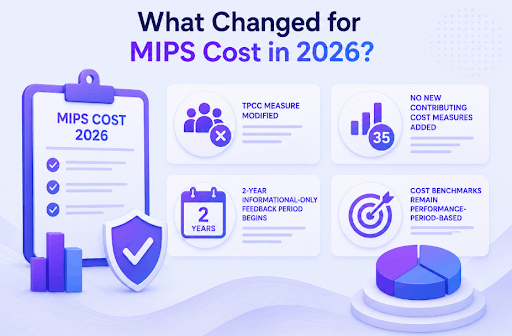
    What Changed for MIPS Cost in 2026?

    CMS finalized four Cost-category updates for 2026 in the November 5, 2025, Physician Fee Schedule Final Rule. The updates cover the TPCC measure design, the scoring-eligible measure count, the treatment of newly-finalized measures, and benchmark methodology:

    CMS finalized four Cost-category updates for 2026

    • TPCC measure modified: Candidate events initiated by ACP TIN-NPIs are excluded when all non-ACP TIN-NPIs in the group are specialty-excluded from TPCC.
    • No new contributing cost measures added: The 35 scoring-eligible measures are unchanged from 2025. One new claims-based measure was finalized but carries informational-only status.
    • 2-year informational-only feedback period begins: Any new cost measure finalized beginning with PY 2026 enters a 2-year informational period before scoring.
    • Cost benchmarks remain performance-period-based: CMS did not shift Cost benchmarks to a historical-data basis for 2026.

    Which 2026 Cost Change Matters Most for Clinicians?

    The TPCC modification matters most for groups with mixed physician-ACP staffing. If a group practice includes physicians who are specialty-excluded alongside ACPs who previously triggered TPCC attribution, the 2026 rule change may reduce or eliminate TPCC attribution for that group. Groups in this situation should audit their TIN-NPI composition and run an attribution review before the performance year ends to understand the practical exposure.

    The 2-year informational-only feedback period carries zero immediate scoring impact because the only new measure finalized for 2026 already enters informational-only status automatically. The remaining two changes (no new contributing measures; benchmark methodology unchanged) are procedural confirmations with minimal operational effect on 2026 Cost scores.

    How Does the 2-Year Informational-Only Feedback Period Work?

    Beginning with performance year 2026, any new cost measure CMS finalizes enters a 2-year informational-only feedback period before contributing to the Cost category score. The three-stage timeline for a new measure runs as follows:

    Year Status Score Impact
    Year of finalization (PY 2026 or later) Informational-only No contribution to Cost score or MIPS Final Score
    Year 2 Informational-only No contribution to Cost score or MIPS Final Score
    Year 3 onward Standard scoring Contributes to the Cost category percent score

    Clinicians receive performance feedback on new-measure results during the two informational years. That feedback allows practices to understand cost position and adjust care coordination patterns before the measure carries scoring weight. The 2-year buffer applies only to measures newly finalized after 2026; existing measures (TPCC, MSPB Clinician, and the 32 episode-based measures) continue under standard scoring in 2026.

    How Can a Practice Influence MIPS Cost Performance?

    Even though CMS calculates MIPS Cost, clinicians influence performance through five indirect levers. Each lever targets a specific cost mechanism within the attribution model:

    • Complete HCC Coding: Accurate ICD-10 documentation confirms that HCC scores reflect true patient complexity. Incomplete HCC coding produces lower risk adjustment and makes actual costs appear higher relative to expected costs, lowering the Cost measure score.
    • Coordinate Post-acute Placement: Placement decisions after hospitalization (skilled nursing facility, home health, or self-managed recovery) directly affect episode costs for episode-based measures and MSPB Clinician, because post-discharge claims fall inside the episode window.
    • Manage Referral Patterns: Referrals to in-network or value-based specialists reduce fragmentation costs that fall inside the attribution windows of TPCC and episode-based measures.
    • Follow Up After Hospital Discharge: Timely post-discharge primary-care visits reduce readmission risk and the associated claims that accumulate inside MSPB Clinician and episode-based episode windows.
    • Document Primary-care Visits Fully: Complete primary-care visit documentation supports both HCC accuracy and TPCC attribution. Underdocumented visits may not qualify as primary-care E/M visits, reducing the visit count that determines TPCC attribution.

    How Does Macralytics Monitor MIPS Cost Attribution and Risk?

    Macralytics reviews MIPS Cost attribution accuracy using QPP feedback reports, validates HCC coding completeness against the attributed patient population, and identifies episode-based measure exposures before the performance year closes. The review process checks TIN-NPI-level attribution results, flags candidate events that may be subject to specialty exclusion, and confirms that risk adjustment inputs align with the practice’s actual patient complexity.

    Practices that complete an attribution review before year-end have time to correct documentation gaps and request a Targeted Review if attribution errors are identified after final-score release. For details on how we monitor MIPS Cost performance, visit the Macralytics QPP services page.

    Do MIPS Value Pathway (MVP) Cost Measures Match Traditional MIPS Cost Measures?

    Partial. MIPS Value Pathways (MVPs) draw from the same 35-measure inventory used in traditional MIPS, but MVP participants receive a specialty-aligned subset of those measures rather than the full set. The attribution rules for MVP Cost differ from traditional MIPS Cost attribution because MVPs apply MVP-specific candidate-event logic aligned to each pathway’s specialty focus. 

    The underlying measure logic for TPCC, MSPB Clinician, and the 32 episode-based measures is unchanged across both pathways. The subset of measures scored and the attribution path that leads to each score differ between traditional MIPS and MVP reporting.

    The MIPS Cost category is the CMS-calculated, claims-based 30%-weighted component of the MIPS Final Score that measures resource use across 35 measures for the 2026 performance year. Clinicians submit no Cost data; attribution and scoring run automatically from Medicare Part B claims.

  • MIPS Performance Categories: Quality, Cost, PI, IA

    MIPS Performance Categories: Quality, Cost, PI, IA

    MIPS, the Merit-Based Incentive Payment System, scores Medicare Part B clinicians across four performance categories: Quality (30%), Cost (30%), Promoting Interoperability (25%), and Improvement Activities (15%) for the 2026 performance year. 

    CMS combines the four weighted scores into a MIPS final score on a 0 to 100 scale. The final score is compared to the 75-pointperformance threshold. This is done to set each clinician’s payment adjustment, up to plus or minus 9 percent of Medicare Part B allowed charges, applied two years later.

    Read the article below to understand all of the performance categories in detail. After going through this guide, you will have a firm grip on the weightage of each performance category, reweighting redistribution, and other related concepts. 

    What are MIPS Performance Categories?

    MIPS Performance Categories are the four scoring areas CMS uses to evaluate clinician performance under the Quality Payment Program. Each category is scored on an internal 100-point scale, weighted, and summed to produce the MIPS final score. MIPS scores clinicians across four performance categories, including Quality, Cost, Promoting Interoperability, and Improvement Activities.

    The 2026 standard weights are Quality 30 percent, Cost 30 percent, Promoting Interoperability 25 percent, and Improvement Activities 15 percent, per the November 5, 2025 Physician Fee Schedule Final Rule. The four category scores combine into a MIPS final score on a 0 to 100 point scale. 

    The following table shows the 2026 standard weights, what each category measures, and which party is responsible for submitting the data.

    Category 2026 Weight What It Measures Who Submits
    Quality 30% Clinical care delivery via 6 clinician-selected measures from a 187-measure inventory Clinician
    Cost 30% Resource use measured via Medicare Part B claims data CMS calculates, no clinician submission
    Promoting Interoperability (PI) 25% Electronic health information exchange using CEHRT Clinician
    Improvement Activities (IA) 15% Practice-improvement work across approximately 100 activities Clinician

    Quality and Cost each carry equal weight at 30 percent, making them the two largest scoring components. The following sections cover each MIPS Performance Category in the order CMS lists the categories in the title. 

    What is the MIPS Quality Category?

    The MIPS Quality category measures clinical care delivery and accounts for 30 percent of the 2026 MIPS final score. CMS finalized 187 MIPS Quality measures for the 2026 performance year, including 5 new measures, 10 retired measures, and 30 substantively modified measures.

    Clinicians select 6 measures from the 187-measure inventory, with at least 1 outcome or high-priority measure required. Quality measures require 75 percent data completeness for the 2026 performance year. CMS scores each submitted measure against a decile benchmark derived from prior-year national performance data.

    Key Quality category requirements for the 2026 performance year:

    • Measure Selection: 6 measures from 187 total, including at least 1 outcome or high-priority measure per CMS guidelines.
    • Data Completeness: 75 percent of submitted cases must meet the completeness criterion or the measure receives a score of zero.
    • Benchmarking: CMS scores each measure against a decile performance band using prior-year national performance data as the reference population.
    • Topped-out Measures: CMS caps the scoring contribution for measures where national performance consistently exceeds the top decile, limiting maximum point accrual.

    Weighted at 30 percent, the Quality category is one of the two highest-weighted MIPS Performance Categories alongside Cost. 

    What is the MIPS Cost Category?

    The MIPS Cost category measures resource use and accounts for 30 percent of the 2026 MIPS final score. The Cost category includes 35 measures for 2026: Total Per Capita Cost (TPCC), Medicare Spending Per Beneficiary (MSPB), and 32 episode-based cost measures.

    CMS calculates Cost performance directly from Medicare Part B claims. Clinicians do not submit Cost data. New cost measures enter a two-year informational-only feedback period before counting in the MIPS final score, allowing practices to review attribution data before the measure affects payment.

    Cost category key facts for 2026:

    • Total measures: 35 total, structured as TPCC, MSPB, and 32 episode-based cost measures.
    • Submission requirement: None. CMS calculates the Cost category entirely from Medicare Part B claims.
    • New-measure transition: A two-year informational-only feedback period applies to newly adopted cost measures.
    • Attribution review: Practices benefit from auditing their claims attribution to understand which Cost measures apply before payment calculations are finalized.

    What is the MIPS Promoting Interoperability (PI) Category?

    The MIPS Promoting Interoperability (PI) category measures electronic health information exchange and accounts for 25 percent of the 2026 MIPS final score. PI replaced the Medicare EHR Incentive Program (Meaningful Use) in 2017 under the Quality Payment Program framework.

    The PI category requires Certified Electronic Health Record Technology (CEHRT), specifically the 2015 Edition Cures Update, for the 2026 performance year. Clinicians must use CEHRT for a continuous 180-day minimum reporting period during the performance year.

    Key 2026 updates to the PI category include:

    • Security Risk Analysis (SRA): The SRA now requires two yes-attestations under the HIPAA Security Rule starting in PY 2026, replacing the prior single-attestation standard.
    • 2025 SAFER Guides: CMS adopted the 2025 SAFER Guides as the current self-assessment framework for PI reporting readiness.
    • TEFCA Bonus Measure: A new optional Public Health Reporting bonus measure under the Trusted Exchange Framework and Common Agreement (TEFCA) is available for clinicians participating in a national interoperability network.

    What is the MIPS Improvement Activities (IA) Category?

    The MIPS Improvement Activities (IA) category measures practice-improvement work and accounts for 15 percent of the 2026 MIPS final score. The IA inventory includes approximately 100 activities organized across CMS-defined subcategories.

    Clinicians attest to 2 activities (or 1 activity with a qualifying special status) for a minimum of 90 continuous days during the performance year. Each activity carries a defined weight toward the 40-point IA maximum score.

    IA activity weights and requirements for 2026:

    • High-weighted Activities: Each high-weighted IA is worth 20 points toward the 40-point maximum.
    • Medium-weighted Activities: Each medium-weighted IA is worth 10 points toward the 40-point maximum.
    • Minimum Duration: 90 continuous days of activity performance per attestation period.
    • 2026 Subcategory Change: The Advancing Health and Wellness (AHW) subcategory replaces the Achieving Health Equity (AHE) subcategory, per the November 5, 2025 Final Rule. Three new activities were added and 8 were removed.

    How does MIPS Reweighting Redistribute Category Weights?

    Reweighting is the process by which CMS redistributes the weight of a MIPS Performance Category reduced to 0 percent across the remaining three scored categories. Three conditions trigger reweighting: 

    • A qualifying special status
    • An approved hardship exception
    • An inability to score a category due to insufficient data.

    When Promoting Interoperability is reweighted to 0 percent, the redistribution path differs for large practices and small practices (15 eligible clinicians or fewer). For large practices, the 25 percent PI weight redistributes equally between Quality and Cost. For small practices, the PI weight flows to Quality and IA rather than to Cost.

    The following table shows the standard 2026 weights alongside four reweighting scenarios for large practices and small practices.

    Scenario Quality Cost PI IA
    Standard (all categories scored) 30% 30% 25% 15%
    PI = 0% (large practice) 42.5% 42.5% 0% 15%
    PI = 0% (small practice with ≤15 clinicians) 40% 30% 0% 30%
    Quality = 0% (approved exception) 0% 37.5% 37.5% 25%
    IA = 0% (approved exception) 34.3% 34.3% 31.4% 0%

    Small practices with no PI submission are auto-reweighted to Quality 40 percent and IA 30 percent under the traditional MIPS 2026 structure. 

    What is Automatic vs. Manual Reweighting?

    Automatic reweighting means CMS applies the category weight redistribution without any clinician action, triggered by a qualifying special status. Manual reweighting means a clinician submits an approved Hardship Exception or Extreme and Uncontrollable Circumstances (EUC) application to request redistribution.

    Clinicians who receive automatic reweighting for Promoting Interoperability can still override the automatic status by voluntarily submitting PI data during the performance year. Voluntary PI submission restores the standard 25 percent PI weight and removes the automatic reweighting from the final score calculation.

    Which Special Statuses Trigger Automatic Reweighting of PI?

    Four special statuses trigger automatic reweighting of Promoting Interoperability to 0 percent. CMS applies the redistribution without any clinician action when a qualifying status is confirmed for the performance year.

    Special Status Qualifying Threshold PI Redistribution (Large Practice) PI Redistribution (Small Practice with ≤15)
    ASC-based Clinician (POS code 24) ≥75% of Medicare services billed with POS 24 25% split: Quality +12.5%, Cost +12.5% 25% split: Quality +10%, IA +15%
    Hospital-based Clinician ≥75% of Medicare services in hospital settings (POS 21, 22, or 23) 25% split: Quality +12.5%, Cost +12.5% 25% split: Quality +10%, IA +15%
    Non-patient-facing Clinician ≤100 patient-facing encounters in the prior performance year 25% split: Quality +12.5%, Cost +12.5% 25% split: Quality +10%, IA +15%
    Small Practice ≤15 eligible clinicians in the group 25% split: Quality +12.5%, Cost +12.5% 25% split: Quality +10%, IA +15%

    Clinicians who qualify under any of the four automatic reweighting statuses may still submit Promoting Interoperability data voluntarily. Voluntary PI submission overrides automatic reweighting and restores the standard 25 percent PI weight in the MIPS final score calculation. 

    How Do the Four MIPS Category Scores Combine into the MIPS Final Score?

    The four MIPS Performance Category scores combine into the MIPS final score using the following formula: 

    (Quality Score × 0.30) + (Cost Score × 0.30) + (Pi Score × 0.25) + (Ia Score × 0.15) + Applicable Bonus Points. 

    The MIPS performance threshold is 75 points for performance year 2026, held through 2028.

    A worked example shows the calculation for a clinician scoring 80 percent on Quality, 70 percent on Cost, 88 percent on PI, and 100 percent on IA:

    • Quality: 80 × 0.30 = 24.0 points
    • Cost: 70 × 0.30 = 21.0 points
    • Promoting Interoperability: 88 × 0.25 = 22.0 points
    • Improvement Activities: 100 × 0.15 = 15.0 points
    • Base MIPS final score: 82.0 points

    A base score of 82.0 exceeds the 75-point threshold, placing the clinician above the performance threshold and qualifying for a positive payment adjustment. MIPS adjusts Medicare Part B payments by up to plus or minus 9 percent based on final score position relative to the threshold and the performance benchmark.

    A final score below 75 points triggers up to a negative 9 percent Medicare Part B adjustment. The complex-patient bonus and other applicable bonuses are added to the base calculation after the four weighted category scores are summed. PY 2026 performance results affect 2028 Medicare Part B payments.

    What Changed in the Four MIPS Performance Categories for 2026?

    CMS finalized four-category updates for 2026 in the November 5, 2025 Physician Fee Schedule Final Rule. Each MIPS Performance Category received distinct changes to its measure inventory, reporting rules, or subcategory structure.

    Category What Changed for 2026 What Did Not Change
    Quality 5 new measures added; 10 retired; 30 substantively modified — 187 total measures 6-measure selection rule; 75% data completeness requirement; decile benchmarking structure
    Cost No new measures added; 35 measures retained from 2025 TPCC, MSPB, and episode-based structure; no-submission rule; two-year informational-only period
    Promoting Interoperability (PI) SRA now requires two yes-attestations; 2025 SAFER Guides adopted; TEFCA bonus measure added 180-day continuous reporting period; 2015 Edition Cures Update CEHRT requirement
    Improvement Activities (IA) 3 new activities added; 8 activities removed; AHW subcategory replaces AHE subcategory 90-day continuous attestation period; high-weighted (20 pts) and medium-weighted (10 pts) structure

    The 2026 Final Rule also added 6 new specialty types to MIPS Value Pathways (MVPs), bringing the total MVP count to 27 active pathways for the performance year.

    Which of The Four MIPS Categories Changed Most for 2026?

    Promoting Interoperability changed most for 2026. The SRA two-attestation requirement is the largest single-rule shift across all four MIPS Performance Categories, as the change replaces a long-standing single-attestation standard with a dual-attestation requirement under the HIPAA Security Rule.

    Improvement Activities ranks second in change depth, with the Advancing Health and Wellness (AHW) subcategory replacing Achieving Health Equity (AHE) and 8 activities removed from the inventory. Quality and Cost received measure-inventory updates but no rule-level changes to selection methodology or submission requirements. Rule changes carry greater scoring impact than inventory updates alone.

    Which MIPS Performance Category Should a Practice Prioritize First?

    Category prioritization depends on four factors specific to each practice. The fastest path to the 75-point performance threshold varies based on special status, CEHRT readiness, existing Quality data maturity, and available time in the performance year.

    • Check special status first. ASC-based, hospital-based, non-patient-facing, and small practices receive automatic PI reweighting to 0 percent. Practices with PI auto-reweighted skip PI preparation entirely and reallocate that effort to Quality, Cost attribution, and IA.
    • Lock PI early if CEHRT is installed. PI accounts for 25 percent of the MIPS final score. A practice with a functioning 2015 Edition Cures Update CEHRT system that secures a strong PI score early builds a large portion of the threshold in one category.
    • Prioritize Quality when the measured inventory is mature. Six measures averaging the 7th or 8th decile yield 21 to 24 points of the 30-point Quality weight. Quality performance compounds across performance years as benchmark positions improve.
    • Use IA for the fastest single-quarter lift. One or two activity attestations covering 90 continuous days earns the full 15-point IA contribution. IA is the quickest incremental path to the threshold for practices starting below 75 points.

    Cost is CMS-calculated from Medicare Part B claims. The Cost category requires attribution review rather than direct submission, so practices focus on confirming which episode-based measures apply to their patient population. 

    MIPS Value Pathways offer specialty-specific measure bundles covering all four MIPS Performance Categories for practices in one of the 27 available MVPs. 

    How Does Quality Compare to IA for Fast Threshold Attainment?

    IA wins on speed: 1 to 2 attestations covering 90 continuous days earns the full 15-point IA contribution toward the performance threshold. Quality wins on ceiling: 6 measures averaging the 7th or 8th decile yield 21 to 24 points of the 30-point Quality weight over a full performance year.

    Category Lever Time to Full Points Maximum Contribution to Final Score
    Improvement Activities (IA) 90 continuous days 15 points
    Quality Full 12-month performance year 30 points

    For practices scoring below the 75-point threshold, an IA-first combined with Quality-second sequence is the fastest dual-lever path to threshold attainment. The two categories together contribute up to 45 points of the 75-point minimum target.

    How Does Macralytics Support Practices Across All Four MIPS Performance Categories?

    Macralytics conducts category-by-category audits for each of the four MIPS Performance Categories as part of the MIPS Reporting Services workflow. The Macralytics process covers Quality measure selection from the 187-measure inventory, PI attestation management for the two-attestation SRA requirement, Cost attribution review, and IA activity identification to reach the 75-point threshold.

    Practices that work with Macralytics receive a structured review of each MIPS Performance Category before the performance year begins. The review covers applicable special statuses, CEHRT readiness for PI, measure-selection logic for the Quality category, and eligible activities for IA. 

    What are the Most Common MIPS Performance Category Questions?

    Five questions surface consistently when clinicians review the four MIPS Performance Categories. Here we will answer them to clear doubts related to MIPS performance categories. 

    Are the four MIPS performance categories weighted equally?

    No, the four MIPS Performance Categories carry different weights for 2026: Quality at 30 percent, Cost at 30 percent, Promoting Interoperability at 25 percent, and Improvement Activities at 15 percent. Weights shift through reweighting when a category is reduced to 0 percent and the weight redistributes across the remaining three scored categories.

    Did MIPS performance category weights change for 2026?

    No, CMS held the standard weights unchanged from 2025: Quality 30 percent, Cost 30 percent, Promoting Interoperability 25 percent, and Improvement Activities 15 percent, per the November 5, 2025 Physician Fee Schedule Final Rule.

    Can a MIPS performance category be reweighted to zero percent?

    Yes, CMS automatically reweights Promoting Interoperability to 0 percent for ASC-based, hospital-based, non-patient-facing, and small-practice clinicians (15 eligible clinicians or fewer). Other MIPS Performance Categories can be reweighted to 0 percent through an approved Hardship Exception or when insufficient data prevents CMS from scoring the category.

    Is Cost the only MIPS category CMS calculates without clinician submission?

    Yes, CMS calculates Cost performance directly from Medicare Part B claims, as clinicians submit no Cost data. The other three MIPS Performance Categories (Quality, Promoting Interoperability, and Improvement Activities) require active clinician submission during the performance year.

    Do the four MIPS performance categories apply to MVP reporting?

    Yes, MIPS Value Pathways cover all four MIPS Performance Categories. Promoting Interoperability functions as a foundation layer across all 27 MVPs for 2026, and each MVP bundles specialty-specific Quality, IA, and Cost measures alongside the PI foundation layer.

  • MIPS (Merit-Based Incentive Payment System): The Ultimate Guide

    MIPS (Merit-Based Incentive Payment System): The Ultimate Guide

    MIPS is a value-based payment program under the Centers for Medicare & Medicaid Services(CMS) that adjusts Medicare Part B payments based on clinician performance. It evaluates providers on quality, cost, improvement activities, and use of certified EHR systems. The system mainly focuses on two key areas, Quality and Cost, which carry the highest weight in scoring. 

    Quality measures include outcomes like blood pressure control, preventive screenings, and chronic disease management. The reporting process includes data collection, measure selection, and data submission through approved channels. Not submitting MIPS data leads to penalties of up to -9% on Medicare payments. 

    Eligibility depends on Medicare billing thresholds and applies mainly to physicians, nurse practitioners, and physician assistants who meet minimum service and patient volume requirements. Providers can improve performance by selecting strong measures, improving documentation, and using certified EHR systems effectively. 

    MIPS also provides benefits such as financial incentives, improved patient outcomes, and better compliance with federal standards. In 2027, CMS is expected to further expand MIPS Value Pathways and increase performance thresholds. This guide provides a clear breakdown of how MIPS works, including scoring, reporting requirements, eligibility rules, penalties, and strategies to improve performance under the CMS value-based payment system.

    What is MIPS in Healthcare?

    MIPS in healthcare is a Medicare Part B value-based payment program administered by the Centers for Medicare and Medicaid Services (CMS). MIPS is one of two participation tracks under the Quality Payment Program (QPP). CMS scores MIPS across four categories on a Final Score from 0 to 100 points.

    MACRA, the Medicare Access and CHIP Reauthorization Act of 2015, created the Merit-Based Incentive Payment System. MIPS replaced PQRS (the Physician Quality Reporting System), the Value-Based Payment Modifier, and the Medicare EHR Incentive Program (Meaningful Use) in performance year 2017.

    • Administered by the Centers for Medicare and Medicaid Services (CMS)
    • Applies only to Medicare Part B billing, not Medicaid services
    • Created under MACRA legislation in 2015 and active from PY2017
    • Operates on a two-year lag (PY2024 affects 2026 Medicare Part B payments)
    • Replaced three legacy programs: PQRS, the Value-Based Payment Modifier, and Meaningful Use

    For the parent program context, see the Quality Payment Program complete guide.

    Who is Required to Participate in MIPS?

    Thirteen clinician types are eligible for MIPS reporting under Medicare Part B. CMS identifies each eligible clinician by National Provider Identifier (NPI) and Tax Identification Number (TIN). A clinician must report MIPS data when Medicare Part B billing exceeds the low-volume threshold in a determination period.

    The 13 MIPS-eligible clinician types are:

    1. Physicians
    2. Physician Assistants (PAs)
    3. Nurse Practitioners (NPs)
    4. Clinical Nurse Specialists (CNSs)
    5. Certified Registered Nurse Anesthetists (CRNAs)
    6. Physical Therapists (PTs)
    7. Occupational Therapists (OTs)
    8. Speech-Language Pathologists (SLPs)
    9. Qualified Audiologists
    10. Registered Dietitians or Nutrition Professionals
    11. Clinical Psychologists
    12. Clinical Social Workers
    13. Certified Nurse-Midwives

    A clinician crosses the low-volume threshold when three criteria are exceeded together during the determination period:

    • $90,000 in Medicare Part B allowed charges
    • 200 Part B patients
    • 200 covered professional services

    All three thresholds must be exceeded for MIPS reporting to apply. CMS publishes a QPP Participation Status Lookup tool at qpp.cms.gov, where each clinician can verify MIPS eligibility by entering an NPI. Below-threshold clinicians remain exempt unless they opt in voluntarily.

    What are the Four MIPS Performance Categories?

    MIPS contains four performance categories that combine into a single Final Score from 0 to 100 points. Each category carries a fixed weight under standard, non-MVP reporting for performance year 2024. The Quality and Cost categories carry the heaviest weight at 30 percent each.

    The following table shows each MIPS performance category, its PY2024 weight, what it measures, and what triggers reweighting.

    Category Weight (PY2024) What it measures Reweighting triggers
    Quality 30% Clinical quality measures reported across the performance year Insufficient data, fewer than six measures available, hardship approval
    Promoting Interoperability (PI) 25% EHR-based exchange of patient health information using CEHRT Hospital-based, ASC-based, non-patient-facing, small-practice, EUC events
    Improvement Activities (IA) 15% Activities that improve clinical practice, care coordination, or patient engagement Approved hardship application, EUC events
    Cost 30% Resource use across attributed Medicare Part B beneficiaries First-year participation, attribution thresholds not met, EUC events

    Each category score scales to its weight, then sums to the MIPS Final Score. The Quality category requires Certified Electronic Health Record Technology (CEHRT) for the Promoting Interoperability category measures. The Cost category is calculated by CMS from claims data and requires no submission from the clinician.

    If one category is reweighted to zero, CMS redistributes that weight across the remaining categories. For a deeper category-level breakdown, see the MIPS performance categories deep-dive.

    How is the MIPS Final Score calculated?

    The MIPS score is calculated as a single composite score out of 100 points, where each performance category contributes based on its assigned weight. Each category score is first measured individually, then converted into weighted points, and finally added together to form the final score. 

    Final MIPS Score = (Quality Score × Weight) + (Cost Score × Weight) + (Promoting Interoperability Score × Weight) + (Improvement Activities Score × Weight)

    Example Calculation

    Assume a clinician has the following scores:

    • Quality = 80
    • Cost = 70
    • Promoting Interoperability = 90
    • Improvement Activities = 100

    Now apply weights:

    • Quality (30%) → 80 × 0.30 = 24
    • Cost (30%) → 70 × 0.30 = 21
    • Promoting Interoperability (25%) → 90 × 0.25 = 22.5
    • Improvement Activities (15%) → 100 × 0.15 = 15

    Final Score = 24 + 21 + 22.5 + 15 = 82.5 / 100

    The final score (0–100) is then compared against the annual performance threshold to determine payment adjustments. A higher score means a larger positive adjustment, and a lower score yields a negative adjustment.

    What are the Performance Thresholds and Penalties for MIPS?

    These performance thresholds and payment adjustment rules are established by the Centers for Medicare & Medicaid Services (CMS) under the Quality Payment Program framework. CMS reviews national performance data each year and sets these benchmarks to ensure fair evaluation. The table below shows how these CMS-defined thresholds translate into real financial outcomes for clinicians:

    Outcome Score Range Threshold Status Payment Adjustment Description
    Maximum Penalty 0 – 18.75 pts Below threshold −9% Lowest scores receive the maximum negative adjustment to Medicare Part B reimbursements.
    Sliding Penalty 18.76 – 74.99 pts Below threshold −9% to 0% Partial penalty on a sliding scale — the closer to 75, the smaller the reduction.
    Neutral 75 pts (exactly) = Threshold 0% Score meets the threshold exactly. No bonus, no penalty. Reimbursements unchanged.
    Positive Incentive 75.01 – 100 pts Above threshold Up to +9% Higher scores earn progressively larger positive adjustments. Top performers gain maximum.

    What Is the Process of MIPS Reporting?

    The MIPS reporting service process involves collecting data, selecting measures, submitting data, receiving CMS feedback, and adjusting payment based on performance. Here is the step-by-step process involved in MIPS reporting:

    Data Collection

    Data collection means gathering patient and performance information from daily clinical practice. This data is usually taken from EHR systems, registries, and billing records. Accurate data is very important because even small errors can affect the final MIPS score. Good documentation ensures correct reporting and better performance results.

    Measure Selection

    Measure selection directly impacts the final MIPS score. Clinicians should choose measures that match their specialty and patient population so the reporting is accurate. Specialty-specific measure sets are available to help providers select appropriate measures for their practice.

    High-performance measures with achievable benchmarks help maximize scoring potential. It is also important to choose measures where the practice already performs well, as this reduces the risk of low scores and reporting gaps.

    Data Submission

    Clinicians can submit MIPS data through four main methods: EHR systems, qualified registries, QCDRs, and claims-based reporting. CMS requires data to meet specific technical and completeness standards. Submission deadlines fall in March of the year following the performance year.

    EHR and registry submissions offer more measure options than claims-based reporting. Each submission method has specific technical requirements. Providers should verify compatibility with their current systems before choosing a method.

    CMS Feedback

    CMS provides a formal feedback report after processing MIPS submissions. The feedback report shows a scoring breakdown for each performance category. It identifies gaps in performance and areas for improvement. 

    Clinicians can access their feedback through the QPP portal. The report helps providers understand how their final score was calculated. Reviewing feedback is essential for preparing stronger submissions in future years.

    Payment Adjustment

    Payment adjustments are applied to Medicare Part B payments through the Physician Fee Schedule (PFS). Clinicians who score above the performance threshold receive a positive adjustment. Those who score below receive a negative adjustment. 

    The maximum positive adjustment is +9%, and the maximum penalty is -9%. Exceptional performers may qualify for additional bonuses through the exceptional performance threshold. Clinicians can view their final score and payment adjustment through the CMS QPP portal.

    What Does The MIPS EUC Policy Mean?

    MIPS EUC means Extreme and Uncontrollable Circumstances. It is CMS relief for situations that are rare and outside the clinician’s control, such as events that make normal MIPS reporting difficult or impossible. This policy automatically reweights performance categories to 0% to provide neutral payment adjustments without needing a formal application. 

    • Purpose: It provides relief from the normal MIPS reporting burden when major outside events disrupt care or reporting.
    • Trigger Events: CMS describes these as rare events outside the control of the clinician or the facility, and its EUC materials include situations such as natural disasters and cyberattacks. CMS’s broader QPP materials also reference major disruptions like public health emergencies.
    • Types of Relief: Approved EUC requests can lead to category reweighting and, in some cases, exception/exemption-style relief from affected reporting requirements.

    Who Qualifies for the EUC policy?

    EUC relief is available to individuals, group practices, and clinicians in CMS-designated disaster areas. Qualifying criteria include clinician location in an affected region, active enrollment in Medicare, and a documented qualifying event. Clinicians in declared public health emergencies qualify automatically in many cases. Excluded groups include those with prior compliance violations related to MIPS fraud.

    How to Apply for the EUC Exemption?

    Applying for an Extreme and Uncontrollable Circumstances (EUC) exemption under MIPS depends on whether your exemption is automatic or requires an application.

    1. Check If You Qualify For Automatic EUC
    • If CMS designates your area for a disaster (e.g., wildfire, public health emergency), the exemption may be applied automatically.
    • In that case, you do not need to apply. CMS identifies eligible clinicians and reweights categories to 0%.
    • If Not Automatic → Submit An EUC Exception Application

    You must apply if:

    • You are a group, virtual group, or APM entity, or
    • You were affected by an event but not included in automatic relief

    Steps To Apply

    • Go to the Quality Payment Program (QPP) portal
      • Log in using your HARP (HCQIS Access Roles and Profile) credentials
    • Select “Exception Applications”
      • Choose EUC Exception Application
    • Choose affected performance categories
      • Quality
      • Cost
      • Improvement Activities
      • Promoting Interoperability
    • Provide details of the event
      • Example: natural disaster, cyberattack, EHR failure
      • Explain how it impacted your ability to collect or submit data
    • Submit before the deadline
      • Typically, December 31 of the performance year
    • What happens after submission
      • CMS reviews your request
      • If approved → selected categories are reweighted to 0%
      • This results in a neutral payment adjustment

    How does EUC affect MIPS scoring?

    EUC policy allows eligible clinicians affected by disasters to have their performance categories reweighted to 0%, which results in a neutral payment adjustment under Medicare. When EUC is approved, CMS can reweight one, some, or all four MIPS performance categories to 0%.

    If all categories are reweighted, the clinician’s final score is automatically set equal to the performance threshold. This way, they neither gain nor lose Medicare payments.

    How does MIPS affect Medicare Part B payments?

    MIPS adjusts Medicare Part B payments by up to plus or minus 9 percent. Each adjustment applies two years after the performance year. CMS applies the adjustment factor to allowed charges on each Medicare Part B claim during the corresponding payment year.

    The following table shows the performance year-to-payment year ladder, including submission and feedback windows.

    Performance Year Submission Window Feedback Release Payment Year
    PY2023 Jan 2 to Mar 31, 2024 July 2024 2025
    PY2024 Jan 2 to Apr 1, 2025 July 2025 2026
    PY2025 Jan 2 to Mar 31, 2026 July 2026 2027
    PY2026 Jan 2 to Mar 31, 2027 July 2027 2028

    A practice with $500,000 in Medicare Part B allowed charges receives a $45,000 reduction at a -9 percent adjustment. The same practice receives a positive adjustment at the same scale if the final score exceeds 75 points.

    For practices needing reporting support to avoid the -9 percent MIPS penalty, expert review can confirm category scoring before the submission window closes.

    When are MIPS Reporting Deadlines?

    The MIPS submission window opens January 2 and closes March 31 of the year following the performance year. The performance year runs January 1 through December 31. CMS releases performance feedback in July, followed by a Targeted Review window of approximately 60 days.

    The following table maps each performance year stage to its calendar window.

    Performance Year Submission Window Feedback Release Targeted Review Window Payment Year
    PY2024 Jan 2 to Apr 1, 2025 July 2025 ~60 days post-release 2026
    PY2025 Jan 2 to Mar 31, 2026 July 2026 ~60 days post-release 2027
    PY2026 Jan 2 to Mar 31, 2027 July 2027 ~60 days post-release 2028

    CMS does not permit late MIPS submissions. A missed submission window results in a -9 percent Medicare Part B adjustment unless an approved Extreme and Uncontrollable Circumstances (EUC) application applies. The hardship and EUC application deadline is December 31 of the performance year.

    What MIPS Reporting Methods Can Clinicians Choose?

    CMS approves five standard MIPS reporting mechanisms for performance year 2024. Each method supports different MIPS performance categories. Each method also supports a defined submission unit, such as an individual, a group, or a virtual group.

    The following table shows MIPS reporting methods, their best use case, supported categories, and submission units.

    Method Best for Categories supported Submission unit
    Qualified Registry Small to mid-size practices reporting Quality and IA Quality, IA, PI Individual, group, virtual group
    Qualified Clinical Data Registry (QCDR) Specialty practices using QCDR-specific measures Quality, IA, PI Individual, group, virtual group
    EHR / CEHRT Practices using a certified EHR system for direct submission Quality, IA, PI Individual, group, virtual group
    Medicare Claims Solo and small-practice clinicians (15 or fewer NPIs at TIN) Quality only Individual
    CMS Web Interface Legacy reporting unit, sunset for most cases Quality Group (limited eligibility)

    Reporting units, including individual NPI-level, TIN-level group, virtual group, and APM Entity submissions, are covered separately in the supplementary section. MVP-specific reporting follows its own structured measure groups.

    What is the Cost of MIPS Non-Participation?

    A clinician who skips MIPS reporting receives a -9 percent Medicare Part B payment adjustment for the corresponding payment year. The penalty applies two years after the missed performance year. Failure to participate also forfeits any positive adjustment the clinician could have earned.

    A worked example clarifies the dollar exposure:

    • Practice Medicare Part B allowed charges: $500,000
    • Direct penalty at -9 percent: $45,000 reduction in payment year
    • Foregone positive adjustment (if PT exceeded): scaled positive percentage on the same $500,000 base
    • Combined opportunity cost: penalty plus the missed positive scaled adjustment

    Hardship and Extreme and Uncontrollable Circumstances (EUC) exceptions offer an alternative path for clinicians blocked from reporting. Each application must be submitted to CMS by December 31 of the performance year. Approval reweights or waives specific MIPS performance categories.

    What is the Difference Between MIPS and Advanced APMs?

    CMS divides QPP participation into MIPS and Advanced Alternative Payment Models (Advanced APMs) based on financial-risk participation. MIPS clinicians submit data and receive a scored Medicare Part B adjustment. Advanced APM Qualifying APM Participants (QPs) take on downside financial risk and are exempt from MIPS reporting.

    The following table compares the two QPP tracks across the core decision factors.

    Feature Traditional MIPS Advanced APM
    Financial risk None (data submission only) Downside risk required for QP status
    MIPS exempt status No, reporting is required Yes, QPs are excluded from MIPS reporting
    Payment adjustment Plus or minus 9% on Medicare Part B claims APM Incentive Payment (sunset) and QP conversion factor differential post-2025
    Reporting burden Four performance categories submitted to CMS APM-level reporting through the APM Entity
    Example Specialty practice reporting via QCDR Medicare Shared Savings Program ACO at the Advanced track

    A clinician with Partial QP status can elect to report MIPS or stay out of MIPS for that year. Practice-level financial-risk capacity drives the choice between MIPS and Advanced APM tracks.

    What are MIPS Value Pathways (MVPs)?

    MIPS Value Pathways (MVPs) are CMS-curated, specialty-aligned reporting bundles that shorten traditional MIPS measure selection. Each MVP bundles a specialty’s most relevant Quality measures, Improvement Activities, and Promoting Interoperability requirements. Two example MVPs are the Heart Disease MVP and the Diabetes MVP.

    Each MVP contains two layers:

    • Foundation layer: A shared base of Promoting Interoperability measures and population health Quality measures applied across MVPs
    • Measure groups: Specialty-specific Quality measures and Improvement Activities curated by clinical area
    • Subgroup reporting: Multi-specialty TINs can split into subgroups to report MVPs aligned to each specialty

    CMS continues to expand the MVP catalog each Final Rule cycle. The CY2026 Physician Fee Schedule Final Rule confirms MVP expansion as the long-term direction beyond traditional MIPS. Adoption remains voluntary for the performance year 2024.

    What is the role of Advanced APMs in QPP?

    Advanced Alternative Payment Models (Advanced APMs) are the second participation track of the Quality Payment Program. A clinician with Qualifying APM Participant (QP) status is excluded from MIPS reporting. QP status is determined by participation thresholds in payments or patients flowing through an Advanced APM.

    Named Advanced APMs include:

    • Medicare Shared Savings Program (MSSP): Multi-specialty ACO model at Advanced tracks (Enhanced Track, Pathways to Success)
    • ACO REACH: Realizing Equity, Access, and Community Health model under the CMS Innovation Center
    • Primary Care First: Primary care risk-bearing model with capitated payment elements

    The 5 percent APM Incentive Payment sunsets after performance year 2023 (final payment year 2025). Beginning performance year 2024 (payment year 2026), QPs receive a higher Medicare Physician Fee Schedule conversion factor than non-QPs. Partial QP status grants flexibility but no automatic MIPS exemption.

    What MIPS specialty Measure Sets Exist?

    CMS publishes specialty-specific MIPS measure sets that shorten measure selection for clinicians in defined specialties. Each set bundles the Quality measures most relevant to a clinical area. Specialty sets reduce the burden of choosing six measures from the full MIPS measure inventory.

    Example MIPS specialty measure sets include:

    • Cardiology MIPS measure set
    • Ophthalmology MIPS measure set
    • Anesthesiology MIPS measure set
    • Orthopedic surgery MIPS measure set
    • Internal medicine MIPS measure set

    The current MIPS measure inventory contains more than 40 specialty sets per the latest CMS Final Rule. Each set lists eligible Quality measures plus relevant Improvement Activities. Specialty measure set use is optional, but it eases reporting for single-specialty groups.

    Ready To Improve Your MIPS Performance And Maximize Incentives?

    What MIPS Special Statuses provide Exemptions or Bonuses?

    CMS recognizes several MIPS special statuses that adjust reporting requirements or scoring. Each special status applies based on practice size, setting, patient population, or extraordinary circumstance. Special statuses can reweight specific categories or grant scoring bonuses.

    The recognized MIPS special statuses are:

    • Small practice: 15 or fewer NPIs at the TIN, receiving a +6 small-practice bonus on Quality
    • Non-patient-facing clinician: Limited direct patient encounters during the determination period
    • Hospital-based clinician: 75 percent or more of services in inpatient, on-campus outpatient, or emergency department settings
    • ASC-based clinician: 75 percent or more of services in an ambulatory surgical center
    • Rural and Health Professional Shortage Area (HPSA): Practices located in CMS-designated rural or HPSA areas
    • Hardship exception: Approved applications reweight categories such as Promoting Interoperability
    • Extreme and Uncontrollable Circumstances (EUC) policy: Active triggers reweight categories or waive specific reporting

    The hardship and EUC application deadline is December 31 of the performance year. CMS publishes special-status eligibility criteria in each Final Rule.

    What is MIPS Facility- Based Scoring?

    Hospital-based MIPS-eligible clinicians may receive a Final Score derived from their attributed hospital’s Hospital Value-Based Purchasing (VBP) Program performance. Facility-based scoring substitutes the hospital’s quality score for the clinician’s own Quality and Cost category scores. CMS auto-applies the higher of the facility-based or submitted score.

    Eligibility for facility-based scoring requires:

    • 75 percent or more of services in inpatient or emergency department settings
    • Attribution to a single CMS-identified Hospital VBP Program hospital
    • Hospital with a current Hospital VBP Total Performance Score

    CMS confirms facility-based scoring eligibility each year through the QPP Participation Status Lookup. No additional submission step is required. CMS applies facility-based scoring automatically when the resulting Final Score is higher than the clinician’s submitted score.

    How does MIPS Group Reporting Differ from Individual Reporting?

    The MIPS reporting unit determines whether the submission is evaluated at the individual NPI level or the TIN level. Individual reporting attributes a Final Score to one NPI. Group reporting aggregates all clinicians billing under one TIN into a single Final Score.

    The following table compares individual and group reporting on the four decision factors.

    Feature Individual reporting Group reporting
    Data unit NPI under one TIN All NPIs billing under one TIN
    Threshold determination Per NPI at TIN At TIN-level (all clinicians combined)
    Score attribution Final Score applies to the single NPI Final Score applies to every NPI in the TIN
    Reporting flexibility Each clinician can choose a method One submission covers the full group

    Group reporting can lift below-threshold clinicians into MIPS if the group’s combined billing exceeds the low-volume threshold. Virtual groups follow a separate reporting model for solo and small practices, covered in the next section.

    How do MIPS Virtual Groups Work?

    A MIPS Virtual Group combines two or more solo practitioners or small practices into one MIPS reporting entity. Each participating practice must have 15 or fewer clinicians at the TIN. Virtual groups aggregate Medicare Part B data across all member TINs. A single MIPS Final Score applies to every NPI in every TIN.

    Virtual Group formation requires:

    • Two or more eligible TINs, each meeting solo or small-practice size limits
    • A formal written agreement among all participating TINs
    • Election submitted to CMS by December 1 of the year preceding the performance year
    • Designated Virtual Group representative for CMS communication

    Each TIN remains a separate legal entity for billing. The Virtual Group exists only for MIPS reporting and scoring. Election cannot be withdrawn after the December 1 deadline.

    Is medical MIPS the same as the MIPS bicycle or ski helmet system?

    No, Medical MIPS is the Merit-Based Incentive Payment System, a CMS Medicare Part B value-based payment program for clinicians. The MIPS-helmet entity is the Multi-directional Impact Protection System, an unrelated cycling and ski helmet safety brand. This article covers only the medical Medicare entity.

    Is MIPS Reporting Mandatory for all Eligible Clinicians?

    Yes, for eligible clinicians billing Medicare Part B above the low-volume threshold. A clinician must report MIPS when all three low-volume threshold criteria are exceeded together. The three thresholds are $90,000 in Medicare Part B allowed charges, 200 Part B patients, and 200 covered professional services. Below-threshold clinicians may opt in voluntarily.

    Can a Small Practice be Exempt from MIPS?

    No, Small practices (15 or fewer NPIs at the TIN) are not categorically exempt. Eligible small-practice clinicians must report MIPS but receive a +6 small-practice bonus on the Quality category and a 3x complex-patient multiplier under defined criteria.

    Does MIPS Apply to Medicaid Services?

    No, MIPS applies to Medicare Part B services only. State Medicaid programs operate separate quality and value-based payment frameworks unrelated to MIPS, such as the Texas Quality Incentive Payment Program (QIPP).

    Can a Clinician Change MIPS Reporting Method after Submission?

    Clinicians can submit corrected data during the open submission window (January 2 through March 31 of the year following the performance year). After the window closes, only the Targeted Review process can amend submitted data. See the MIPS Targeted Review process for full details.

    Is the -9 percent MIPS Penalty Avoidable?

    Yes, clinicians who score at or above the 75-point Performance Threshold avoid the -9 percent adjustment. Approved hardship and EUC exceptions reweight or waive specific categories. For practices needing support across all four categories, an expert MIPS reporting service can confirm scoring before the submission window closes.

    Can hardship exemptions waive MIPS requirements?

    Yes, in defined circumstances. Approved hardship and EUC applications can reweight or zero-out specific MIPS performance categories. Trigger types include small-practice hardship, decertified EHR, and EUC events such as natural disasters or public health emergencies. The application deadline is December 31 of the performance year.

    What Are the Best MIPS Reporting Companies?

    The best MIPS reporting companies include Macralytics, Transcure, and Mingle Health. These companies stand out for their ability to simplify complex reporting requirements while helping practices maximize their MIPS scores and avoid penalties. They offer end-to-end support, including measure selection, real-time performance tracking, data validation, and timely submission to the Centers for Medicare & Medicaid Services.